




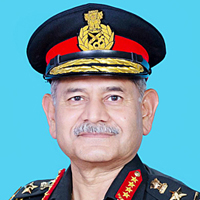
The insightful articles, inspiring narrations and analytical perspectives presented by the Editorial Team, establish an alluring connect with the reader. My compliments and best wishes to SP Guide Publications.
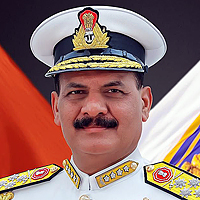
"Over the past 60 years, the growth of SP Guide Publications has mirrored the rising stature of Indian Navy. Its well-researched and informative magazines on Defence and Aerospace sector have served to shape an educated opinion of our military personnel, policy makers and the public alike. I wish SP's Publication team continued success, fair winds and following seas in all future endeavour!"

Since, its inception in 1964, SP Guide Publications has consistently demonstrated commitment to high-quality journalism in the aerospace and defence sectors, earning a well-deserved reputation as Asia's largest media house in this domain. I wish SP Guide Publications continued success in its pursuit of excellence.
UNDERWATER SYSTEMS / RUBIN DESIGN BUREAU
For 125 years, Rubin Design Bureau of the United Shipbuilding Corporation has been shaping the world’s submarines, blending innovation, expertise, and enduring global partnerships
India and Russia have long-standing relations, which are distinguished by mutual trust and cooperation for the benefit of both. This strategic partnership has withstood the tests of time and is backed by the people of both countries. From the date when India gained Independence and till this day our countries are closely tied politically and economically in all spheres of international cooperation.
Military-technical aspect is one of the strongest time-proven pillars of Indo-Russian relations. Rubin Design Bureau and Indian Navy are tied by long-term partnership in designing, support of construction and delivery of several series of ships to the Indian Navy as well as assistance in their life extension. The 1st of September 2025 marked 60 years since the day when the agreement was signed for construction of four large diesel-electric submarines of Kalvari class for India. The submarines were designed by Rubin Design Bureau and were built by the Admiralty Shipyard in Leningrad (today Saint Petersburg). Both the entities are under the United Shipbuilding Corporation. The lead submarine S 23 Kalvari came to Visakhapatnam in July 1968. In December 1968, S 22 Khanderi reached India and S 21 Karanj and S 20 Kursura arrived in October and December 1970, respectively. Thus, foundation was laid for a long-lasting cooperation between Rubin Design Bureau and Indian industry.
Year 2025 is remarkable for Rubin Design Bureau for one more date - 125th birth anniversary of the Design Bureau. During this time, more than 1000 submarines were built to designs developed by Rubin including over 100 ones for export. Rubin is a designer of nuclear and non-nuclear submarines. Working in two directions simultaneously we are capable of employing scientific and technical solutions being practised for both nuclear and non-nuclear submarines. Rubin being a leading design bureau of the United Shipbuilding Corporation keeps working on improvements of different types of submarines and new advanced projects.
Rubin Design Bureau and its subcontractors have vast competences and ensure a full cycle from construction of submarines to their refit and modernisation. Rubin develops design documents, supports construction and trials, refit and modernisation, provides for designer’s supervision throughout the life cycle of submarine. Our employees work at shipyards in Russia and customers’ countries as well as participate actively in training of submarine designers and crews. In addition to submarine designing, Rubin has experience in the development of training systems. In cooperation with United Shipbuilding Corporation’s enterprises, it is possible to develop a project of training centre in customer’s country, support its construction and outfit it with training simulators.
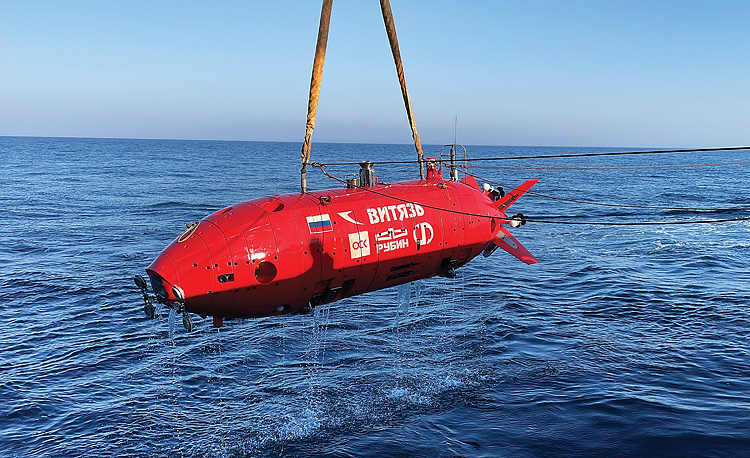
Over 600 companies are involved in the creation of submarines – developers and vendors of equipment, automatic systems and electronic warfare systems. Rubin Design Bureau coordinates and directs activities of all cooperating partners. Today, Rubin provides support for batch construction of nuclear and non-nuclear submarines of the fourth generation, undertaking work on the fifth generation and fulfilling contractual obligations towards foreign customers. About 15 years ago, Rubin proceeded to a new activity area – marine robotics. On May 9, 2020, Unmanned Underwater Vehicle Vityaz, designed and constructed by Rubin through the request of the Russian Foundation for Advanced Research Projects (RFARP), accomplished the world’s first fully autonomous mission in the Mariana Trench. Now, the order portfolio of the leading Design Bureau contains small as well as large and extra-large research vessels with increased diving depth intended for oceanographic work, geological and prospecting survey in the World Ocean. We conduct a number of initiative developments for extension of vessel functions and increase in endurance aiming to their employment in the interests of both offshore mining companies and research and development establishments.
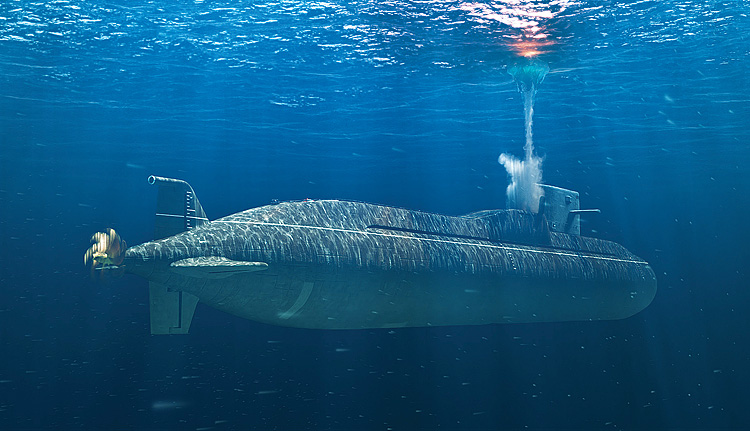
Submarine projects offered by Rubin Design Bureau feature high variability. Hallmark of Russian submarines is their striking capability and stealth. Submarine Amur 1650 with Vertical Launching System (VLS) and Air Independent Propulsion (AIP) has the largest ammunition among conventional submarines in the world – up to 28 weapon units. Amur 1650 with VLS can be fitted up with Club-S cruise missiles or Russian-Indian ultrasonic missiles BrahMos. The extensive missile arsenal can strike both land and surface targets. Thus, the non-nuclear submarine is capable of handling a wide range of tasks in a theatre of war operations. A wide variety of acoustic protection means, streamlined hull design and equipment with reduced noise contribute to the submarine’s low signature.
Through our multi-year partnership in the field of defence cooperation, we have gained wide experience in creation of advanced systems, and we are ready to employ it in the projects of any level of complexity.