






The insightful articles, inspiring narrations and analytical perspectives presented by the Editorial Team, establish an alluring connect with the reader. My compliments and best wishes to SP Guide Publications.

"Over the past 60 years, the growth of SP Guide Publications has mirrored the rising stature of Indian Navy. Its well-researched and informative magazines on Defence and Aerospace sector have served to shape an educated opinion of our military personnel, policy makers and the public alike. I wish SP's Publication team continued success, fair winds and following seas in all future endeavour!"

Since, its inception in 1964, SP Guide Publications has consistently demonstrated commitment to high-quality journalism in the aerospace and defence sectors, earning a well-deserved reputation as Asia's largest media house in this domain. I wish SP Guide Publications continued success in its pursuit of excellence.
SUBMARINES
While India’s naval nuclear deterrence is progressing, the delay over Akula’s delivery is a matter of concern under the leased systems. For a regional power aiming to secure its maritime interests in the Indian Ocean Region, amidst growing Chinese naval assertiveness, that capability is not nice-to-have — it is essential.
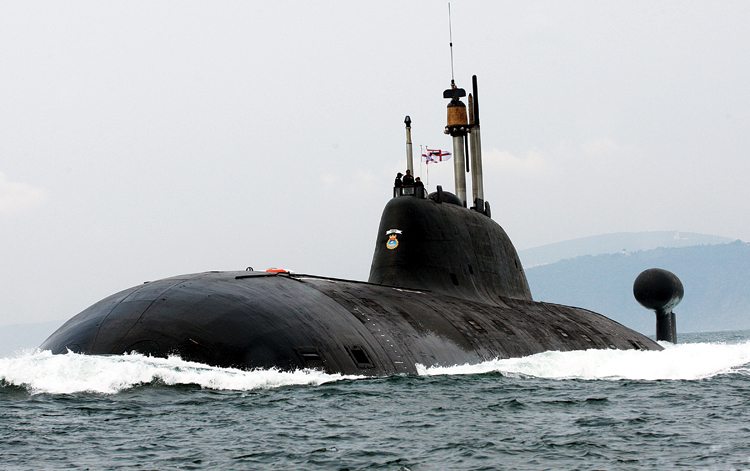
The 2019 agreement between India and Russia — a $3 billion lease for a capable Akula-class SSN for ten years — signalled a conscious drive by India to upgrade its undersea warfare capability. The vessel, to join as INS Chakra-III, was originally scheduled for delivery by 2025.
But now that delivery has slipped to 2028. The delay owes to a complex mix of technical difficulties, supply-chain constraints worsened by the Russia–Ukraine war, and broader geopolitical uncertainty.
That postponement matters — and not just in calendar years. It prolongs a critical capability gap for the Indian Navy: since the earlier leased SSN (the previous INS Chakra II) returned to Russia in 2021, India has effectively been without a nuclear-powered attack submarine.
This hiatus comes at a time when undersea capabilities are rapidly becoming central to power projection, maritime domain awareness, and strategic deterrence in the Indo-Pacific.
Despite the delay, INS Chakra-III remains a strategically solid acquisition — arguably more relevant than ever in the current maritime environment. The modernised Akula design promises significant capabilities: stealth, deep-diving endurance, high sustained speeds, and armament flexibility (torpedoes, heavyweight weapons, and, reportedly, long-range cruise missiles such as the 3M14K “Kalibr” with up to 1,500-2,000 km reach).
In practical terms, this gives India an underwater platform that can — if needed — operate far from coastal waters, conduct long-range strike missions, undertake intelligence and surveillance, and provide a credible deterrent floating under the oceans.
For a regional power aiming to secure its maritime interests in the Indian Ocean Region (IOR) amidst growing Chinese naval assertiveness, that capability is not nice-to-have — it is essential.
Furthermore, Chakra-III serves as an important interim bridge. While India builds its own next-generation SSNs under Project 77 (scheduled to deliver the first indigenous SSN by 2036–37), a leased Akula helps maintain operational familiarity, sustain crew readiness, and ensure continuity of nuclear-submarine-level deterrence.
Yet, the Chakra-III path is not without complications or risks. The delays illustrate exactly why relying on foreign-built, refurbished and leased platforms can be unpredictable. As pointed out by analysts close to the negotiations, the long timeline — carved out to refurbish, modernise, and integrate Indian systems (like sonar, communication, tactical control) — includes many moving parts.
Moreover, while a leased SSN fills a short-term gap, it does not substitute for long-term strategic autonomy. The 10-year lease might give the Navy some time, but it also imposes inevitable limitations — in maintenance flexibility, lifecycle management, upgrades, and future-proofing. Once the lease ends, unless renewed or replaced, the capability vanishes. This underlines the importance of India’s push for its own SSNs under Project 77 — a plan that must succeed if India’s undersea ambitions are to be sustainable.
Finally, in the current geopolitical backdrop — supply-chain disruptions, sanctions, and global contestation — such deals may be subject to delays, renegotiation, or external interference, making them vulnerable. Strategic planners must factor that risk.
According to a recent fact-sheet, PLAN currently has six SSBNs (ballistic-missile submarines) and six SSNs (attack submarines), along with a much larger force of conventional diesel/electric + AIP submarines.
Older data show that over the years, China steadily expanded its nuclear submarine fleet. For instance, by 2020 they had about six SSBNs and 7 SSNs; some projections suggest this could grow to ~8 SSBNs and ~13 SSNs by 2030.
Each Type 094 carries submarine-launched ballistic missiles (SLBMs). Early versions used the JL-2 SLBM, which had intercontinental range; more recent boats are believed to be capable of using improved missiles such as JL-3 SLBM, extending reach and adding to sea-based nuclear deterrence.
China is already working on a next-generation SSBN: the Type 096 (Tangclass). This new class is expected to feature improved stealth, sensors and weapons, potentially marking a qualitative jump in China’s sea-based nuclear capability.
The backbone of China’s SSN fleet is the Type 093 (Shang-class). According to recent data, PLAN operates a total of about 6 SSNs from this class (including variants Type 093, 093A, and possibly newer 093B).
The newer Shang-class submarines offer better stealth (quieter), more advanced sensors, and more capable weapons (torpedoes, anti-ship missiles) — making them a credible platform for sea-control, anti-ship or anti-submarine operations, and possibly land-attack with conventional cruise missiles.
The presence of a credible SSBN fleet (Type 094, and future Type 096) gives China a sea-based nuclear deterrent — vital for second-strike capability, survivability of its nuclear deterrent, and strategic depth. This makes China’s nuclear posture more survivable and less vulnerable to pre-emptive strikes on land-based assets.
An expanding SSN fleet enhances China’s ability to project power undersea — conducting submarine patrols, imposing sea-denial, threatening surface ships and other submarines, gathering intelligence, and potentially projecting deterrence beyond coastal waters.
For regional powers (India, Pacific-rim states, US & allies), China’s growing nuclear-submarine capability adds complexity: underwater tracking, anti-submarine warfare (ASW), maritime surveillance will become more challenging — raising the bar for detection and counter-submarine operations.
Given China’s shipbuilding capacity (some shipyards reportedly capable of producing multiple nuclear submarines per year), the long-term trajectory points toward a larger, more advanced and stealthier nuclear-submarine fleet.