


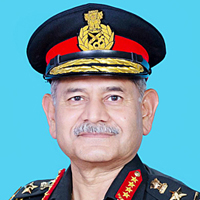
The insightful articles, inspiring narrations and analytical perspectives presented by the Editorial Team, establish an alluring connect with the reader. My compliments and best wishes to SP Guide Publications.
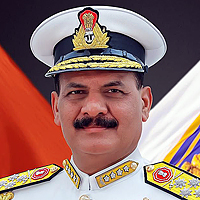
"Over the past 60 years, the growth of SP Guide Publications has mirrored the rising stature of Indian Navy. Its well-researched and informative magazines on Defence and Aerospace sector have served to shape an educated opinion of our military personnel, policy makers and the public alike. I wish SP's Publication team continued success, fair winds and following seas in all future endeavour!"

Since, its inception in 1964, SP Guide Publications has consistently demonstrated commitment to high-quality journalism in the aerospace and defence sectors, earning a well-deserved reputation as Asia's largest media house in this domain. I wish SP Guide Publications continued success in its pursuit of excellence.
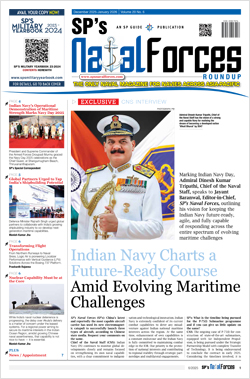
CNS INTERVIEW
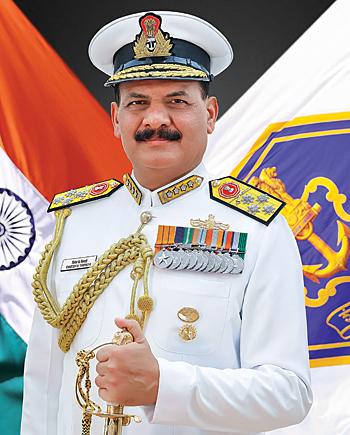
Marking Indian Navy Day, Admiral Dinesh Kumar Tripathi, Chief of the Naval Staff, speaks to Jayant Baranwal, Editor-in-Chief, SP’s Naval Forces, outlining his vision for keeping the Indian Navy future-ready, agile, and fully capable of responding across the entire spectrum of evolving maritime challenges
SP’s Naval Forces (SP’s): China’s latest and reportedly the most capable aircraft carrier has used its new electromagnetic catapult to successfully launch three types of aircraft, according to Chinese state media. Request your comments on the same.
Chief of the Naval Staff (CNS): Indian Navy (IN) continues to monitor global developments closely and remains focused on strengthening its own naval capabilities, with a clear commitment to indigenisation and technological innovation. Indian Navy is extremely confident of its current combat capabilities to deter any misadventure against Indian national maritime interests across the region. At the same time, enhancement of own capabilities is a constant endeavour and the Indian Navy is fully committed to maintaining combat edge in the IOR. Our priority is the protection of national interests and contributing to regional stability through strategic partnerships and multilateral engagements.
SP’s: What is the timeline being pursued for the P-75(I) Submarine programme and if you can give us little update on the same?
CNS: The ongoing case of P-75(I) for construction of state-of-the-art submarines, equipped with Air Independent Propulsion, is being pursued under the Strategic Partnership Model with complete Transfer of Technology. It is being endeavoured to conclude the contract in early 2026. Considering the timelines involved, it is expected that the first submarine under P-75(I) will be inducted in 2033 and one submarine will be inducted every year thereafter. The Project is envisaged to be completed by 2038.
SP’s: The recent conflict in Ukraine has provided new insights into maritime warfare, including the use of unmanned systems and long-range precision weapons. What lessons has the Indian Navy drawn from the Russia–Ukraine conflict, particularly in the context of naval combat and maritime logistics?
CNS: The most important lesson that the ongoing Russia-Ukraine conflict has brought out, is that it has debunked the myth of short and swift wars. It has clearly established the need for and importance of a robust and resilient civil-military industrial complex to sustain long duration conflicts. The persistent use of drones and missiles indicates that sustainability hinges on cost-effective, scalable production, and innovation to counter resource-intensive attrition strategy.
Another important lesson has been that of the advent of long-range precision vectors, delivered at stand-off ranges from own territory. This highlights that strategic depth no longer provides sanctuary and one must have effective Air Defence/Anti-Missile Defence (AD/AMD) capabilities to counter these persistent threats.
The innovative employment of uncrewed systems and constant iteration of their design, lethality and tactics around its employment is another important lesson to be drawn. The prolonged conflict has also witnessed the integrated use of wire guided First Person View (FPV) drones and Loitering Munitions (LMs) and their effective degradation of Counter-UAS systems. Similarly, a swarm of Uncrewed Surface Vessels (USVs) can aim to overwhelm a warship’s defences and ship-borne counter-drone systems need focussed attention.
“Our priority is the protection of national interests and contributing to regional stability through strategic partnerships and multilateral engagements”
Based on these lessons, the Indian Navy is continually refining its operational outlook and enhancing combat efficiency. Focussed efforts are underway to induct niche technologies, low-cost, high-impact, uncrewed solutions, and refining our CONOPS. Simultaneously, emphasis is also being laid on crew training, development of support infrastructure, and logistical frameworks to sustain prolonged high tempo operations. These measures collectively ensure that the Indian Navy remains future-ready, agile, and capable of responding across the entire spectrum of maritime challenges.
SP’s: Unmanned platforms—both underwater and surface—are transforming the way modern navies operate. What roles do you foresee for these systems in the Indian Navy’s doctrine, and how are you planning to integrate them operationally?
CNS: Uncrewed/autonomous systems have tremendous potential to strengthen Indian Navy’s operations across the surface, subsurface and air domains. These systems, backed by a robust network – reliable and resilient in nature – are envisioned to complement crewed platforms through Manned-Unmanned Teaming (MUM-T).
“It is expected that the first submarine under P-75(I) will be inducted in 2033 and one submarine will be inducted every year thereafter. The Project is envisaged to be completed by 2038.”
As regards to their role, the Indian Navy has been employing uncrewed aerial systems for maritime surveillance missions for about two decades now, towards building Maritime Domain Awareness in our areas of interest. Looking forward, the uncrewed assets would serve to enhance current IN operational capabilities by enabling access to contested areas for unfettered operation by crewed platforms, increase persistence whilst on task, as also increase targeting accuracy through embedded Artificial Intelligence tools, Machine Learning algorithms and Data analytics.
SP’s: With the Navy being increasingly deployed for both deterrence and humanitarian operations—from anti-piracy patrols to evacuations—how do you balance, these diverse operational demands without overstretching assets or personnel?
CNS: The Indian Navy balances its deterrent responsibilities and humanitarian commitments through a combination of operational flexibility, force optimisation, personnel welfare, and continued training. Our platforms are designed for multi-mission deployments, allowing seamless transition from combat duties to missions, such as anti-piracy, Search and Rescue (SAR), Humanitarian Assistance and Disaster Relief (HADR), Anti-Narcotics Operations (ANO), Non-Combatant Evacuations (NEO), etc.
Equally important, assets that have been deployed for extended durations are systematically rotated to allow for planned maintenance/ refit, operational assessments, and safety audits. The crew are deputed for refresher training courses, as and when they fall due. The Navy also places strong emphasis on force optimisation, deploying just the right mix of assets, to maximise resources in accomplishment of a mission. Close coordination with national stakeholders and navies of Friendly Foreign Countries (FFCs) further enhances efficiency and avoids duplication of efforts. This balanced and adaptive framework enables the Indian Navy to maintain a high operational tempo, safeguard national interests, and continue enhancing maritime security, including HADR (Humanitarian Assistance and Disaster Relief) missions across the region.
SP’s: Exercises and multilateral engagements have become a hallmark of India’s naval diplomacy. How do you view their role in deterrence, capacity building, and interoperability — and what new engagements or infrastructures (e.g., information-sharing nodes, joint logistics) do you see as priorities?
CNS: Multilateral exercises and engagements have evolved over time, from being a tool of naval diplomacy, to strategic apparatus for enhancing influence and interaction through operational engagements and interoperability with our partners. The Indian Navy’s engagements with like-mind partner navies demonstrate India’s commitment to shared growth and security across regions, in line with our Prime Minister’s vision of MAHASAGAR – Mutual and Holistic Advancement for Security and Growth Across Regions. At the same time, these interactions are also a reflection of the Indian Navy’s growing capabilities and reach, serving as a deterrent against, both, traditional and nontraditional sources of threats.
“Indian Navy is continually refining its operational outlook and enhancing combat efficiency. Focussed efforts are underway to induct niche technologies, low-cost, high-impact, uncrewed solutions, and refining our CONOPS.”
These Joint operations and exercises also provide a unique opportunity for participating navies to witness new technologies, imbibe best practices from each other, and achieve desired level of interoperability, which is critical during conduct of real time missions such as Humanitarian Assistance and Disaster Relief. These interactions at sea encompass operations, including Hydrography cooperation, Joint EEZ and Coordinated Patrols, and bilateral and multilateral exercises.
In this endeavour, the Indian Ocean Ship (IOS) Sagar, is a unique initiative towards enhancing Navy-to-Navy cooperation with IOR nations. As part of the initiative, INS Sunayna was deployed to the South-West IOR with an embedded, multinational crew comprising personnel from IN and nine Friendly Foreign Countries (FFCs) (Comoros, Kenya, Madagascar, Maldives, Mauritius, Mozambique, Seychelles, Sri Lanka, and South Africa). The ship was deployed for over a month, undertaking port calls at Dar-es-Salaam, Nacala, Port Louis, Port Victoria and Male. Additionally, the ship also undertook joint surveillance of EEZs of Tanzania, Mozambique, Mauritius and Seychelles.
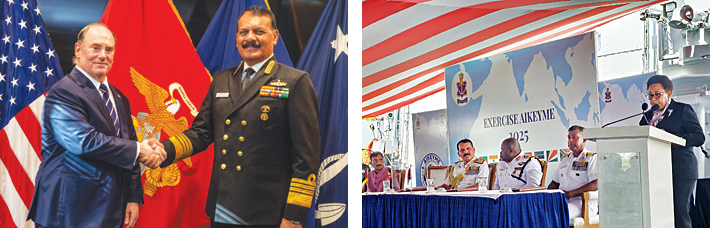
Further, a large-scale multilateral maritime exercise with East African countries, titled ‘Africa India Key Maritime Engagement’ aka ‘AIKEYME’, which means ‘Unity’ in Sanskrit, was conducted this year, as an initiative to enhance interoperability with the navies/ maritime agencies of Africa towards tackling non-traditional maritime security threats. The maiden edition of the exercise was co-hosted by the Indian Navy and the Tanzania Peoples Defence Force (TPDF) and was conducted at Dares-Salaam, Tanzania. The exercise spanned over six days and also included participation from Comoros, Djibouti, Kenya, Madagascar, Mauritius, Mozambique, Seychelles and South Africa.
“Uncrewed/autonomous systems have tremendous potential to strengthen Indian Navy’s operations across the surface, sub-surface and air domains”
Going forward, we will assume the Chair of the Indian Ocean Naval Symposium (IONS) and take over command of Combined Task Force (CTF) 154, next year. Further, along with the forthcoming IFR-26 at Visakhapatnam in February 2026, we look forward to hosting over 55 navies for Exercise MILAN-26, with the core purpose of professional interaction and meaningful exchange of good practices.
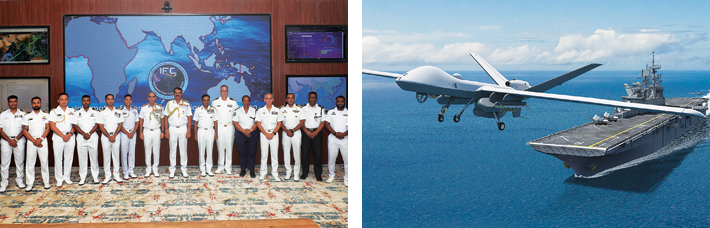
Further, the Information Fusion Centre – Indian Ocean Region (IFC-IOR), hosted by the Indian Navy, was established on December 22, 2018 to enhance Maritime Domain Awareness, safety, and security in the IOR. Since its inception, the Centre has established working-level linkages with more than 28 partner countries and 54 multinational constructs, thereby enhancing shared situational awareness of all stakeholders. Leveraging its linkages, the Centre has been instrumental in coordinating operational responses to contingencies across the IOR, and cases are being progressed towards increasing the strength of International Liaison Officers (ILOs) to 26, by early 2026.
Our multinational maritime security collaboration through the IFC-IOR, participation in Combined Maritime Forces (CMF), leadership roles in IONS, and growing relevance of MILAN, reinforce India’s standing as a trusted and credible maritime partner. Our aim is to contribute positively towards further strengthening collective maritime security, and set an example for maritime cooperation in the region.