




The insightful articles, inspiring narrations and analytical perspectives presented by the Editorial Team, establish an alluring connect with the reader. My compliments and best wishes to SP Guide Publications.
"Over the past 60 years, the growth of SP Guide Publications has mirrored the rising stature of Indian Navy. Its well-researched and informative magazines on Defence and Aerospace sector have served to shape an educated opinion of our military personnel, policy makers and the public alike. I wish SP's Publication team continued success, fair winds and following seas in all future endeavour!"

Since, its inception in 1964, SP Guide Publications has consistently demonstrated commitment to high-quality journalism in the aerospace and defence sectors, earning a well-deserved reputation as Asia's largest media house in this domain. I wish SP Guide Publications continued success in its pursuit of excellence.
AIRCRAFT CARRIER
A carrier should be seen as an important component of a wider maritime strategy, not as a substitute for other naval assets. The government must now decide if India needs a genuine three-carrier force or merely two carriers with one replacing an ageing platform.
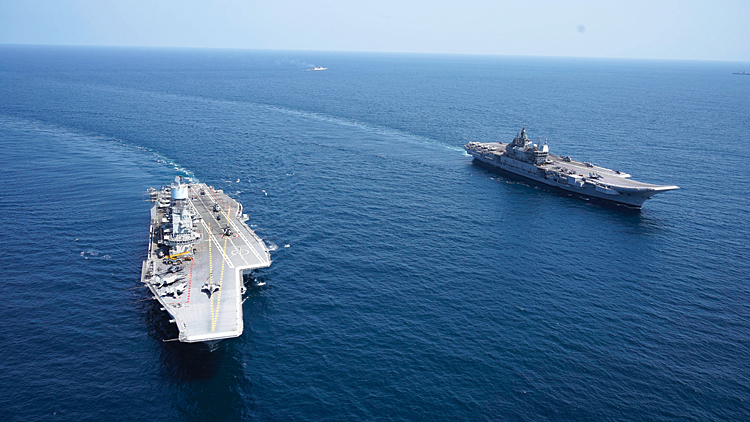
As China expands its carrier fleet and strengthens its presence across the Indo-Pacific, India must resolve its long-standing aircraft carrier debate. The challenge is not simply to build another warship, but to establish a sustainable carrier strategy that balances operational needs and technological ambition. This is equally about competing defence priorities as well.
India’s aircraft carrier debate has reached a point where prolonged indecision could become a strategic liability. The Indian Navy (IN) has two aircraft carriers, INS Vikramaditya and INS Vikrant, but that does not mean it can maintain two carriers at sea or guarantee a continuous naval aviation presence on both the eastern and western seaboards.
The distinction is important. Aircraft carriers are among the most complex and demanding military platforms to operate. They require regular maintenance, periodic refits, aviation upgrades, crew training and among others. When one carrier enters a prolonged maintenance cycle, the operational burden falls on the other. So, a force of two carriers therefore offers limited flexibility, particularly when India has to monitor two major maritime theatres.
INS Vikramaditya, the refurbished former Soviet-era Kiev-class carrier, has been in Indian service since 2013. INS Vikrant, commissioned in September 2022, represents a much bigger achievement: India’s ability to design and construct an aircraft carrier domestically under Project 71.
Together, these ships have given the Navy an important carrier-borne aviation capability. But two carriers cannot guarantee uninterrupted coverage of the Arabian Sea and the Bay of Bengal while retaining sufficient capacity for maintenance and contingencies.
It would also provide greater flexibility during a crisis in the western Indian Ocean and the eastern maritime theatre.
The western seaboard connects the country to the Persian Gulf, the Gulf of Aden and the wider Arabian Sea, while the eastern seaboard leads to the Bay of Bengal and the strategically important approaches to the Malacca Strait. Both theatres are increasingly important for India’s energy security, commercial shipping, and broader regional interests.
The Indian Ocean is no longer a relatively uncontested maritime space. China’s expanding naval presence, growing submarine operations and overseas bases have increased its ability to operate far beyond the neighbourhood.
China’s carrier programme has entered a new phase. The commissioning of its third aircraft carrier, Fujian, on November 5, 2025, marked an important milestone in the modernisation of the People’s Liberation Army Navy.
Unlike the Liaoning and Shandong, Fujian has a flat flight deck and electromagnetic catapult launch technology, known as EMALS. It is designed to operate more sophisticated aircraft, including the J-35 stealth fighter and KJ-600 airborne earlywarning aircraft.
Fujian’s commissioning should not, however, be confused with full operational maturity. Integrating its aircraft, developing flight operations to be an effective carrier strike group will take time.
However, the significance lies in the direction of China’s naval development. Beijing is investing heavily to project military power and its carrier programme is an important part of that ambition.
Aircraft carriers are so important for the Navy to conduct air defence, maritime strike, surveillance and other missions without depending entirely on access to foreign bases or the availability of land-based airfields.
For India, this flexibility is particularly valuable in the northern Indian Ocean, where strategic developments can unfold rapidly.
The debate over a third carrier is also complicated by the question of design. Should India order another aircraft carrier based on the 45,000-tonne INS Vikrant, with upgradation, or should it pursue a larger, approximately 65,000-tonne vessel equipped with advanced launch technology? The two options reflect different approaches to India’s long-term naval ambitions.
A repeat of the Vikrant-class design offers a relatively practical route. Cochin Shipyard has already acquired valuable experience in designing and constructing a carrier of this size. A follow-on vessel would allow IN to use existing infrastructure, retain skilled manpower and continue building a domestic industrial base. Design modifications could incorporate learnings from Vikrant’s construction and operational experience, while improving indigenous content and aviation facilities.
It could also reduce the technical risks and uncertainties associated with developing an entirely new class of carrier. For a country still building its indigenous aircraft-carrier ecosystem, continuity has considerable value.
The larger INS Vishal concept, on the other hand, of around 65,000 tonnes, potentially equipped with EMALS and a catapult-assisted take-off but arrested recovery (CATOBAR) configuration, would offer greater flexibility in operating heavier aircraft.
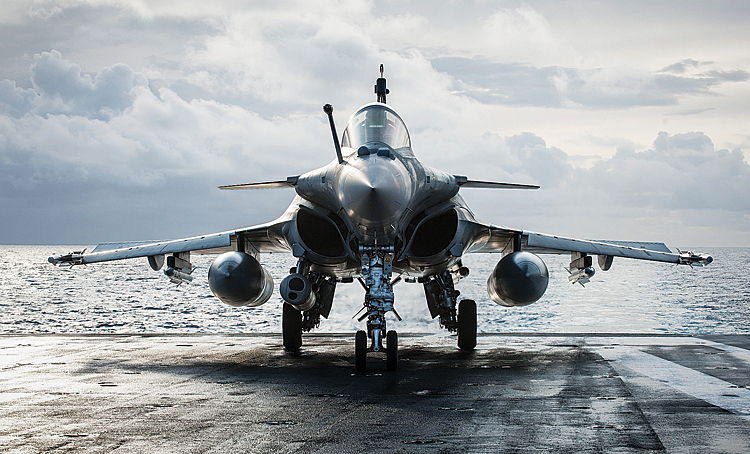
The advantages are significant. Electromagnetic catapults can launch aircraft carrying greater fuel and weapons loads than those generally possible with a ski-jump arrangement.
More importantly, they can support fixed-wing airborne early-warning aircraft, giving a carrier strike group a much wider surveillance capability. Such a platform could eventually operate more advanced naval fighters, unmanned combat aircraft and other aviation systems.
However, technological ambition must be matched by industrial readiness and financial capacity. EMALS, arresting systems, advanced electrical infrastructure and an aviation ecosystem would require substantial investment. There is little value in building a technologically sophisticated carrier if its aviation componentis missing.
There is also an important distinction in the history of the programme. The larger 65,000-tonne INS Vishal concept and the Navy’s more recent proposal for a repeat of the Vikrant design are not the same project. The proposal examined by the Defence Procurement Board in 2023 was for a follow-on carrier based on INS Vikrant, with a cost of around ₹40,000 crore.
The larger CATOBAR carrier remains a separate, more ambitious design proposition. India must avoid allowing this design debate to become another reason for postponement. The immediate priority should be to settle the operational requirement and choose a design that can be delivered within a realistic timeframe. A repeat design with improvements may be a more sensible starting point than pursuing an advanced platform whose development could take considerably longer.
An aircraft carrier is not an isolated acquisition. A fully operational carrier strike group requires destroyers, frigates, submarines, fleet support ships, helicopters and a good number of carrier-borne aircraft. Thus, the strongest argument against a third carrier is its cost. The expenditure continues throughout the vessel’s operational life, covering maintenance, upgrades, training, logistics and the replacement of ageing equipment.
At a time when the Indian Army needs modern artillery, air defence systems, drones, and the Indian Air Force faces the grave challenge of replenishing its fighter squadrons, allocating tens of thousands of crores to another carrier will also invite questions.
But the argument that a carrier will divert resources from the Army and Air Force also needs to be examined in the context of long-term defence planning. Carrier construction is a long-gestation programme, with expenditure over several years rather than incurred in a single financial year.
The Parliamentary Standing Committee on Defence made this point in its 36th Report, presented in March 2023. It observed that carrier maintenance could take between six months and two years, depending on the nature of the refit. It also noted that the process from planning to full operationalisation could take 10–15 years. The committee recommended that the government take a final decision, propose a clear roadmap and begin planning for a third carrier.
There is also an industrial dimension. Building another indigenous carrier would sustain expertise developed at Cochin Shipyard and support a wider network of Indian engineering, electronics, steel, propulsion and defence companies. The experience gained from INS Vikrant should not be allowed to dissipate.
Crucially, carrier construction is not simply about producing one warship; it is about retaining the ability to design, integrate, and build complex naval platforms.
The government’s task is to establish a funding model that accommodates this long-term investment without compromising the modernisation needs of the other two services.
Perhaps the most troubling aspect of India’s carrier debate is the prolonged decision-making process. The proposal for a second indigenous aircraft carrier has been discussed for years, yet a firm construction decision has remained elusive.
The DPB examined the repeat-carrier proposal in September 2023. However, subsequent public reporting has continued to point to uncertainty over its approval and the government’s preferred fleet structure.
By the time a new carrier enters service, INS Vikramaditya may be approaching the end of its operational life. This is precisely why India needs a long-term carrier acquisition policy rather than isolated procurement decisions.
The construction of INS Vikrant demonstrated that India could overcome the technological, engineering and industrial challenges of building an aircraft carrier. But the next carrier will also require years of design finalisation, infrastructure preparation, construction, sea trials and aviation assets.
The Parliamentary Standing Committee’s estimate of 10–15 years from planning to full operationalisation should serve as a warning. Every year of indecision pushes the potential induction date further into the future.
The government must therefore move beyond repeated assessments and establish a clear timeline. The Navy’s requirement, the MoD’s assessment and the government’s financial priorities must conclude a decision.
There is another argument that deserves attention. The nature of naval warfare is changing rapidly. Long-range anti-ship missiles, advanced submarines, unmanned systems, satellite-based ISR and precisionguided weapons have made large surface combatants vulnerable in waters.
China’s growing anti-access and areadenial capabilities underline the risks of operating expensive naval platforms within the reach of hostile missile systems.
Aircraft carriers are not invulnerable, and their effectiveness depends on the strength of the entire carrier strike group.
The Andaman and Nicobar Islands also offer considerable strategic advantages. Their location near the western approaches to the Malacca Strait makes them important for monitoring maritime traffic and operational reach in the eastern Indian Ocean.
A carrier should be seen as an important component of a wider maritime strategy, not as a substitute for other naval assets.
The government must now resolve three questions. First, does India want a genuine three-carrier force or merely two carriers with one replacing an ageing platform? Second, should the next carrier be an improved Vikrant-class vessel or a larger platform equipped with EMALS? Third, how can the programme be financed without undermining the Army’s and Air Force’s urgent modernisation requirements?
These questions require an assessment by the Navy, the MoD, the Finance Ministry and thepolitical leadership. They should not remain trapped in an endless cycle of interdepartmental consultations.
India has already demonstrated that it can build an aircraft carrier. The challenge now is to demonstrate that it can plan and sustain a carrier programme over several decades.
Manish Kumar Jha is a Consulting & Contributing Editor for SP’s Aviation, SP’s Land Forces and SP’s Naval Forces and a security expert. He writes on national security, military technology, strategic affairs & policies.