



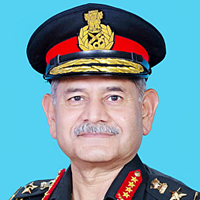
The insightful articles, inspiring narrations and analytical perspectives presented by the Editorial Team, establish an alluring connect with the reader. My compliments and best wishes to SP Guide Publications.
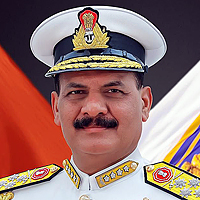
"Over the past 60 years, the growth of SP Guide Publications has mirrored the rising stature of Indian Navy. Its well-researched and informative magazines on Defence and Aerospace sector have served to shape an educated opinion of our military personnel, policy makers and the public alike. I wish SP's Publication team continued success, fair winds and following seas in all future endeavour!"

Since, its inception in 1964, SP Guide Publications has consistently demonstrated commitment to high-quality journalism in the aerospace and defence sectors, earning a well-deserved reputation as Asia's largest media house in this domain. I wish SP Guide Publications continued success in its pursuit of excellence.

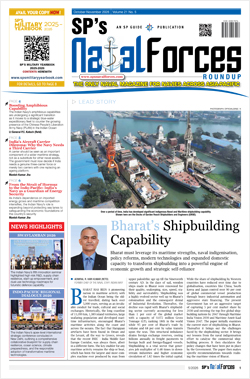
In the lead story, Admiral R. Hari Kumar (Retd) examines the gap between India’s historic maritime and shipbuilding strengths and its current position in the global commercial shipbuilding industry. Despite its extensive coastline, substantial maritime trade and established naval shipbuilding capabilities, India accounts for less than one per cent of global shipbuilding. The article identifies the structural challenges facing domestic shipyards, including high capital costs, import dependence, limited automation, productivity gaps and inadequate supply-chain capacity. Drawing lessons from the Indian Navy’s successful indigenisation journey, it explores how naval manufacturing expertise could support commercial shipbuilding. It also examines government initiatives, financial support, maritime clusters, workforce development and advanced manufacturing technologies, arguing that their effective implementation could help establish a globally competitive shipbuilding ecosystem and strengthen economic selfreliance.
In Boosting Amphibious Capability, Lt General P.C. Katoch (Retd) examines the Indian Navy’s efforts to strengthen its amphibious warfare, sealift and expeditionary capabilities in response to evolving maritime requirements. Reviewing existing landing platforms and craft, the article outlines planned acquisitions, including next-generation LPDs and larger Landing Craft Utility vessels. These platforms are expected to enhance the Navy’s ability to transport troops, armour and equipment over long distances, reinforce island territories and operate in challenging sea conditions. Their wider roles in logistics, coastal security, search and rescue, and HADR are also highlighted.
Does the Indian Navy Need a Third Aircraft Carrier? Manish Kumar Jha assesses the operational and strategic case for a third carrier amid China’s expanding carrier programme. The article explains why two carriers cannot ensure sustained aviation coverage across India’s eastern and western maritime theatres, particularly when one is undergoing maintenance. It examines the choice between a follow-on INS Vikrant-class carrier and a larger, more technologically ambitious CATOBAR design, weighing the financial, industrial and operational implications. It also considers the need to balance carrier investment, calling for a clear, long-term acquisition roadmap.
Manish Kumar Jha also explores the relationship between maritime security and India’s energy and economic security. Focusing on vulnerable shipping routes, particularly the Strait of Hormuz, the article examines the consequences of disruptions to oil and gas supplies. Drawing on developments in 2026, including Operation Urja Suraksha, it discusses the Navy’s role in protecting merchant shipping and Indian seafarers. It also considers wider Indo-Pacific threats, maritime surveillance, international coordination and sustained naval deployments, arguing that safeguarding India’s maritime interests requires a whole-of-government approach.
Wishing all discerning readers happy reading!