




The insightful articles, inspiring narrations and analytical perspectives presented by the Editorial Team, establish an alluring connect with the reader. My compliments and best wishes to SP Guide Publications.
"Over the past 60 years, the growth of SP Guide Publications has mirrored the rising stature of Indian Navy. Its well-researched and informative magazines on Defence and Aerospace sector have served to shape an educated opinion of our military personnel, policy makers and the public alike. I wish SP's Publication team continued success, fair winds and following seas in all future endeavour!"

Since, its inception in 1964, SP Guide Publications has consistently demonstrated commitment to high-quality journalism in the aerospace and defence sectors, earning a well-deserved reputation as Asia's largest media house in this domain. I wish SP Guide Publications continued success in its pursuit of excellence.
LEAD STORY
Bharat must leverage its maritime strengths, naval indigenisation, policy reforms, modern technologies and expanded domestic capacity to transform shipbuilding into a powerful engine of economic growth and strategic self-reliance
 | Admiral R. Hari Kumar (Retd) Former Chief of the Naval Staff, Indian Navy |
Bharat has been a pioneering nation in maritime activity with the Indian Ocean being the oldest travelled, dating back over 5,000 years, serving as an invaluable conduit for trade, cultural and social exchanges. Historically, the long coastline of 11,099 km, 1,389 island territories, large seafaring population and developed maritime infrastructure, encouraged Bharat’s maritime activities along the coast and across the oceans. The fact that Harappan artefacts have been found in Oman and the Levant, all the way to Greece, reveals that the recent IMEC - India Middle East Europe Corridor, was always there, albeit in a different form. The key enabler for any maritime activity remains the ship or boat, which has been the largest and most complex machine ever produced by man from upper paleolithic age up till the Nineteenth century AD. In the days of sail, wooden ships made in Bharat were renowned for their quality, seakeeping, size, speed, stability and survivability. Shipbuilding was a highly evolved sector well up to Bharat’s colonisation and the consequent denial of Industrial Revolution. Thereafter, the decline was rapid with Bharat’s shipbuilding sector currently accounting for less than 1 per cent of the global market with a capacity of 0.072 million Gross Tonnage (GT), ranking 18th in the world while 95 per cent of Bharat’s trade by volume and 68 per cent by value transits upon the seas. This structural imbalance drains foreign exchange reserves, costing billions annually in freight payments to foreign built and foreign-flagged vessels. Shipbuilding is a vital sector that generates job multiplier of 6.48 times in downstream industries and higher economic circulation of 1.82 times the initial capital. While the share of shipbuilding by Western countries have reduced over time due to globalisation, countries like China, South Korea and Japan control over 90 per cent of global commercial vessel production through heavy industrial automation and aggressive state financing. The present Government has set an aggressive target of capturing 5 per cent market share by 2030 and entering the top five global shipbuilding nations by 2047 through Maritime India Vision 2030 and Maritime Amrit Kaal Vision 2047. The paper initially examines the current state of shipbuilding in Bharat. Thereafter it brings out the challenges faced by the shipbuilding sector. It brings out lessons from the naval indigenisation effort to catalyse the commercial shipbuilding process. It then elucidates the policy changes that have been put in place by the Government. The paper then makes specific recommendations towards realising the maritime vision of Bharat.
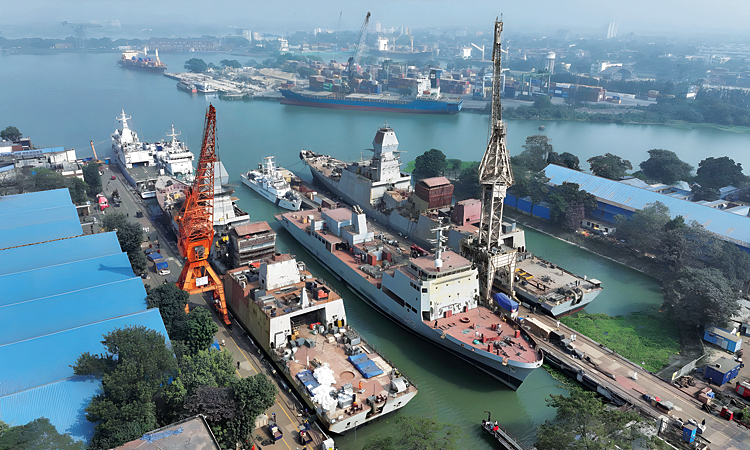
The shipbuilding sector market size in Bharat is about $1.1 billion, a small fraction of the $200 billion global industry and consists of public and private sector shipyards. Public sector shipyards like Mazagon Dock Shipbuilders Limited (MDSL), Cochin Shipyard Limited (CSL), Goa Shipyard Limited (GSL), Garden Reach Shipbuilders and Engineers Limited (GRSE)and Hindustan Shipyard Limited (HSL) hold majority of infrastructure and financial resources. While Cochin Shipyard Limited (CSL) leads in both commercial and complex naval shipbuilding, Mazagon Dock Shipbuilders Limited (MDSL), Garden Reach Shipbuilders & Engineers Limited (GRSE) and Goa Shipyard Limited (GSL) focus primarily on naval orders. Hindustan Shipyard Limited (HSL) had built large cargo ships for a long period of time till market factors made it economically unviable. A number of private shipyards like L&T Shipbuilding, Swan Defence and Heavy Industries Limited, Chowgule and Co, Mandovi Docks, Titagarh Naval Systems Limited, etc, have also developed over time and have gradually been expanding their capability and capacity from constructing coastal vessels, interceptor craft and tugs to medium-sized cargo ships. L&T Shipbuilding, Kattupalli and Swan Defence and Heavy Industries Limited handle sophisticated defence and commercial auxiliary vessels. A number of private yards have struggled with debt or filed for bankruptcy due to long periods without new orders, cash flow issues, poor fiscal discipline and losses due to poor management. Some large greenfield private shipyard projects for building large LNG carriers are also under process.
Bharat spends an estimated $75 billion to $85 billion annually in foreign freight bills since domestic shipping lines own very few vessels. This capital outflow highlights the strategic need for domestic shipbuilding and ownership. Shipyards also lacked a level playing field with ships built in Bharat costing over 20 per cent more than those built in China or South Korea. This price gap stems from systemic disadvantages consisting of high working capital interest rates (10-12 per cent vs 3-4 per cent abroad), import dependencies (propulsion, electronics), inverted tariff structures on raw components and long build times due to low automation. Up to 60 per cent to 70 per cent of a ship’s value lies in its components, including propulsion systems, navigation suites, deck machinery, marine valves, pumps, motors, control systems and specialised steel. Bharat lacks a mature ecosystem for marine ancillaries, forcing yards to import basic equipment. This incurs additional freight costs, customs delays and currency fluctuation risks. Inverted duty structures historically penalised domestic manufacturing by placing higher tariffs on raw materials and components than on finished vessels. While recent tax reforms have eased these issues, bureaucratic hurdles and securing bank guarantees causes delays. There is a huge productivity gap when comparing with foreign yards which use advanced robotics, modular block construction and digital twin technology to build mega-carriers in about 12 months. In contrast, Indian commercial projects often face delays due to low automation, outdated material handling and slower dry dock rotations.
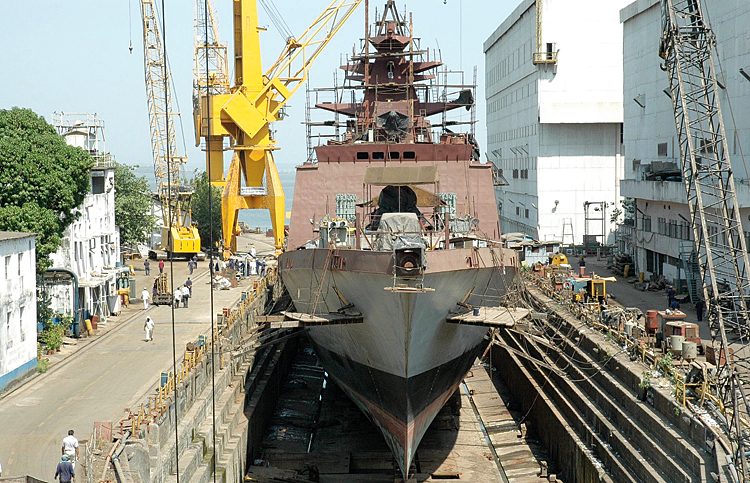
While commercial shipbuilding has lagged, Bharat’s warship construction sector provides a strong template for domestic manufacturing. Bharatiya Nausena has championed indigenisation over a long period of time, transitioning from a “Buyers Navy” to a “Builders Navy”. Starting with a modest Seaward Defence Boat in the 1960’s to commissioning the Vikrant, Project 17A Frigates and New Generation Survey Vessels in the 2020’s with over 75 per cent indigenous content has been a remarkable success story in indigenous warship design and warship building. This military success offers several valuable industrial advantages and lessons for commercial shipbuilding as well. Collaboration between the Bharatiya Nausena, Defense Metallurgical Research Laboratory (DMRL) and Steel Authority of India Limited (SAIL) led to the domestic production of DMR-249 warship-grade steel which eliminated reliance on foreign specialty steels and established a local supply chain for commercial hull manufacturing. In terms of defining the capability, building a warship has three major aspects – Float, Move, Fight. Float component consisting of design, steel, fabrication and hull systems is more than 96 per cent indigenous. Move component consisting of propulsion, shafting, control systems, engines, power systems, pumps, motors, etc, is over 65 per cent indigenous. Fight component consisting of sensors, weapons, combat management systems, networks and communications, etc, is around 60 per cent indigenous. Much technology transfer has been achieved through designing and building guided-missile destroyers, stealth frigates and submarines. This has built up a skilled domestic workforce in complex systems integration, advanced welding and precision engineering. The aim is also to shift from a regional warship builder to an affordable warship exporter, targeting markets in Southeast Asia, the Middle East and Africa by offering competitive naval patrol vessels, fast attack craft and auxiliary vessels.
Maritime Amrit Kaal Vision 2047 envisages scaling up of capacity to 3 million gross tonnages annually and generate 2.2 million direct and indirect jobs
To address structural changes across infrastructure development, supply chain indigenisation, fiscal policy and militarycommercial synergy, the Government has outlined aggressive measures along with time bound targets to scale domestic capabilities and transform shipyards into contemporary enterprises. During the ‘Samudra se Samriddhi’ programme held at Bhavnagar, Gujarat on September 20, 2025, Prime Minister Narendra Modi stated that, “Shipbuilding is no ordinary industry. Across the world, it is called the Mother of All Industries.” Maritime India Vision 2030 aims to secure 5 per cent share of the global shipbuilding market alongside port capacity enhancements. Maritime Amrit Kaal Vision 2047 envisages scaling up of capacity to 3 million gross tonnages annually, rank amongst the global top five in shipbuilding and generate 2.2 million direct and indirect jobs driving employment in engineering, welding, logistics and marine design. The Government plan is focused on setting up dedicated maritime clusters along both coasts (e.g., Gujarat, Maharashtra, Tamil Nadu, and Andhra Pradesh). These hubs co-locate shipyards, component suppliers, testing labs and maritime universities to lower logistics costs. There is a focus towards quadrupling the Indian-flagged fleet tonnage, creating a steady stream of domestic orders for local yards and reducing reliance on foreign shipping lines. Since long-term capital is a key requirement for shipbuilding, Sagarmala Finance Corporation Limited (SMFCL) has been launched as the country’s first specialised financial institution dedicated to funding the maritime and shipping sector. It commenced active lending operations in December 2025 with an overall borrowing limit of ₹25,000 crore and set a lending target of ₹8,000 crore for the fiscal year to provide short, medium and long-term funding for ports, shipping companies, MSMEs, startups, shipbuilding and inland waterways. The comprehensive ₹69,725 crore package approved by the government is built upon a strategic fourpillar approach to revitalise India’s maritime infrastructure, boost domestic tonnage and eliminate cost disadvantages faced by domestic shipyards. Shipbuilding Financial Assistance Scheme (SBFAS) for ₹24,736 crore is meant as a financial cushion to level the playing field between domestic shipyards and heavily subsidised global competitors. It provides an extended timeline upto March 31, 2036, financial assistance between 15 per cent to 25 per cent of contract value or fair price of a vessel to bridge international cost disparities and shipbreaking credit note with a dedicated ₹4,001 crore suballocation to incentivise owners to recycle old ships domestically and purchase newly manufactured ones from Bharat’s shipyards. National Shipbuilding Mission is being set up as a dedicated central body to aggregate national ship demand, streamline procurement and oversee international industrial tie-ups. Maritime Development Fund (MDF) of ₹25,000 crore to provide the maritime sector with cheap, long-term capital using a blended finance model. Maritime Investment Fund (MIF) has been allocated ₹20,000 crore to operate on a public-private equity structure where 49 per cent consists of concessional Government capital and 51 per cent is commercially raised from multilateral institutions, sovereign funds and bilateral lenders. Interest Incentivisation Fund has been allocated ₹5,000 crore to act as an interest subvention cushion, effectively reducing the net borrowing costs for companies looking to expand shipping tonnage or set up local ship-repair facilities. Shipbuilding Development Scheme (SbDS) of ₹19,989 crore focuses on physical infrastructure capacity expansion, asset building and geographical clusters. It funds the initial establishment of three state-of-the-art greenfield shipbuilding clusters in Andhra Pradesh, Gujarat and Tamil Nadu. It also finances construction of capital-heavy infrastructure like mega dry-docks, advanced blasting shops and heavy-duty cranes that can be shared across multiple small-and-medium shipbuilders to cut their overhead costs. Skilling, Policy & Regulatory Enhancements have been put in place to govern how the money is deployed through grant of infrastructure status directly to large ships to help operators secure lower interest rates and flexible loan tenures from standard commercial banks. It also institutionalises specialised workforce upgrades. Currently, 11 major domestic shipyards have entered into active MoUs with 34 Industrial Training Institutes (ITIs) across 8 coastal states to provide structured On-the-Job Training (OJT) for marine fabrication and engineering. A Ship Technology Centre has also been approved with a funding support of ₹305 crore to support Research an Development efforts for futuristic designs. The Harit Nauka guidelines mandate that domestic ports transition to green tugboats. This policy creates a steady baseline of orders for local shipyards, helping them build experience in electric and hybrid propulsion before scaling up to larger commercial vessels.
Comprehensive policy measures have been spelt out by the Government to support the shipbuilding sector by addressing the core issues. However, its success lies in the details of execution and implementation. Ease of doing business must address grant of timely approvals to allot land for shipyard projects. Shipbuilding requires a complete ecosystem spanning multiple domains, fields and ministries/departments to compete and succeed globally. While the National Shipbuilding Mission is being envisaged, it is felt that a National Shipbuilding Authority could provide the teeth and heft to address cross domain issues with speed and decisiveness to achieve the targets set in the maritime policies. Since cost remains a key consideration in commercial shipbuilding, operations and maintenance, shipyards need to focus on efficiency in time and cost to build quality ships. Modern technology needs to be adopted in shipbuilding at an accelerated pace. Greenfield projects can readily implement contemporary technology. But for most of the existing yards this is a challenging task due to constraints of land/space and mindsets, requiring viable innovative solutions. Adoption of “Smart Shipbuilding Farms” or “Open-Air/Land-Based Modular Shipbuilding”, the new way in which ships are built without a traditional drydock or slipway, using Self Propelled Modular Transporters that lift and move a 10,000 tonne block/ship needs to be adopted to achieve scale so as to reduce build time and cost to compete globally. Industry 4.0 tools to improve efficiency, AI assisted Virtual/Augment Reality, Model Based Systems Engineering which provide 3D model with 3D walkthrough designs, Digital Twins that reduce rework by 30-40 per cent, Contemporary Robotic Welding creating mega panels of 20x40m that helps reduce build time substantially, 3D printing of propellers, valves and spare parts, etc. need to be implemented urgently. Such modern techniques and technology have helped reduce build time for a container ship from 36 months to 12-18 months in Korean and Chinese shipyards. Cost reduction of 10-15 per cent has also been made possible. Some of this technology has already been adopted for warship building in Bharat at CSL’s new “International Ship Repair Facility” and GRSE modular halls. The International Maritime Organization (IMO) has set a target of netzero greenhouse gas emissions for international shipping by 2050. This creates an opportunity for Bharat to bypass traditional vessel designs and establish an early lead in green shipping technology. Cochin Shipyard Limited has already developed hydrogen fuel cell vessels and hybrid electric catamarans for inland waterways. Future projects could focus on methanol, ammonia and batteryassisted/hybrid propulsion systems which will need fuel flexible tanks for Ammonia/Methanol/Hydrogen and engine rooms predesigned for dual-fuel engines to be factored in ship design.
Bharat’s GDP is 3.5 trillion dollars today and by some estimates, it could surpass 26 trillion dollars mark by 2047 – a nearly eight-fold increase. It is evident, that an export-based economy will be a prime mover for achieving the goal of becoming a fully developed nation by 2047. Therefore, the aspects of ‘port-led development’ and ‘Blue Economy’ will continue to play a pivotal role as vast volumes of exports, inevitably, will be facilitated by ships. So, in a sense, Bharat’s maritime sector stands at a turning point. While its current global market share remains low, the combination of growing domestic freight demand, established naval construction capabilities and clear long-term Government targets provides a strong foundation for expansion. By addressing high capital costs, building up local supply chains, modernising, implementing contemporary technology, upskilling the workforce, improving productivity, investing early in green propulsion and creating an empowered agency to aggressively facilitate and pursue the national vision, Bharat can transform its shipbuilding industry into a major driver of economic growth and strategic self-reliance.