



The insightful articles, inspiring narrations and analytical perspectives presented by the Editorial Team, establish an alluring connect with the reader. My compliments and best wishes to SP Guide Publications.
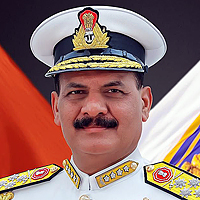
"Over the past 60 years, the growth of SP Guide Publications has mirrored the rising stature of Indian Navy. Its well-researched and informative magazines on Defence and Aerospace sector have served to shape an educated opinion of our military personnel, policy makers and the public alike. I wish SP's Publication team continued success, fair winds and following seas in all future endeavour!"

Since, its inception in 1964, SP Guide Publications has consistently demonstrated commitment to high-quality journalism in the aerospace and defence sectors, earning a well-deserved reputation as Asia's largest media house in this domain. I wish SP Guide Publications continued success in its pursuit of excellence.
“UN Convention on the Law of Seas legal framework can be further strengthened through a comprehensive global naval architecture”
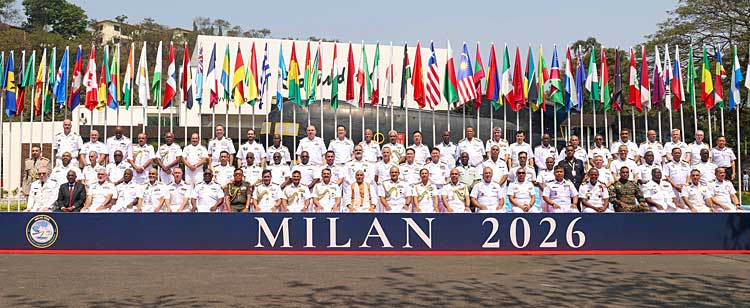
Defence Minister Rajnath Singh has called upon the international community to effectively tackle the evolving complex & interconnected challenges at sea while acting in the spirit of mutual respect and give & take. He was addressing Navy Chiefs and Heads of Delegations from 74 countries during the inaugural ceremony of Exercise MILAN at Visakhapatnam, Andhra Pradesh on February 19, 2026.
“The role of Navies in international peacemaking has only increased over time. There has been an exponential economic growth during last few decades leading to massive increase in international trade and transport. There has also been a rise in contests for ownership of straits and channels, sometimes causing threats of flare up. Increasing international attention to underwater resources, particularly rare-earth minerals are adding a new dimension to this tension. In addition, there is a need to guard our waters from the nefarious terrorist activities which are spreading tentacles across countries and regions,” said Defence Minister.
Rajnath Singh asserted that traditional threats coexist with emerging challenges such as piracy, maritime terrorism, illegal fishing, trafficking, cyber vulnerabilities, and disruptions to critical supply chains, adding that climate change is intensifying natural disasters, making humanitarian and disaster relief operations more frequent and demanding. No single navy, however capable, can address these challenges alone, he said, underscoring the need for enhanced cooperation among the Navies to ensure a safer and more secure future.
India aspires to establish an equitable maritime order based on international rules & freedom of navigation
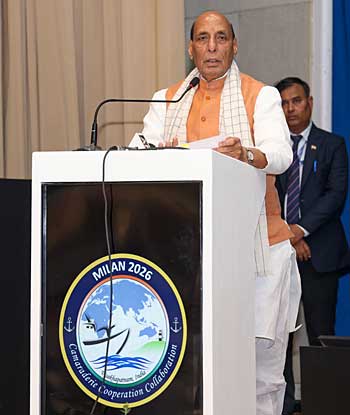
Defence Minister emphasised that the robust legal framework provided by the UN Convention on the Law of Seas (UNCLOS) to address matters related to international waters can be further strengthened through a comprehensive global naval architecture. He stated that UNCLOS provides a comprehensive and time-tested mechanism for dispute redressal & peaceful co-existence among nations, and the comprehensive global naval architecture would facilitate information sharing, protect links of communications and curbs criminal activities, including terrorism on high seas, along with the usual role of protecting the national boundaries on a global scale.
Pointing out that the established international order is witnessing an upheaval, Rajnath Singh stated that platforms like MILAN bring together professional expertise, build mutual trust, enhance interoperability, and enable coordinated responses to common challenges. “When our ships sail together, when our sailors train together, and when our commanders deliberate together, we build a shared understanding that transcends geography & politics and provides an opportune moment to deliberate on this idea of cooperation,” he said.
Highlighting that India has long recognised the need of this cooperation, Defence Minister said that shaped by the vision of Security and Growth for All in the Region (SAGAR), the country's approach to the seas has evolved into the vision of Mutual and Holistic Advancement for Security And Growth Across Regions (MAHASAGAR). This evolution from SAGAR i.e., seas to MAHASAGAR i.e., oceans reflects India's deepening commitment to engaging with partners in the region and beyond, he said.
“Evolution of PM Modi's vision from SAGAR to MAHASAGAR reflects India's deepening commitment to engaging with partners in the region and beyond”
Enumerating India's efforts to bring the countries together, Rajnath Singh said “We have participated regularly in the multilateral engagements and coordinated patrols. Our forces have responded swiftly to humanitarian crises. We have been engaged in many joint Exclusive Economic Zones surveillance and hydrographic assistance and support missions in times of cyclones.” He added that as a trusted Vishwa-Mitra (global friend), India will continue to play a constructive and dependable role in the region, underlining that holistic maritime security and mutual prosperity are indivisible, and can only be achieved through cooperation, trust, and shared commitment among like-minded nations.
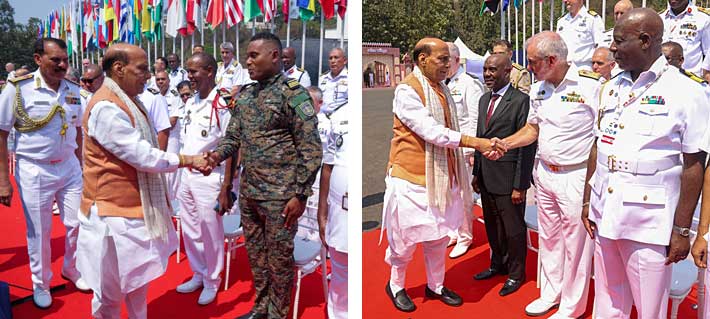
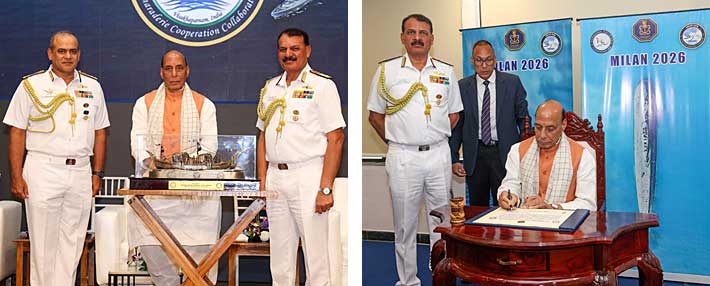
Defence Minister described MILAN 2026, with the participation of 74 nations, as a reflection of the confidence the global maritime community places in India as a trusted and responsible maritime partner. “MILAN 2026 seeks to enhance interoperability among navies of partner countries, improve professional competence by sharing of professional experiences and practices, and deepen friendships by evolving bonds of mutual advantage. We aspire to establish an equitable maritime order based on international rules and freedom of navigation in accordance with international law,” he said.
Rajnath Singh added that the International Fleet Review 2026 was a clear affirmation of goodwill, professionalism and mutual respect among the world's navies. He termed it as a powerful reminder that while their flags differ, the countries speak the same maritime language, a shared commitment to keep the global commons safe, secure, and stable.
In his opening remarks, Chief of the Naval Staff Admiral Dinesh K Tripathi likened MILAN to a Maritime Mahakumbh, wherein maritime professionals from across the world come together, united by a common commitment and purpose to keep the seas safe, secure, and open. He emphasised that a maritime nation like India clearly recognises that today's maritime challenges are complex, interconnected, and transnational, that are best addressed through cooperation and partnership.
“India is a trusted Vishwa-Mitra, will continue to play a constructive & dependable role in the region”
The Chief of the Naval Staff stated that the approach to this complex maritime environment is rooted in PM Modi's vision of MAHASAGAR, an inclusive and collaborative approach based on partnership and shared responsibility. He added that as the principal manifestation of India's maritime power, the Indian Navy is guided by this inclusive vision. He underlined that by working together, the Indian Navy seeks to enhance collective competence and strengthen shared resilience against the ever-evolving maritime challenges.
Admiral Dinesh K Tripathi asserted that during MILAN 2026, the navies will engage in complex maritime manoeuvres, drills and exercise, professional exchanges and insightful discussions. While enhancing mutual understanding, trust and interoperability, these interactions will also help in learning from each other's experience and expertise, he said.
Secretary, Department of Defence R&D and Chairman DRDO Dr Samir V. Kamat, Flag Officer Commanding-in-Chief, Eastern Naval Command Vice Admiral Sanjay Bhalla, former Indian Navy Chiefs, Naval Chiefs and Heads of Delegations from participating friendly countries; senior officers from the Indian Navy, Commanding Officers of ships and personnel of participating countries attended the event, underscoring the diplomatic and strategic significance of the exercise.
MILAN 2026 is among the largest and most complex editions of the Indian Navy exercise to date, bringing together naval ships, aircraft, and professional delegations from 74 countries. The exercise aims to deepen professional relationships, enhance operational compatibility, and promote a shared understanding of contemporary maritime challenges in an increasingly interconnected security environment.
MILAN 2026 aligns with the vision of Mutual and Holistic Advancement for Security and Growth Across Regions (MAHASAGAR) articulated by Prime Minister Narendra Modi, and reflects India's proactive approach towards promoting peace, stability, and prosperity across the maritime commons.
Navy Chiefs & Heads of Delegations from 74 countries taking part in Exercise MILAN organised by Indian Navy to reinforce cooperative maritime engagement, collective security & rule-based maritime order
The Exercise will be conducted in two phases - Harbour Phase and Sea Phase. The Harbour Phase focuses on strengthening professional interaction, fostering mutual understanding, enhancing cooperation and people-to-people linkages through a comprehensive programme of engagements. Key activities during this phase include the International Maritime Seminar, Subject Matter Expert Exchanges, bilateral engagements, MILAN of Young Officers, and cross-deck visits among participating navies. The Harbour Phase also includes pre-sail planning conferences, operational and technology demonstrations, city and cultural tours, sports interactions, and a MILAN Cultural Evening, providing participating personnel and delegations opportunities for meaningful interaction beyond operational engagements.
The Sea Phase will feature a series of advanced operational exercises at sea, designed to enhance maritime cooperation and interoperability among participating navies. These exercises will include coordinated maritime security operations, tactical manoeuvres and communication drills, thereby strengthening mutual trust, operational synergy, and collective readiness.
Through MILAN 2026, the Indian Navy continues to reinforce its commitment to cooperative maritime engagement, collective security, and the promotion of a rule-based maritime order, reaffirming India's role as a dependable partner and net security provider in the Indian Ocean Region and beyond.