


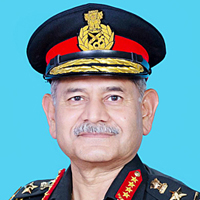
The insightful articles, inspiring narrations and analytical perspectives presented by the Editorial Team, establish an alluring connect with the reader. My compliments and best wishes to SP Guide Publications.
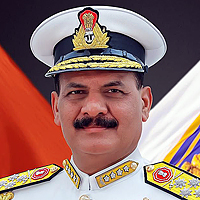
"Over the past 60 years, the growth of SP Guide Publications has mirrored the rising stature of Indian Navy. Its well-researched and informative magazines on Defence and Aerospace sector have served to shape an educated opinion of our military personnel, policy makers and the public alike. I wish SP's Publication team continued success, fair winds and following seas in all future endeavour!"

Since, its inception in 1964, SP Guide Publications has consistently demonstrated commitment to high-quality journalism in the aerospace and defence sectors, earning a well-deserved reputation as Asia's largest media house in this domain. I wish SP Guide Publications continued success in its pursuit of excellence.
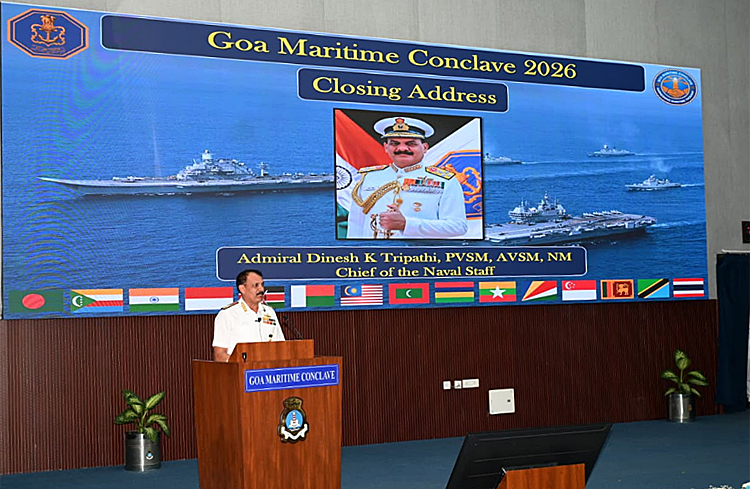
The 5th Edition of the Goa Maritime Conclave (GMC-26) was successfully conducted at Naval War College, Goa on February 21, 2026, bringing together Chiefs of Navies and senior maritime leaders from 15 Indian Ocean Region nations. The Conclave reaffirmed the collective commitment of regional partners to strengthen cooperative mechanisms aimed at addressing common maritime security challenges in the Indian Ocean Region (IOR).
Organised by the Indian Navy under the overarching theme of "Common Maritime Security Challenges in the IOR - Progressing Lines of Efforts (LsOE) to Mitigate Dynamic Threats", GMC-26 underscored India's continued role as a convenor of structured maritime dialogue and an enabler of collaborative security architecture in the region. Conducted in consonance with the Prime Minister's vision of ' MAHASAGAR - Mutual and Holistic Advancement for Security and Growth Across Regions', the conclave provided a structured platform for deliberations focused on actionable outcomes and collaborative implementation frameworks.
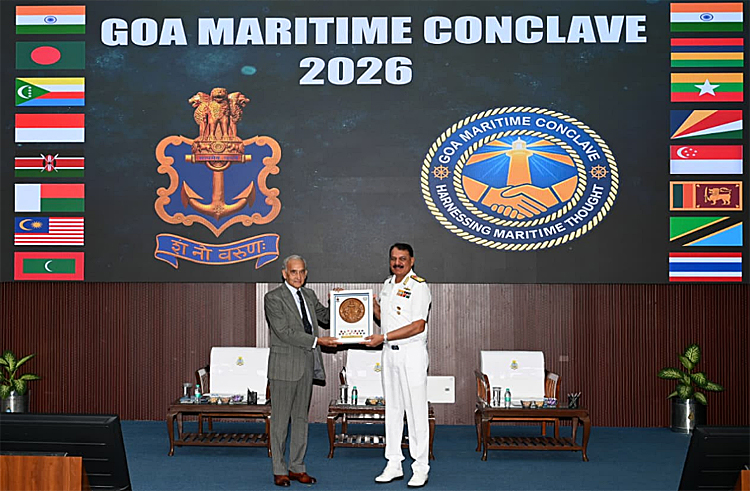
In his Keynote address, Admiral Arun Prakash, (Retd), former Chief of Naval Staff, highlighted that the evolving maritime security environment demands synchronised regional responses anchored in real-time information exchanges, institutionalised coordination mechanisms and sustained capacity development. He emphasised that addressing challenges such as Illegal, Unreported and Unregulated (IUU) fishing, trafficking networks and other transnational maritime crimes requires collective ownership and shared responsibility among IOR nations.
The first session moderated by Vice Admiral G. Ashok Kumar, (Retd), former National Maritime Security Coordinator, focused on enhancing mechanisms for real-time exchanges of maritime information and operational coordination to counter IUU fishing, drug trafficking and other illegal maritime activities. The speakers in this session were Rear Admiral TVN Prasanna, of the Indian Navy and Colonel Amanulla Ahmed Rasheed from Maldives. Issues of trans-national significance like strengthening maritime domain awareness networks, interoperability of information-sharing systems and the need for structured institutional linkages to enable rapid and coordinated responses across jurisdictions were highlighted by the speakers.
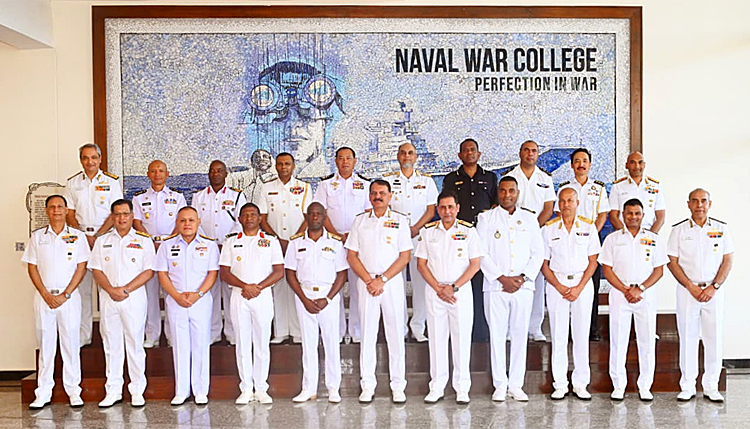
The second session examined collaborative pathways for capacity building and capability enhancement among maritime agencies of the IOR. Rear Admiral Srinivas Maddula, and Captain (IN) Ranendra S. Sawan, Senior Fellow, National Maritime Foundation, shared their insights, with Admiral Karambir Singh (Retd), former Chief of the Naval Staff and Chairman, National Maritime Foundation, moderating the session. The ensuing deliberations highlighted the importance of pooling regional training resources, expanding professional exchange programmes and strengthening institutional frameworks to ensure long-term maritime resilience. The session reinforced the understanding that sustainable maritime stability in the IOR is contingent upon coordinated capability development and structured cooperation.
The Conclave concluded with addresses by Chiefs of Navies and Heads of Delegations, who articulated national perspectives on advancing collaborative Lines of Efforts to mitigate dynamic maritime threats.
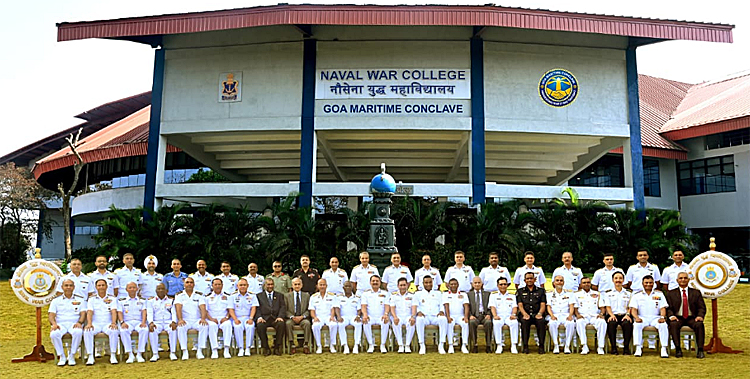
Admiral Dinesh K. Tripathi, CNS conveyed sincere appreciation to all partner nations for their participation and enduring commitment to shared maritime security in the Indian Ocean Region. He underscored that in an era of adaptive maritime threats, we must move from shared awareness to coordinated action by leveraging technology, seamless information sharing and focused operations under the vision of MAHASAGAR.
The deliberations reflected strong convergence on strengthening regional maritime partnerships, institutionalising cooperation mechanisms and enhancing collective capacity.
In its fifth iteration, the Goa Maritime Conclave reaffirmed India's commitment to fostering inclusive, consultative and action-oriented maritime cooperation in the Indian Ocean Region. GMC-26 once again resolved to uphold safe, secure and stable seas through structured collaboration, real-time information exchange and coordinated capacity development initiatives.