




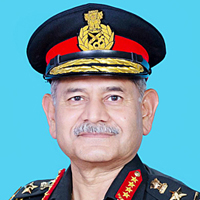
The insightful articles, inspiring narrations and analytical perspectives presented by the Editorial Team, establish an alluring connect with the reader. My compliments and best wishes to SP Guide Publications.
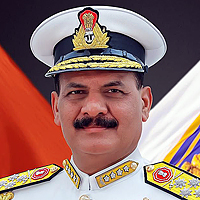
"Over the past 60 years, the growth of SP Guide Publications has mirrored the rising stature of Indian Navy. Its well-researched and informative magazines on Defence and Aerospace sector have served to shape an educated opinion of our military personnel, policy makers and the public alike. I wish SP's Publication team continued success, fair winds and following seas in all future endeavour!"

Since, its inception in 1964, SP Guide Publications has consistently demonstrated commitment to high-quality journalism in the aerospace and defence sectors, earning a well-deserved reputation as Asia's largest media house in this domain. I wish SP Guide Publications continued success in its pursuit of excellence.
“Defence exports poised to reach approximately ₹29,000 crore by April 2026”
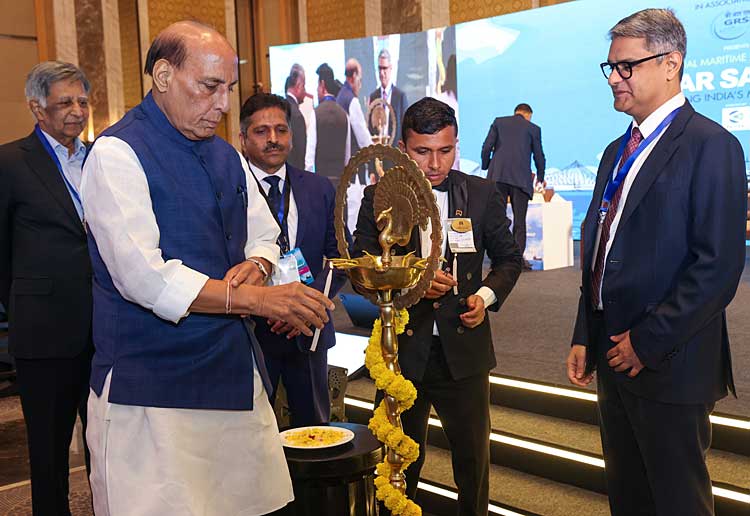
“Self-reliance is the only way to stay relevant and ready in the present era of uncertainty,” said Defence Minister Rajnath Singh while inaugurating Sagar Sankalp - Reclaiming India's Maritime Glory, a defence and maritime dialogue jointly organised by Garden Reach Shipbuilders & Engineers (GRSE) Limited and a private media organisation in Kolkata, West Bengal on March 6, 2026. He emphasised that the current global situation has led to the realignment of supply chains, formation of new equations, and constant rise in maritime activities, reaffirming the Government's resolve of attaining self-reliance in every field.
“Indian Navy's readiness, success of operations like Op Sindoor & self-reliance steps indicate that our defence sector is moving in the right direction”
“Old ideas, old global order, and old perceptions are changing rapidly. These are the uncertainties we need to understand. The current situation in the Middle East is one prime example. What is happening there is quite unusual. It is difficult to make concrete comments about the future course of events in the Middle East or in our neighborhood. The Strait of Hormuz or the entire Persian Gulf region is crucial for global energy security. When there is disturbance in the region, it directly impacts the supply of oil and gas. Moreover, we're witnessing supply chain disruptions in other sectors as well. These uncertainties have a direct impact on the economy and global trade. The global scenario is an abnormal situation. What is more worrying is the fact that this abnormality is becoming the new normal,” said Defence Minister.
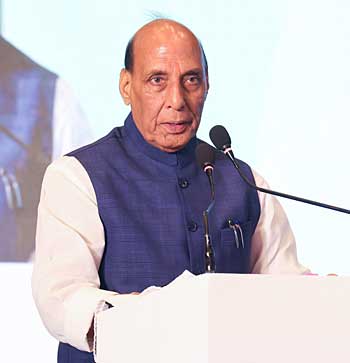
Describing “technological dynamism” as another crucial element in today's world, Rajnath Singh stated that technology is bringing about unprecedented changes in every sphere of life, and it is even more clearly visible in the defence sector. He highlighted that high-end and precision technologies are being used in the defence sector, and the Government aims to achieve Atmanirbharta in defence tech to remain stay ready for emerging and future challenges.
Defence Minister enumerated the structural and policy reforms implemented by the Government to bolster defence production qualitatively and quantitatively, with special emphasis on transparency, financial discipline, performance benchmarking, and R&D. Terming DPSUs as a key pillar of the Government's self-reliance vision, he stated that, in the shipbuilding sector, GRSE and other shipyards, have also been given special focus to make the domestic industrial ecosystem strong and futuristic. “The goal is to develop ships into technology hubs, not just production units. Efforts are being made to bring them up to the global standards through infrastructure modernisation, digital ship design tools, modular construction techniques, and supply chain integration,” he said.
Rajnath Singh also highlighted the steps taken to provide a level playing field to the private industry in the defence sector, including improved import-export processes, availability of DRDO labs, facilitating green channel certification, establishing defence corridors and opening up reserved orders of DPSUs. These steps, he said, are not only meant to facilitate, but to enable the private sector to achieve maximum performance, underlining the Government's objective to ensure the nation's development through equal participation of public and private sectors.
Defence Minister pointed out that the Government's efforts are yielding positive results as, in the Financial Year 2024-25, domestic defence production surpassed a record figure of ₹1.50 lakh crore, with defence exports touching an all-time high of approximately ₹24,000 crore. He stated that by April 2026, the defence exports are poised to reach approximately ₹29,000 crore and the Government has set a target to export defence equipment worth ₹50,000 crore by FY 2029-2030.
“Our aim is to develop ships into technology hubs & bring them up to global standards through infrastructure modernisation”
Rajnath Singh acknowledged the fact that the private industry, today, contributes with approximately 25 percent of the defence platforms/equipment and accessories manufactured in the country, and exuded confidence that this participation will increase to 50 per cent share of total defence production by value in the times to come.
Defence Minister noted that all the warships and submarines on order for the Indian Navy are being built in Indian shipyards - from design, engineering, construction to lifecycle support. He termed it as a major leap towards self-reliance. “Self-reliance is no longer just a slogan; it is being established as a practical reality. A Builder's Navy is not a slogan; it is a ground reality,” he said.
Rajnath Singh also praised the contribution of MSMEs, start-ups, and indigenous vendors in the construction of large platforms, asserting that a warship is a product of joint efforts, also known as the Conglomerate Effect. This conglomerate effect creates synergy, increases efficiency, mitigates risk, and creates an ecosystem of innovation, he said. He emphasised that the Government has introduced several financial assistance schemes to advance India's shipbuilding landscape, including the creation of a dedicated mechanism for long-term funding, liberalised FDI norms, and encouraged PPP model. Under the Maritime India Vision 2030 and Maritime Amrit Kaal vision 2047, investments worth approximately ₹3 lakh crore have been planned to develop world-class shipbuilding clusters, he added.
“Government aims to steer India into top 10 shipbuilding nations by 2030 & top five by 2047”
Concluding his address, Defence Minister said that India's maritime domain will be safe, prosperous, and strong if the nation moves forward with coordinated planning, technology adoption, and institutional synergy. “The Indian Navy's readiness, the success of operations like Operation Sindoor, and the steps towards self-reliance indicate that India's defence sector is moving in the right direction. If we work together to advance this maritime vision, in the years to come, India will not only safeguard its interests but also make a significant contribution to global maritime stability. Our target is to steer India into the top 10 shipbuilding nations by 2030, and reaching the top five by 2047,” he said.
In his remarks, CMD, GRSE Commodore P.R. Hari (Retd) reflected on India's civilisational maritime legacy and the evolution of indigenous shipbuilding capability. He noted that India's transition “from a Buyer's Navy to a Builder's Navy” marked a decisive turning point in restoring industrial depth. He also cited the journey from the delivery of INS Ajay in 1961 to the next-generation platforms under construction as symbolic of technological transformation and rising indigenisation.
The conclave brought together senior naval leadership, policymakers and industry stakeholders to deliberate on strengthening India's maritime security architecture and shipbuilding ecosystem. Panel discussions focused on aligning naval shipbuilding with emerging geopolitical dynamics, addressing grey-zone threats and distributed maritime operations; building sovereignty at sea through resilient domestic supply chains; expanding shipbuilding scale to meet global trade and energy transition demands; and positioning India as a competitive global destination for shipbuilding and ship repair through progressive port policy, regulatory reform and industrial collaboration.