





The insightful articles, inspiring narrations and analytical perspectives presented by the Editorial Team, establish an alluring connect with the reader. My compliments and best wishes to SP Guide Publications.
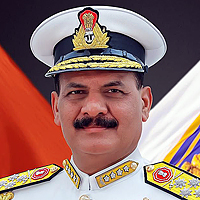
"Over the past 60 years, the growth of SP Guide Publications has mirrored the rising stature of Indian Navy. Its well-researched and informative magazines on Defence and Aerospace sector have served to shape an educated opinion of our military personnel, policy makers and the public alike. I wish SP's Publication team continued success, fair winds and following seas in all future endeavour!"

Since, its inception in 1964, SP Guide Publications has consistently demonstrated commitment to high-quality journalism in the aerospace and defence sectors, earning a well-deserved reputation as Asia's largest media house in this domain. I wish SP Guide Publications continued success in its pursuit of excellence.
Milestone advances the program toward carrier integration and operational testing
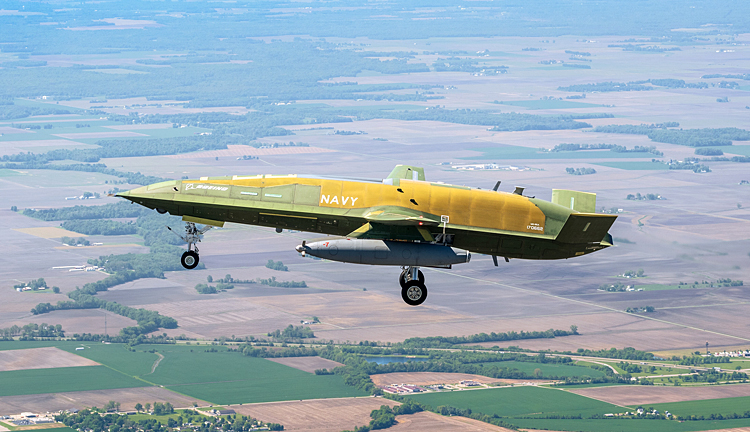
Boeing and the US Navy have successfully completed the first test flight of an operational MQ-25A Stingray™. The milestone advances the Stingray closer to aircraft carrier operations and marks the beginning of a new era in naval aviation.
During the two-hour flight, the unmanned aircraft successfully demonstrated its ability to autonomously taxi, take off, fly, land and respond to commands from the Unmanned Carrier Aviation Mission Control System MD-5 Ground Control Station (GCS). Boeing and US Navy Air Vehicle Pilots facilitated the mission by sending the aircraft commands and then monitored its performance from the GCS at MidAmerica St. Louis Airport in Mascoutah, Ill., where the program is based. Once airborne, the Stingray executed a pre-determined mission plan that validated its flight controls, navigation, and safe integration with the GCS.
"Today's successful flight builds on years of learning from our MQ-25A T1 prototype and represents a major maturation of the program," said Dan Gillian, vice president and general manager, Boeing Air Dominance. "The MQ-25A is the most complex autonomous system ever developed for the carrier environment, and this historic achievement advances us closer to safely integrating the Stingray into the carrier air wing."
"The first flight of the MQ-25A is a landmark achievement for the Navy-Boeing team and a critical step toward the future of the carrier air wing," said Rear Adm. Tony Rossi, who oversees the Program Executive Office for Unmanned Aviation and Strike Weapons. "This flight demonstrates our progress in delivering a carrier-based refueling capability that will significantly extend the reach and lethality of our fleet."
The MQ-25A is the Navy's gateway to integrating unmanned aircraft on the carrier deck, enabling manned-unmanned teaming. Its autonomous aerial refueling capability will significantly extend the operational range of the carrier air wing and allow F/A-18 Super Hornets currently performing the aerial refueling role to focus on their primary role as a multi-role strike fighter.
The aircraft is the first of four Engineering Development Model aircraft that will be delivered to the Navy under the original $805M Engineering and Manufacturing Development contract.
"Watching our first Navy aircraft complete an autonomous flight underscores what disciplined teamwork and rigorous testing deliver," said Troy Rutherford, vice president, Boeing MQ-25 program. "Today would not have been possible without the hard work and dedication of our Boeing, Navy, and industry team. Together, we are redefining the future of naval aviation and pushing the boundaries of what's possible with autonomy."
Boeing and the Navy will conduct additional test flights out of MidAmerica St. Louis Airport to further validate the aircraft's flight controls and capabilities before transitioning to Naval Air Station Patuxent River, Maryland, to prepare for carrier qualifications.