






The insightful articles, inspiring narrations and analytical perspectives presented by the Editorial Team, establish an alluring connect with the reader. My compliments and best wishes to SP Guide Publications.

"Over the past 60 years, the growth of SP Guide Publications has mirrored the rising stature of Indian Navy. Its well-researched and informative magazines on Defence and Aerospace sector have served to shape an educated opinion of our military personnel, policy makers and the public alike. I wish SP's Publication team continued success, fair winds and following seas in all future endeavour!"

Since, its inception in 1964, SP Guide Publications has consistently demonstrated commitment to high-quality journalism in the aerospace and defence sectors, earning a well-deserved reputation as Asia's largest media house in this domain. I wish SP Guide Publications continued success in its pursuit of excellence.
The ₹3,000-crore project will give the Army an independent space-based communications backbone as India moves toward greater integration of military space capabilities across the three services
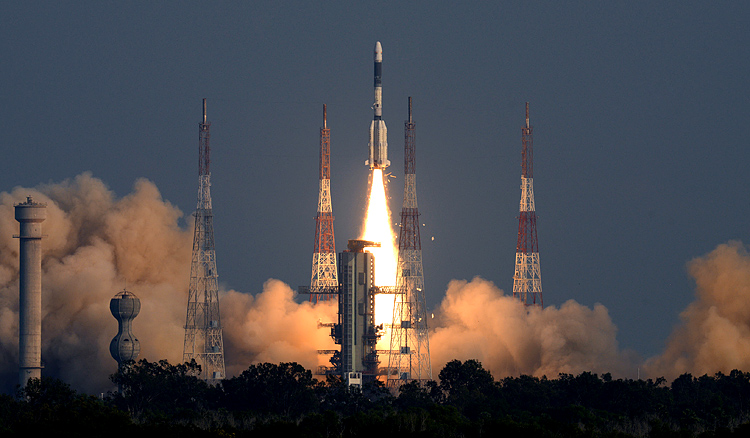
The Indian Army's first dedicated communications satellite, GSAT-7B, is expected to be launched by the Indian Space Research Organisation (ISRO) around mid-2028, a delay of about six months from the original November 2027 target, according to officials familiar with the programme.
Unlike the Indian Navy and the Indian Air Force, which have dedicated communications satellites, the Army currently relies on the IAF's GSAT-7A to meet its space-based communication requirements
The satellite is a significant step toward strengthening the Army's communications infrastructure, particularly for troops deployed in forward areas, where reliable, secure communications are critical for coordinating operations, sharing battlefield information, and directing military assets.
Unlike the Indian Navy and the Indian Air Force, which have dedicated communications satellites, the Army currently relies on the IAF's GSAT-7A to meet its space-based communication requirements. The induction of GSAT-7B is expected to address this long-standing gap and provide the Army with dedicated satellite capacity for its operational needs.
In March 2023, the Ministry of Defence (MoD) signed a contract worth ₹3,000 crore with NewSpace India Limited (NSIL), ISRO's commercial arm, for the development of GSAT-7B. The project is part of the military's broader effort to improve secure communications and strengthen the use of space-based capabilities in modern warfare.
The five-tonne geostationary satellite is designed to provide beyond-line-of-sight communications for deployed troops and military formations. More crucially, GSAT-7B will be able to provide information on weapon systems, airborne platforms and other critical assets

The five-tonne geostationary satellite is designed to provide beyond-line-of-sight communications for deployed troops and military formations. More crucially, GSAT-7B will be able to provide information on weapon systems, airborne platforms and other critical assets. Such capabilities are particularly important in mountainous and remote terrain. Usually, where conventional equipment may falter.
However, delay of around six months is attributed to technical reasons, as per the reports. So the revised launch timeline places the programme's expected culmination around the middle of 2028.
GSAT-7B is also part of a wider expansion of India's military satellite infrastructure. Last week, the defence ministry signed another contract with NSIL, worth ₹2,563 crore, for GSAT-7C, a dedicated communications satellite for the Indian Air Force (IAF).
The two projects underline the growing importance of space-based communications to India's military preparedness, as armed forces increasingly depend on networked operations, real-time information sharing and coordination among units operating across multiple domains.
For the Army, which operates across some of the country's most challenging geographical environments, a dedicated satellite could improve communications between headquarters and formations in the field, while supporting the integration of sensors, command systems and weapon platforms
For the Army, which operates across some of the country's most challenging geographical environments, a dedicated satellite could improve communications between headquarters and formations in the field, while supporting the integration of sensors, command systems and weapon platforms.
The development of dedicated satellites for individual services comes as India seeks to improve coordination in the military use of space. The Army, Navy and Air Force increasingly depend on satellites for communications, navigation, surveillance, intelligence and operational planning.
The challenge is no longer simply to acquire more satellites, but to ensure that the capabilities they provide can be integrated across the three services. This is where the concept of a joint military space doctrine becomes important.
A joint military space doctrine provides a common framework for how the armed forces understand, plan and employ space-based capabilities. It seeks to align the requirements of the Army, Navy and Air Force, establish common operational principles and improve coordination in the use of satellite communications, space-based surveillance, navigation and other space-enabled systems.
The challenge is no longer simply to acquire more satellites, but to ensure that the capabilities they provide can be integrated across the three services. This is where the concept of a joint military space doctrine becomes important
It also addresses the vulnerabilities associated with growing dependence on space infrastructure. Additionally, it plays a role in satellite jamming, electronic interference, cyberattacks and threats to critical space assets.
For India, the need for such coordination has become more pressing as military operations increasingly depend on secure data links, persistent surveillance and the ability to share information quickly across services and theatres.
While a dedicated communications satellite for the Army would strengthen one part of this architecture, the larger task is to ensure that service-specific systems work together as part of a coordinated military network.
GSAT-7B is a step towards reducing the Army's dependence on communication capacity operated primarily for another service and strengthening India's ability to conduct integrated, technology-driven military operations today.
Manish Kumar Jha is a Consulting & Contributing Editor for SP's Aviation, SP's Land Forces and SP's Naval Forces and a security expert. He writes on national security, military technology, strategic affairs & policies.