




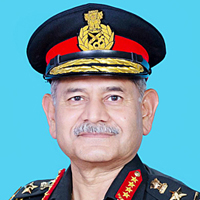
The insightful articles, inspiring narrations and analytical perspectives presented by the Editorial Team, establish an alluring connect with the reader. My compliments and best wishes to SP Guide Publications.
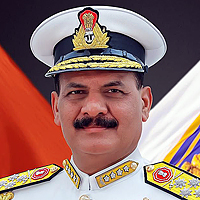
"Over the past 60 years, the growth of SP Guide Publications has mirrored the rising stature of Indian Navy. Its well-researched and informative magazines on Defence and Aerospace sector have served to shape an educated opinion of our military personnel, policy makers and the public alike. I wish SP's Publication team continued success, fair winds and following seas in all future endeavour!"

Since, its inception in 1964, SP Guide Publications has consistently demonstrated commitment to high-quality journalism in the aerospace and defence sectors, earning a well-deserved reputation as Asia's largest media house in this domain. I wish SP Guide Publications continued success in its pursuit of excellence.
The summit produced a series of agreements to deepen cooperation in defence, maritime security, economic resilience, and advanced technology sectors
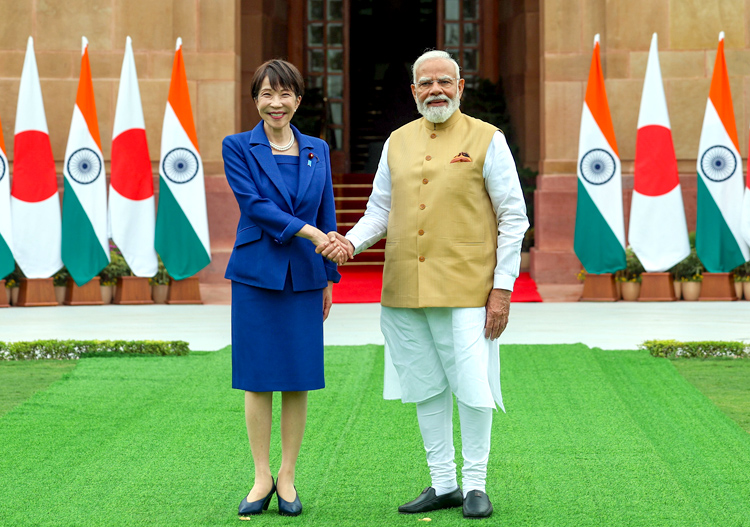
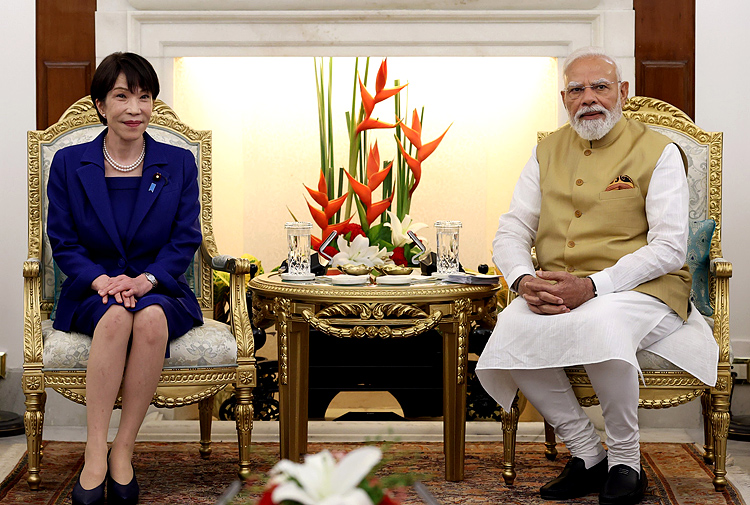
The strategic partnership between India and Japan entered a significant new phase following high-level talks in New Delhi between Prime Minister Narendra Modi and Japanese Prime Minister Sanae Takaichi.
The India-Japan partnership is evolving beyond economic engagement into a comprehensive strategic relationship
The summit produced a series of agreements to deepen cooperation in defence, maritime security, economic resilience, and advanced technology sectors–reflecting the growing strategic convergence between the two Indo-Pacific powers.
At a time of increasing geopolitical competition, contested maritime spaces and supply chain vulnerabilities, the India-Japan partnership is evolving beyond economic engagement into a comprehensive strategic relationship with direct implications for regional security.
A key outcome of the summit was the decision to strengthen defence-industrial cooperation, including collaboration on naval radio antenna systems. While the announcement may appear technical, its strategic significance lies in enhancing maritime communication capabilities and naval interoperability–an increasingly critical requirement as both countries seek to improve coordination in the Indo-Pacific.
For India, deeper defence cooperation with Japan aligns with its broader objective of modernising military capabilities through technology partnerships and indigenous production. For Japan, expanding defence engagement with India is part of Tokyo's effort to strengthen security partnerships with like-minded regional powers amid a changing security environment in East Asia and the broader Indo-Pacific.
Japan in April approved the sale of arms to its overseas friends and partners, including India. Under the leadership of Prime Minister Sanae Takaichi – who took office last October – the government has proposed providing Abukuma-class destroyers of the country's Maritime Self-Defense Force to the Philippines after their decommissioning while planning to export an upgraded version of the MSDF's Mogami-class frigate to Australia.
The talks on the Mogami-class for India have been in the news as well, but there is no confirmation on this.
For India, deeper defence cooperation with Japan aligns with its broader objective of modernising military capabilities through technology partnerships and indigenous production
The maritime domain remains central to India-Japan defence cooperation. Both nations share concerns regarding freedom of navigation, sea-lane security and the stability of the Indo-Pacific maritime commons. Given that critical trade and energy routes pass through these waters, securing maritime infrastructure and communications has become a strategic imperative.
Naval cooperation between the two countries has steadily expanded through joint exercises, operational dialogues and participation in multilateral frameworks. The latest agreements further reinforce this trajectory and indicate a stronger focus on operational synergy.
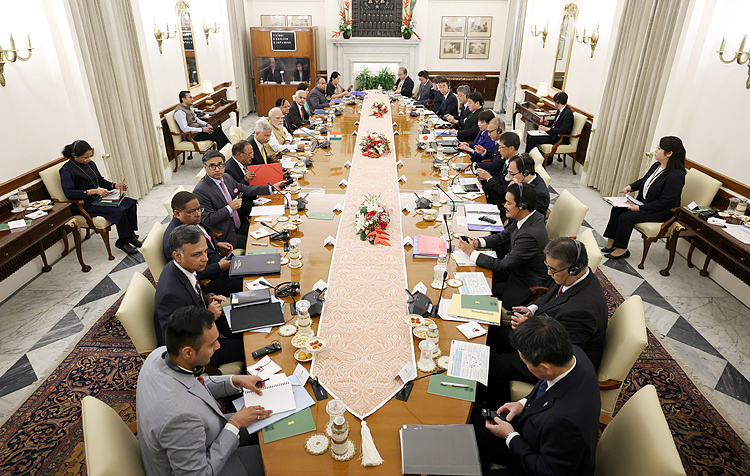
One of the most important outcomes of the summit was the adoption of a joint roadmap on economic security. This marks a significant recognition by both sides that economic strength, industrial resilience and technological superiority are now inseparable from national security.
Prime Minister Modi's statement that "India and Japan view economic security as a shared security interest" captures a shift in strategic thinking.
Both nations share concerns regarding freedom of navigation, sea-lane security and the stability of the Indo-Pacific maritime commons
Japan had already pledged to more than double its investment in India to more than $61 billion over the next decade.
In today's geopolitical environment, secure supply chains, semiconductor capacity, critical minerals and advanced manufacturing capabilities are viewed as strategic assets.
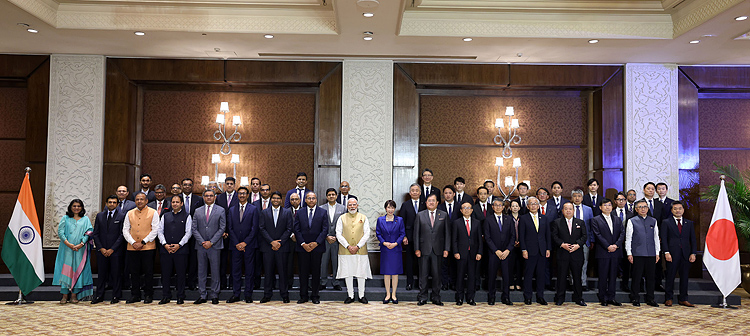
Building on several MoUs, the two sides agreed to intensify cooperation in artificial intelligence, semiconductors, critical technologies, shipbuilding, and biogas. These sectors carry direct strategic relevance. Artificial intelligence is rapidly transforming defence systems, surveillance and decision-making. Semiconductor resilience has become central to both economic and military preparedness. Shipbuilding has implications for naval force expansion and maritime logistics.
Building on several MoUs, the two sides agreed to intensify cooperation in artificial intelligence, semiconductors, critical technologies, shipbuilding, and biogas
For defence planners, this signals an important expansion of India-Japan cooperation into domains that shape future warfare.
Japan remains one of India's most important economic partners and among its largest foreign investors. Nearly 1,400 Japanese companies operate in India, with a significant footprint in manufacturing and industrial development. Major Japanese investments have played a critical role in infrastructure and industrial transformation.
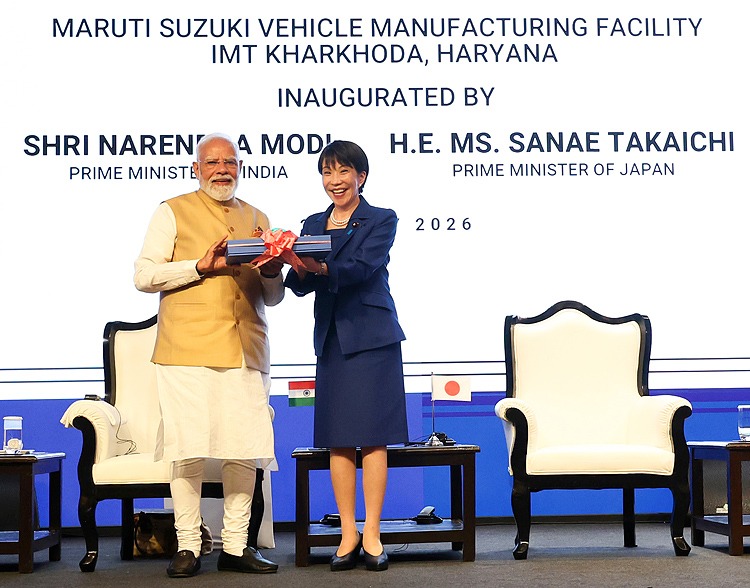
As Prime Minister Modi also highlighted in his speech, India's strategic advantage lies in scale, market depth and manufacturing potential, while Japan contributes technological sophistication, industrial precision and capital. This combination offers significant potential for defence manufacturing and supply chain resilience.
The success of Japanese industrial giants such as Suzuki, Honda and Mitsubishi in India shows how Japanese technology and Indian manufacturing capacity can create globally competitive production ecosystems. In fact, India is the export hub for many such Japanese entities for the global market.
Key sectors identified for future collaboration include shipbuilding, mobility, aerospace and defence manufacturing
This model could increasingly extend into defence manufacturing, aerospace and dual-use technologies.
Prime Minister Modi's target of increasing Japanese investment beyond 3 trillion yen over the next decade and doubling the number of Japanese companies in India reflects the scale of ambition shaping bilateral ties.
Key sectors identified for future collaboration include shipbuilding, mobility, aerospace and defence manufacturing.
These sectors are strategically important not only for economic growth but also for military readiness and long-term national resilience.
As regional security dynamics continue to evolve, India and Japan are positioning themselves as key stakeholders in shaping the future security architecture of Asia
While the India-Japan partnership has been a critical pillar of Indo-Pacific stability, adding defence cooperation actually strengthens the resolve. Both nations share a common vision of a free, open and rules-based Indo-Pacific founded on trust, strategic autonomy and resilient partnerships.
As regional security dynamics continue to evolve, India and Japan are positioning themselves as key stakeholders in shaping the future security architecture of Asia. Their growing strategic alignment–anchored in defence cooperation, technological collaboration and economic security–will likely play a decisive role in ensuring regional stability and strengthening collective resilience.
However, it is also to be seen if defence cooperation results in the exchange of military systems in the near future. The success of the summit will depend on the implementation rather than the intention.
Manish Kumar Jha is a Consulting & Contributing Editor for SP's Aviation, SP's Land Forces and SP's Naval Forces and a security expert. He writes on national security, military technology, strategic affairs & policies.