




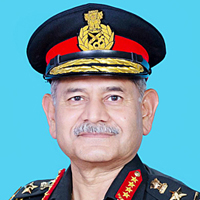
The insightful articles, inspiring narrations and analytical perspectives presented by the Editorial Team, establish an alluring connect with the reader. My compliments and best wishes to SP Guide Publications.
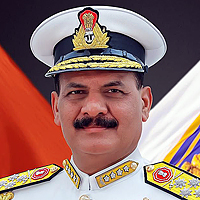
"Over the past 60 years, the growth of SP Guide Publications has mirrored the rising stature of Indian Navy. Its well-researched and informative magazines on Defence and Aerospace sector have served to shape an educated opinion of our military personnel, policy makers and the public alike. I wish SP's Publication team continued success, fair winds and following seas in all future endeavour!"

Since, its inception in 1964, SP Guide Publications has consistently demonstrated commitment to high-quality journalism in the aerospace and defence sectors, earning a well-deserved reputation as Asia's largest media house in this domain. I wish SP Guide Publications continued success in its pursuit of excellence.
Ran Samwad 2026 reinforced a clear message that multi-domain warfare is not a distant concept but an operational reality. Navy Chief puts forth shifting ideas to operationalise India's own strategy. Air Marshal Ashutosh Dixit, CIDS, was direct on the inevitability of multi-domain Operations for the military.
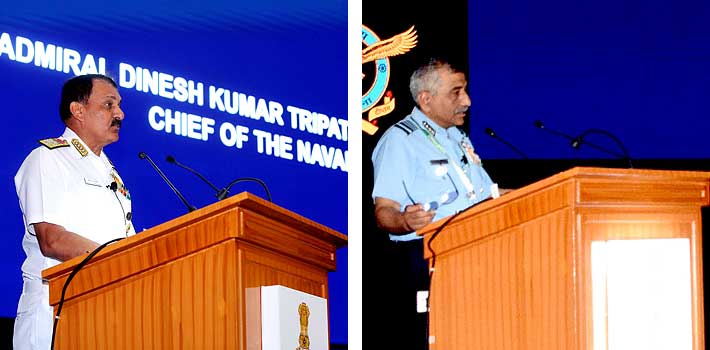
Ran Samwad 2026 emerged as a significant strategic dialogue platform, bringing together senior defence leaders, military thinkers, and policy makers to deliberate on the rapidly evolving nature of warfare. The central theme of the seminar— "Multi-Domain Operations (MDO): An Imperative for Addressing Conventional and Irregular Threats"—captured the urgency with which modern militaries must adapt to a complex and interconnected battle space.
The discussions underscored a fundamental shift: warfare is no longer confined to traditional domains of land, air, and sea. Today's battlefield extends into cyber, space, and even the cognitive domain, where perception, information, and influence shape outcomes as much as firepower. This expansion has blurred the lines between conventional and irregular warfare, demanding a more integrated and agile operational approach.
Indian Navy Chief Admiral Dinesh K. Tripathi highlighted the need for a resilient, future-ready, and indigenous force focusing on multi-domain operations
At Ran Samwad 2026 in Bengaluru, Indian Navy Chief Admiral Dinesh K. Tripathi opened his remarks, which embrace the wider warfighting concept, shifting from "importing strategic thinking" to operationalising India's own strategy. He highlighted the need for a resilient, future-ready, and indigenous force focusing on multi-domain operations—connecting seabed to space—to ensure national maritime security.
Air Marshal Ashutosh Dixit, Chief of Integrated Defence Staff, to Chairman Chiefs of Staff Committee (CISC) delivered the keynote address at Ran Samwad 2026. He highlighted that the modern wars will start well before the first shot is fired - through cyber, space, information and economic disruptions.
Victory now depends on integration, faster decisions, resilient networks and joint actions across multiple domains. For India, multi-domain operations are not a future idea but a necessity
The keynote message was direct: no single service or platform can win wars alone. Victory now depends on integration, faster decisions, resilient networks and joint actions across multiple domains. For India, multi-domain operations are not a future idea but a necessity. It's about how fast and well we can act together.
Air Marshal Dixit highlighted the immediacy of these changes by citing a recent maritime incident: "An Iranian naval frigate was recently sunk nearly 40 nautical miles from Sri Lanka in waters where India has vital interests. For us, this is not a distant spectacle. It is a strategic lesson delivered in real time." His remarks emphasised how regional security events, even those seemingly peripheral, carry direct implications in an interconnected strategic environment.
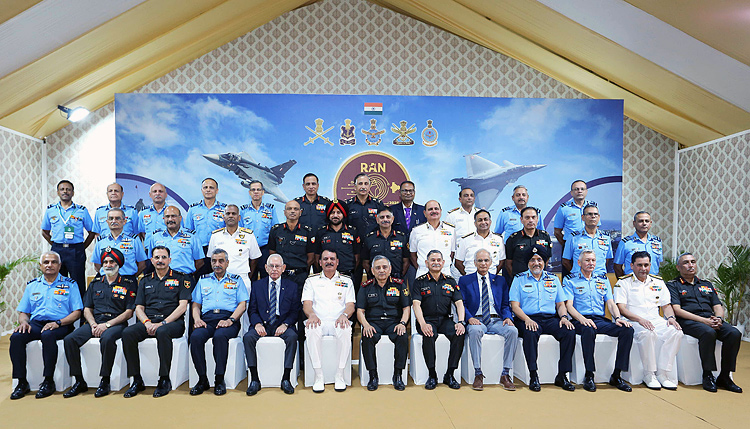
At the heart of Multi-Domain Operations lies the seamless integration of capabilities across all domains. Rather than operating in silos, modern forces must synchronise actions—combining kinetic and non-kinetic tools, conventional strength and technological superiority—to achieve decisive outcomes. This requires not only interoperability among services but also real-time coordination supported by advanced data systems.
Army Chief General Dwivedi emphasised the central role of technology in enabling this transformation. He said, "Technology is the common thread binding the decision-making process in modern warfare by integrating the data into the network, converting the integrated data into a decision advantage, and translating it into a coherent fighting architecture. This must always be technology-enabled, and not technology-led."
At the heart of Multi-Domain Operations lies the seamless integration of capabilities across all domains
His distinction is critical: while technology is indispensable, it must serve strategic intent rather than dictate it.
A key takeaway from Ran Samwad 2026 was that decision superiority—derived from speed, accuracy, and integration of information—will define success in future conflicts. Artificial intelligence, data analytics, autonomous systems, and secure communication networks are becoming force multipliers, enabling commanders to act faster and more precisely than adversaries.
Artificial intelligence, data analytics, autonomous systems, and secure communication networks are becoming force multipliers, enabling commanders to act faster and more precisely
Moreover, the seminar highlighted the growing importance of the cognitive domain, where narratives, misinformation, and psychological operations can influence both public perception and battlefield morale. Winning future wars may depend as much on shaping the information environment as on controlling physical territory.
The discussions also pointed to the need for doctrinal evolution, jointness among armed forces, and investment in emerging technologies. Multi-Domain Operations demand not only new tools but also new ways of thinking—flexible command structures, decentralised execution, and a culture of innovation.
Ran Samwad 2026 reinforced a clear message that multi-domain warfare is not a distant concept but an operational reality. As threats become more complex and diffuse, the ability to integrate capabilities across domains will be the defining factor in maintaining strategic advantage.
Important to note that nations that adapt quickly—balancing technology with doctrine and strategy—will be better positioned to address both conventional and irregular challenges in the battlespace of the future.
Manish Kumar Jha is a Consulting & Contributing Editor for SP's Aviation, SP's Land Forces and SP's Naval Forces and a security expert. He writes on national security, military technology, strategic affairs & policies.