



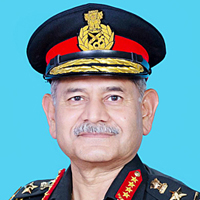
The insightful articles, inspiring narrations and analytical perspectives presented by the Editorial Team, establish an alluring connect with the reader. My compliments and best wishes to SP Guide Publications.
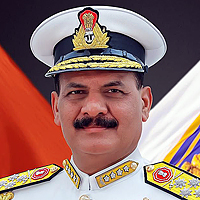
"Over the past 60 years, the growth of SP Guide Publications has mirrored the rising stature of Indian Navy. Its well-researched and informative magazines on Defence and Aerospace sector have served to shape an educated opinion of our military personnel, policy makers and the public alike. I wish SP's Publication team continued success, fair winds and following seas in all future endeavour!"

Since, its inception in 1964, SP Guide Publications has consistently demonstrated commitment to high-quality journalism in the aerospace and defence sectors, earning a well-deserved reputation as Asia's largest media house in this domain. I wish SP Guide Publications continued success in its pursuit of excellence.
The talks between Defence Minister Rajnath Singh and U.S. Secretary of War Pete Hegseth reaffirm the India-U.S. defence partnership, which strives to regain the momentum of strategic trust and democratic resilience. The Kuala Lumpur meeting has in essence injected new possibilities and confirms that defence remains as the major pillar of Delhi's relationship with Washington.
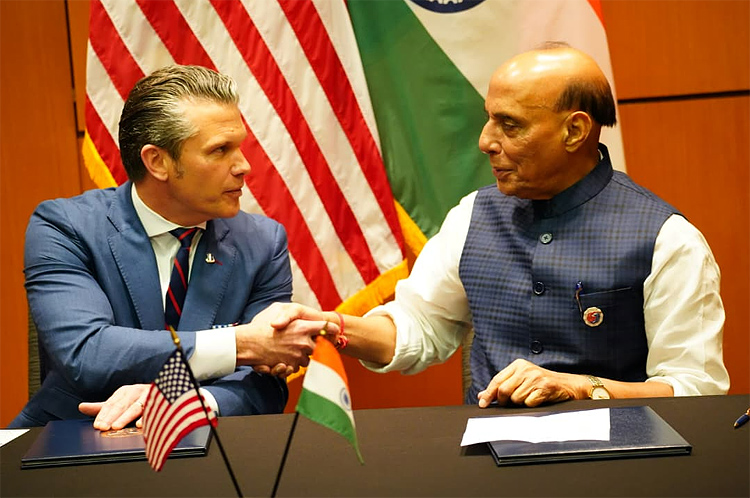
In a significant stride toward strengthening global security and regional stability, Defence Minister of India Rajnath Singh and U.S. Secretary of War Pete Hegseth met on the sidelines of the 12th ASEAN Defence Ministers' Meeting Plus (ADMM-Plus) in Kuala Lumpur on October 31.
The meeting, marked by both warmth and strategic intent, culminated in the signing of a 10-year framework for the U.S.-India Major Defence Partnership, a landmark agreement that sets the tone for the next decade of bilateral cooperation in defence and security.
The meeting culminated in the signing of a 10-year framework for the U.S.-India Major Defence Partnership, a landmark agreement that sets the tone for the next decade of bilateral cooperation in defence and security.
This framework is being looked at as a strategic blueprint for a deepened, technologically advanced, and policy-driven defence relationship. As the Defence Minister noted, the agreement "will provide policy direction to the entire spectrum of the India-U.S. defence relationship and herald a new decade of partnership." His statement underscores India's growing conviction that defence will remain the major pillar of its relationship with Washington, reflecting the broader alignment of their strategic interests in the Indo-Pacific.
For the U.S., Secretary Hegseth's words echoed a similar sentiment: "India is a priority country for us in defence cooperation, and we're committed to work closely with India to ensure a free and open Indo-Pacific." This emphasis on freedom of navigation, rule of law, and regional deterrence aligns squarely with India's own Indo-Pacific vision, which advocates inclusivity, stability, and respect for sovereignty.
"The agreement will provide policy direction to the entire spectrum of the India-U.S. defence relationship and herald a new decade of partnership" – Rajnath Singh, Defence Minister of India
The India-U.S. defence partnership has evolved dramatically over the past two decades–from the signing of foundational agreements like COMCASA and BECA to joint military exercises such as Yudh Abhyas, Malabar, and Cope India.
The new 2025 framework builds upon this momentum by outlining a unified vision for cooperation in defence technology, industrial collaboration, joint innovation, and information sharing. It seeks not only to institutionalise progress but also to infuse predictability and strategic clarity into the partnership.
"India is a priority country for us in defence cooperation, and we're committed to work closely with India to ensure a free and open Indo-Pacific" - Pete Hegseth, U.S. Secretary of War
This framework's timing is particularly significant. The Indo-Pacific remains a theatre of growing geopolitical competition, where maritime security, freedom of navigation, and the balance of power are under constant test. By reaffirming their defence ties, India and the U.S. are signalling their shared resolve to uphold a rules-based international order and deter coercive behaviour in the region.
The bilateral engagement at ADMM-Plus also highlights the importance of multilateral cooperation. Both nations continue to work with ASEAN and other like-minded partners–Australia, Japan, and European allies–to strengthen regional defence architectures and promote peace and stability.
This framework's timing is particularly significant. The Indo-Pacific remains a theatre of growing geopolitical competition, where maritime security, freedom of navigation, and the balance of power are under constant test.
In his post on X (formerly Twitter), Rajnath Singh aptly called the framework "a signal of our growing strategic convergence." Indeed, the convergence is no longer limited to rhetoric–it is increasingly reflected in joint production, co-development of technologies, and enhanced interoperability between the armed forces. Secretary Hegseth's response–that "our defence ties have never been stronger"–captures this evolution with clarity and conviction.
As the world navigates new security challenges, the India-U.S. defence partnership strives to regain the momentum of strategic trust and democratic resilience. The Kuala Lumpur meeting has, in essence, injected new possibilities and a new course for bilateral relations–one defined by shared responsibility, mutual respect, and a vision for a free, open, and secure Indo-Pacific.
The ink on this 10-year framework, while symbolic, is a commitment to collective security and technological empowerment, setting the stage for a transformative decade in global defence cooperation.
Manish Kumar Jha is a Consulting & Contributing Editor for SP's Aviation, SP's Land Forces and SP's Naval Forces and a security expert. He writes on national security, military technology, strategic affairs & policies.