





The insightful articles, inspiring narrations and analytical perspectives presented by the Editorial Team, establish an alluring connect with the reader. My compliments and best wishes to SP Guide Publications.

"Over the past 60 years, the growth of SP Guide Publications has mirrored the rising stature of Indian Navy. Its well-researched and informative magazines on Defence and Aerospace sector have served to shape an educated opinion of our military personnel, policy makers and the public alike. I wish SP's Publication team continued success, fair winds and following seas in all future endeavour!"

Since, its inception in 1964, SP Guide Publications has consistently demonstrated commitment to high-quality journalism in the aerospace and defence sectors, earning a well-deserved reputation as Asia's largest media house in this domain. I wish SP Guide Publications continued success in its pursuit of excellence.
The indigenous AIP will be integrated into India's Project-76 submarine programme and represents a decisive leap in indigenous naval capability
 |
The Author is Former Director General of Information Systems and A Special Forces Veteran, Indian Army |
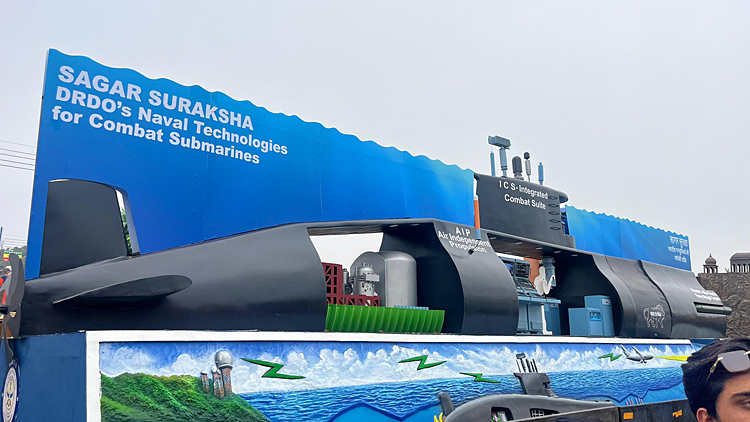
An Air-Independent Propulsion (AIP) system allows non-nuclear submarines to operate without surfacing or using a snorkel to get atmospheric oxygen. By generating power silently while fully submerged, AIP drastically increases a submarine's stealth and endurance. Diesel-electric submarines use diesel engines to run propellers and charge batteries while surfaced or at snorkel depth; producing noise and exposing itself to radar and sonar detection. Without AIP, a conventional submarine can typically only stay submerged for 2-3 days before needing to surface.
AIP provides an additional, secondary power source that generates electricity for the submarine's propulsion and hotel loads without relying on outside air. It allows the boat to glide silently deep underwater for weeks at a time, surfacing only when fuel or supplies run low. Nuclear submarines have unlimited endurance but are extremely expensive to build and maintain. AIP bridges the gap between conventional diesel boats and nuclear submarines, offering comparable acoustic stealth at a fraction of the cost.
AIP bridges the gap between conventional diesel boats and nuclear submarines, offering comparable acoustic stealth at a fraction of the cost
India's reliance on imported AIP spans over two decades: sourcing submarine technologies from multiple countries. France and Germany served as the primary foundational partners for India's AIP-integrated submarine fleet. India has relied on German engineering since the 1980s when it built its Shishumar-class boats with ThyssenKrupp Marine Systems (TKMS), and continues to collaborate with Germany for advanced stealth submarines featuring modern AIP technology. India began operating French-designed Scorpene-class (Kalvari-class) submarines in December 2017, partnering with Naval Group France on detailed design and certification phases to integrate this technology into its submarine fleets.
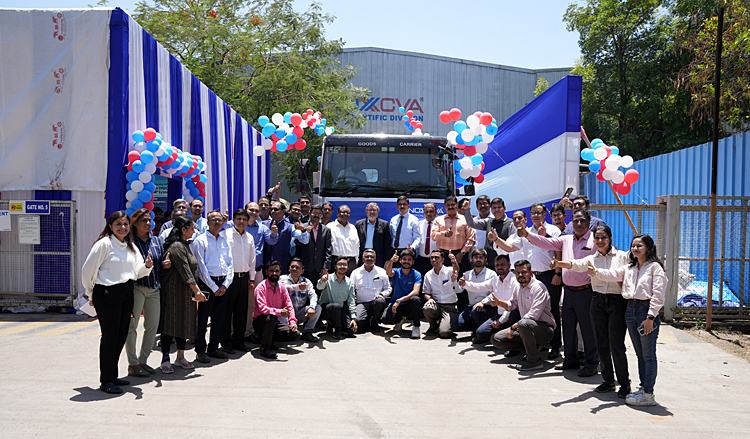
But now India has taken the important leap into an indigenous AIP. The flag-off of the Simulated Liquid Oxygen (LOX) Module from INOXCVA's facility on April 26, 2026 marks a decisive transition point in the Indian Navy's indigenous AIP. This is a signal that a critical subsystem has moved from laboratory validation into the domain of submarine-grade manufacturing where safety, reliability, and integration disciplines are far more stringent. At the core of the development is the LOX storage system, designed to safely contain liquid oxygen at extremely low temperatures within the confined and hostile environment of a submarine.
Aim is to deliver 12 advanced diesel-electric attack submarines with AIP and lithium-ion batteries by the mid-2030s
The LOX 'Simulated Module' indicates that the system is configured for Factory Acceptance Testing (FAT), where design robustness, safety protocols, and performance parameters are validated under controlled industrial conditions. This phase effectively bridges the gap between DRDO's laboratory-scale prototypes and deployable naval hardware. Passing FAT is a prerequisite before integration into a full submarine section, and it reflects confidence that the design can meet operational safety margins under vibration, pressure, and thermal stress conditions typical of undersea deployment.
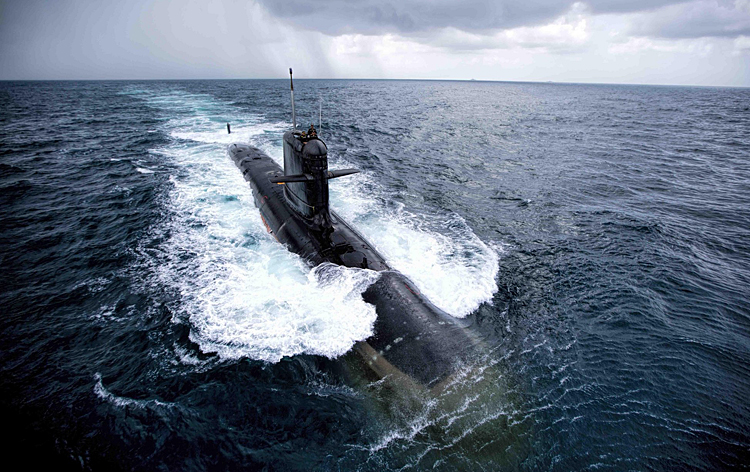
This timeline is aligned with the Indian Navy's timeline for retrofitting INS Khanderi, a Scorpene-class submarine, with the indigenous AIP 'plug'. The current plan targets integration by December 2026, with the LOX module forming a central component of the broader 'Energy Module' being assembled by Larsen & Toubro (L&T). Once validated, the module will be incorporated into the additional hull section at the L&T facility before final integration with the submarine; allowing existing platforms to be upgraded with extended endurance capabilities without entirely new builds.
The propulsion architecture is particularly innovative, combining India's indigenous fuel-cell based AIP system with high-capacity lithium-ion batteries
A defining feature of the indigenous AIP system is its approach to hydrogen management. Instead of storing hydrogen, which poses significant safety risks in a submarine environment, the system generates it on demand from phosphoric acid. This design choice shifts the primary storage challenge to liquid oxygen, making the LOX module the most critical consumable subsystem onboard. The successful industrialisation of this component demonstrates that indigenous industry can now handle high-purity cryogenic systems with safety and reliability required for stealth operations lasting two to three weeks underwater.
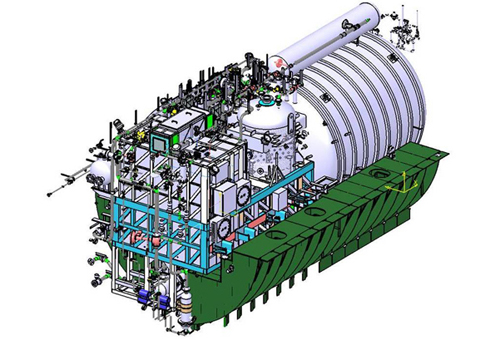
The indigenous AIP will be integrated into India's Project-76 submarine programme and represents a decisive leap in indigenous naval capability; aiming to deliver 12 advanced diesel-electric attack submarines with AIP and lithium-ion batteries by the mid-2030s. The initiative is designed to replace the ageing Kilo-class fleet while achieving unprecedented levels of indigenisation and endurance.
The 12 submarines under the Project-76 initiative, each weighing approximately 3,000 tonnes, are to replace the ageing Sindhughosh-class units. The Warship Design Bureau and the Defence Research and Development Organisation are leading the design phase, with indigenous content projected between 70 per cent and 80 per cent.
Sea trials of the indigenous AIP module are scheduled aboard INS Khanderi later in 2026, serving as a real-world demonstrator for Project-76 technologies
The programme is strategically designed to split construction between Mazagon Dock Shipbuilders Limited (MDSL) and Larsen & Toubro (L&T), enabling parallel production lines to compress delivery timelines. Each shipyard is expected to deliver six submarines, ensuring steady induction into the fleet. The propulsion architecture is particularly innovative, combining India's indigenous fuel-cell based AIP system with high-capacity lithium-ion batteries. This hybrid endurance concept allows for extremely quiet patrols lasting weeks without surfacing, while lithium-ion batteries provide rapid bursts of power for manoeuvres and combat.
Sea trials of the indigenous AIP module are scheduled aboard INS Khanderi later in 2026, serving as a real-world demonstrator for Project-76 technologies. Successful validation will pave the way for integration into the new submarines. Technical and preliminary designs are actively underway, with production orders expected around 2028 and the first inductions beginning by 2034.