



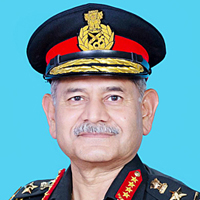
The insightful articles, inspiring narrations and analytical perspectives presented by the Editorial Team, establish an alluring connect with the reader. My compliments and best wishes to SP Guide Publications.
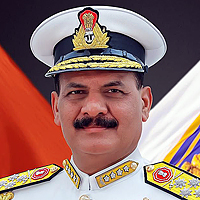
"Over the past 60 years, the growth of SP Guide Publications has mirrored the rising stature of Indian Navy. Its well-researched and informative magazines on Defence and Aerospace sector have served to shape an educated opinion of our military personnel, policy makers and the public alike. I wish SP's Publication team continued success, fair winds and following seas in all future endeavour!"

Since, its inception in 1964, SP Guide Publications has consistently demonstrated commitment to high-quality journalism in the aerospace and defence sectors, earning a well-deserved reputation as Asia's largest media house in this domain. I wish SP Guide Publications continued success in its pursuit of excellence.
India's proposed three Theatre Commands aim to integrate the armed forces operationally, strengthen jointness and improve responses to regional and multi-domain threats.
 |
The Author is Former Director General of Information Systems and A Special Forces Veteran, Indian Army |
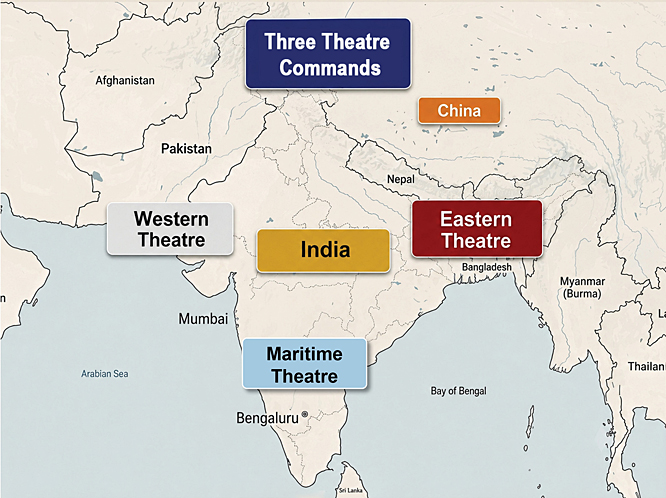
The media is overloaded with news that India is soon to get three Theatre Commands, designed to handle geographical and adversary-specific threats. Under the plan, India's 17 single-service operational commands are to be merged into three unified commands, bringing Army, Navy, and Air Force assets under a single four-star commander to enhance coordination, resource sharing, and multi-domain readiness. The blueprint, originally drafted under former CDS General Anil Chauhan, is being presented by the current CDS General N.S. Raja Subramani to Defence Minister Rajnath Singh, following which it will go for approval to the Cabinet Committee on Security (CCS) headed by Prime Minister Narendra Modi. It is quite possible that Prime Minister Modi may announce the formation of Theatre Commands from the ramparts of the Red Fort on August 15, 2026.
The three Theatre Commands are: Northern Theatre Command (led by an Army officer) – to focus on border challenges with China along the Line of Actual Control (LAC); Western Theatre Command (led by an Air Force officer) - oriented towards the Pakistan border for swift response options and unified deterrence; Maritime Theatre Command (led by a Navy officer) – focusing on India's coastlines, blue-water assets, and Andaman and Nicobar Command (ANC) to protect interests across the Indian Ocean.
India is planning three unified Theatre Commands—Northern, Western and Maritime—to integrate Army, Navy and Air Force assets under single four-star commanders.
Many questions have arisen in the above context. Why are Theatre Commanders service-specific, not rotational as in the ANC – is this a politico-bureaucratic decision? Is Western Theatre Commander from IAF because of Op 'Sindoor' and recovering POK appears distant? Does the Northern Theatre Commander from the Army signal lack of intent to use IAF against China? Above all, why have all three Chiefs of Defence Staff (CDS) been from the Army? Why were the 2nd and 3rd CDS appointees retired three-star officers elevated to four-star – to ensure they are under obligation from day one?
The Theatre Commanders are to be on par with the Service Chiefs. A four-star Vice Chief of Defence Staff (VCDS) is a new addition but whether this will be a rotational post is not known. The Theatre Commanders are to have full operational control over all combat forces. The Service Chiefs (heads of the Army, Navy, and Air Force) will shift to a Raise, Train and Sustain (RTS) role, focusing exclusively on long-term modernisation, recruitment, and procurement. This model separates the responsibility of fighting a war from that of preparing for it.
The CDS is to provide strategic coordination across all theatres to align with national priorities. The Theatre Commanders are to report to the Prime Minister and Defence Minister through the CDS. The overall transformation plan is to be implemented in phases over the years – the timetable for which has not yet been announced.
Under this new system, the functional divisions (Cyber, Space, and Logistics) will act as cross-cutting enablers integrated directly into theatre operations. Instead of operating in separate single-service silos, these critical specialised divisions are being built out as centralised, integrated service providers via the Headquarters Integrated Defence Staff (IDS). Cyber warfare and electronic warfare (EW) units will be embedded into the Northern, Western, and Maritime theatre commands; protecting tri-service communication networks while launching counter-cyber operations against adversary networks. The Defence Space Agency will provide multi-domain intelligence, synthesise real-time satellite imagery, surveillance, and reconnaissance (ISR) data, and feed the data into a tri-service common data link, ensuring that all Theatre Commands share the same live common operational picture (COP) of the battlefield. The Unified Logistics Command is to ensure cross-service maintenance so any military asset can be repaired seamlessly regardless of which service branch owns the base. Joint logistics and resource pooling eliminates duplication by establishing shared supply, fuel, and ammunition depots; such as are already operational in Mumbai, Guwahati, and Port Blair.
The proposed structure gives Theatre Commanders operational control, while the Service Chiefs move towards a Raise, Train and Sustain role focused on modernisation, recruitment and procurement.
India's Theatre Commands are designed strictly around defending domestic borders against specific regional threats. This fundamentally differs from the global, expeditionary footprint of the US and China. The US focuses on global power projection. It divides the entire world into six geographic commands (AFRICOM, CENTCOM, EUCOM, PACOM, NORTHCOM and SOUTHCOM), and features four commands dedicated to global, functional missions (SPACECOM, CYBERCOM, SOCOM and STRATCOM) to protect America's global interests.
China's five Theatre Commands are oriented towards internal stability and immediate peripheral threats (for example, the Eastern Theatre handles Taiwan/South China Sea; the Western Theatre handles India). The Theatre Commands report directly to the Central Military Commission (CMC), which is chaired by President Xi Jinping. While ground, naval, and air forces are assigned to these regional commands, several strategic branches report directly to the national CMC, like the PLA Rocket Force (PLARF), Joint Logistics Support Force (JLSF), Information Support Force (ISF), Aerospace Force (ASF) and Cyberspace Force (CSF).
India's tri-service Integrated Rocket Force (IRF), required to match the rapid, non-contact precision strike capabilities seen in modern conflicts and used by regional adversaries, is still in the making. Unlike the existing Strategic Forces Command (SFC) which handles nuclear arsenal, the IRF is to handle only non-nuclear, conventional weaponry; to prevent accidental nuclear escalation during border crises. The IRF will integrate long-range tactical weapons under one roof, including Pralay ballistic missiles, BrahMos cruise missiles, Pinaka multi-barrel rocket systems, and long-range loitering munitions (drones). The Army has already raised its initial localised rocket-force units to extend artillery ranges up to 1,000-km. However, planners are still debating whether the IRF should mature into a tri-service agency (like Cyber and Space) that loans assets to theatres, or if its missile batteries should be permanently split and distributed under the Northern and Western Theatre heads. Hopefully, the decision will be taken soon.
It is unclear how many years it will take to fully implement the Theatre Command plan, but given the years that have been spent on this issue, which was recommended by the Kargil Review Committee (1999), and endorsed by the Group of Ministers in 2001, reforms are certainly crawling in India. Are we planning to look beyond our borders after the proposed Theatre Commands plan is fully implemented?
Cyber, Space and Logistics are envisaged as cross-cutting enablers, with integrated capabilities intended to provide theatres with common communications, intelligence, surveillance and reconnaissance and logistics support.
A two-star scholar writes: Theatre Commands are not for borders alone – they should look at threats and interests beyond immediate borders, being an instrument of power projection; the Theatre Commanders should be designated Commander West & Central Asia Theatre (CO-WACA) Commander North & East Asia Theatre (CO-NEA) and Commander Indo-Pacific Theatre (CO-INPAC) – covering an arc of 360 degrees around a circle of 5,000 km from Delhi.
There is merit in what the General writes, especially as India claims the Global South leadership, anchored in its massive diplomatic and economic outreach, despite the complexities, with India championing issues like equitable representation, climate justice, and debt relief for developing nations. Also, India is actively cementing its position as a prominent global actor through several strategic initiatives and has launched its campaign for a non-permanent seat on the UN Security Council for the 2028–29 term. It continually leverages platforms like the UN and BRICS to push for structural reforms in global financial institutions and the UNSC to ensure developing nations have a stronger voice. Suffice it to say, we need to start looking beyond our borders in terms of the military.
In this context, we must get the ball rolling for a full-fledged Tri-Service Special Operations Command. The Armed Forces Special Operations Division (AFSOD), established in September 2028, is, at best, a stopgap arrangement, which has also not been optimally employed by the political hierarchy; a case of forgetfulness or lack of resolve? Ironically, when the first CDS was approached by a military official suggesting reforms in the AFSOD, the response was, "Relax, no one is going to use them." We need to take on the threats – like holding the bull by its horns.