





The insightful articles, inspiring narrations and analytical perspectives presented by the Editorial Team, establish an alluring connect with the reader. My compliments and best wishes to SP Guide Publications.

"Over the past 60 years, the growth of SP Guide Publications has mirrored the rising stature of Indian Navy. Its well-researched and informative magazines on Defence and Aerospace sector have served to shape an educated opinion of our military personnel, policy makers and the public alike. I wish SP's Publication team continued success, fair winds and following seas in all future endeavour!"

Since, its inception in 1964, SP Guide Publications has consistently demonstrated commitment to high-quality journalism in the aerospace and defence sectors, earning a well-deserved reputation as Asia's largest media house in this domain. I wish SP Guide Publications continued success in its pursuit of excellence.
In the backdrop of pullout of two US carriers from the Gulf/Red Sea region, the debate is about aircraft carriers becoming obsolete in modern warfare, characterised by increasing vulnerabilities to long-range missiles and advancements in underwater technology
 |
The Author is Former Director General of Information Systems and A Special Forces Veteran, Indian Army |
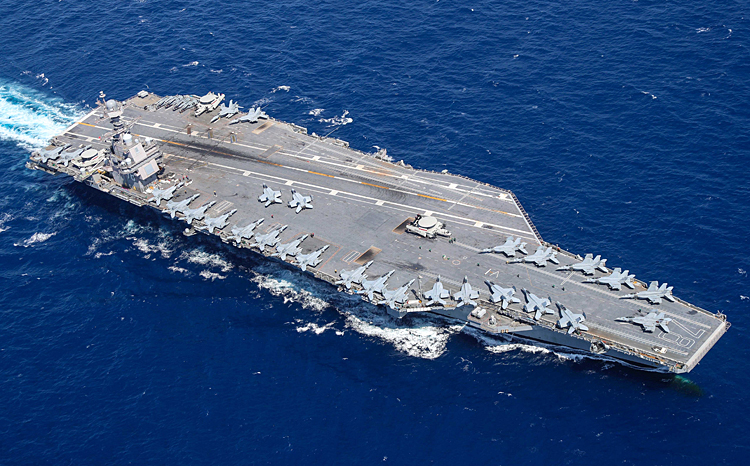
Pullout of America's two carrier groups, USS Gerald R. Ford and USS Abraham Lincoln, supporting the US-Israel war on Iran has generated considerable discussion on the internet. USS Gerald R. Ford was withdrawn from the Red Sea/Gulf region in March 2026 to undergo repairs in Souda Bay, Crete, following a major fire in its laundry facility that damaged living quarters and caused significant operational strain. It took more than 30 hours to extinguish the blaze that damaged sleeping berths for approximately 100 to 600 sailors, forcing many to sleep on floors or in temporary arrangements. The ship had been deployed for nearly 10 months, exceeding the US Navy's standard 6–8-month deployment plan, leading to extreme crew exhaustion and reduced morale. The ship faced persistent, long-standing problems with its Vacuum Collection, Holding and Transfer (VCHT) sewage system, resulting in clogged toilets and unsanitary conditions. The US Navy is investigating the official cause of the fire, which originated in a laundry dryer vent; whether the fire was deliberately started by crew members to force a, break from operations. The investigation follows a similar incident in 2020 where a sailor was accused of starting a fire on the USS Bonhomme Richard due to resentment.
The argument says Investment should shift towards more effective force multipliers rather than high-cost, vulnerable surface platforms like carriers
Iran's Islamic Revolutionary Guard Corps (IRGC) claimed that in March 2026, it struck the USS Abraham Lincoln with ballistic missiles and drones in the Gulf/Sea of Oman, causing significant damage and forcing the carrier to withdraw from the region. The US Central Command, (CENTCOM) has denied any damage to the ship, claiming its repositioning in the Arabian Sea was to stay out of range of Iranian drone swarms.
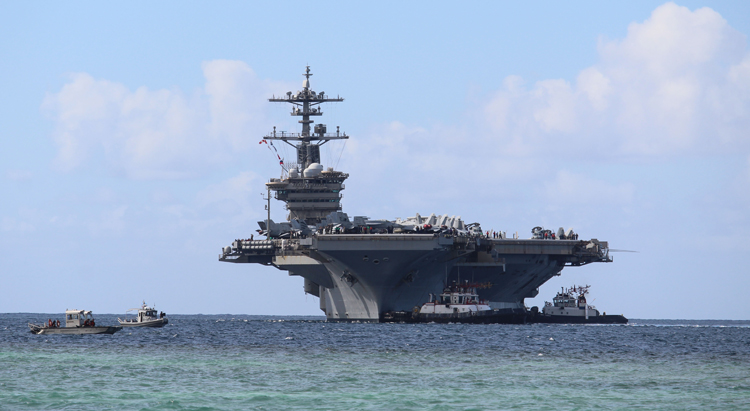
It may be recalled that in May 2025, USS Harry S. Truman withdrew from the Red Sea after Houthi targeted the carrier with drones and missiles and the carrier taking evasive manoeuvres caused two fighter jets falling into the sea, albeit US officials admitted one F/A-18E Super Hornet fell overboard.
The argument favours increasing the fleet of submarines (both nuclear and conventional) to maintain a stealthy and lethal underwater force that can effectively disrupt enemy naval operations
In the backdrop of pullout of two US carriers from the Gulf/Red Sea region in the instant case, the debate is about aircraft carriers are becoming obsolete in modern warfare, characterised by increasing vulnerabilities to long-range missiles and advancements in underwater technology; and that investment should shift towards more effective force multipliers rather than high-cost, vulnerable surface platforms like carriers that become sitting ducks in high-intensity conflict against adversaries with advanced anti-access/area-denial (A2/AD) capabilities.
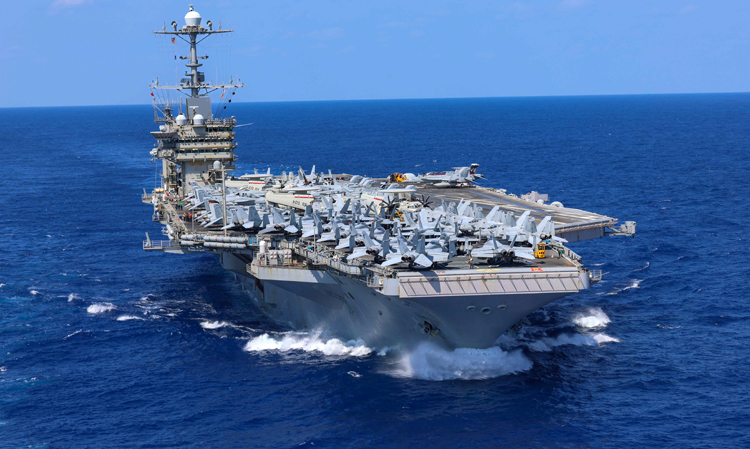
The extremely high cost of building and maintaining carriers, combined with long construction timelines, makes them an inefficient investment compared to submarines. The argument favours increasing the fleet of submarines (both nuclear and conventional) to maintain a stealthy and lethal underwater force that can effectively disrupt enemy naval operations. In the Indian context, development of advanced, long-range maritime strike missiles by adversaries makes operating surface ships in contested waters highly risky. The argument emphasises that in the Indian context, technological superiority is paramount for air dominance, which should be the priority, rather than relying on carrier-borne aircraft, which may not match land-based fighters in performance or numbers. It is being argued that if three US aircraft carriers with all powerful weapon systems cannot go near Hormuz, India must draw useful lessons from this. Gone are the days of gunboat diplomacy; where all the US aircraft carriers cannot get even one ship across the Straits of Hormuz into the Indian Ocean, so what is their use?
It is being argued that if three US aircraft carriers with all powerful weapon systems cannot go near Hormuz, India must draw useful lessons from this
In the above context, it must be acknowledged that the debate about carriers versus submarines is not new. India's underwater capabilities are far below what is required. Look at China, which gave priority to building its submarine and underwater capabilities before going in for aircraft carriers. But that does not render aircraft carriers redundant by any chance, citing the Hormuz choke point. Carriers are meant to project power at sea and combat/destroy the enemy, not open choke points. It is far easier to choke an area, like the Straits of Hormuz or Straits of Bab el Mandeb in the Red Sea if one is sitting astride the fighting littorals bordering it. In the case of India, China/Pakistan are not sitting astride the Straits of Malacca or the Straits of Hormuz.
There is no denying that Carrier Battle Groups (CBGs) are best for sea control thousands of km away from own shores
The requirement of aircraft carriers must be viewed in the backdrop of what extent of sea control is being sought. There is no denying that Carrier Battle Groups (CBGs) are best for sea control thousands of km away from own shores. Will India need power projection capabilities beyond its immediate neighbourhood, then, including for guarding SLOCS – answer should be yes, in addition to coalitions, alliances, partnerships confronting China's aggressive moves. As part of RMA, China did go for massive infusion of submarines but is now concentrating on CBGs because submarines are good for sea denial, not sea control. Also, submarines cannot achieve three-dimensional control over a large expanse of ocean, far from one's shores.