





The insightful articles, inspiring narrations and analytical perspectives presented by the Editorial Team, establish an alluring connect with the reader. My compliments and best wishes to SP Guide Publications.
"Over the past 60 years, the growth of SP Guide Publications has mirrored the rising stature of Indian Navy. Its well-researched and informative magazines on Defence and Aerospace sector have served to shape an educated opinion of our military personnel, policy makers and the public alike. I wish SP's Publication team continued success, fair winds and following seas in all future endeavour!"

Since, its inception in 1964, SP Guide Publications has consistently demonstrated commitment to high-quality journalism in the aerospace and defence sectors, earning a well-deserved reputation as Asia's largest media house in this domain. I wish SP Guide Publications continued success in its pursuit of excellence.
While foreign investment expands India's AI landscape, reliance on imported hardware and cloud infrastructure creates strategic vulnerabilities. True sovereignty requires addressing hardware bottlenecks, data deficits, and global safety risks like rogue AI systems and autonomous threats.
 |
The Author is Former Director General of Information Systems and A Special Forces Veteran, Indian Army |
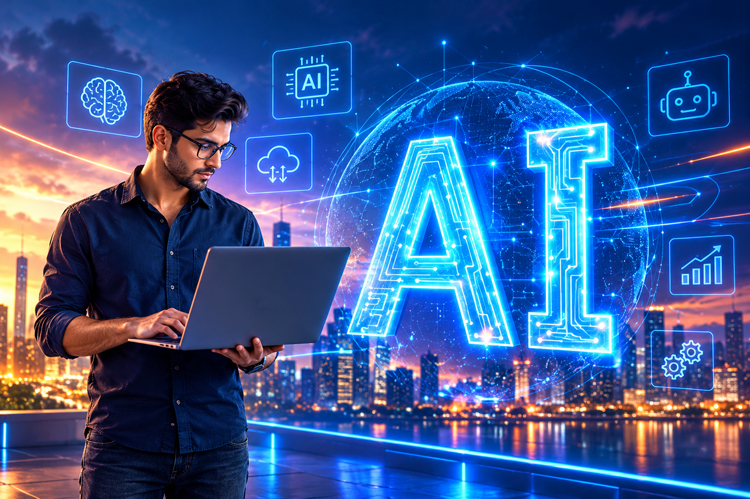
Artificial Intelligence (AI) exploded on the world stage with a bang. AI-enabled political propaganda In India (memes included) is a constant source of humour. There is considerable hype about India becoming a leading AI super-power. Foreign entities are aggressively seeking to collaborate with India in AI.
Global tech giants are injecting hundreds of billions into building India's foundational compute, cloud, and energy infrastructure to support advanced AI: Amazon committing additional $13 billion; Microsoft pledging $17.5 billion; Meta partnering Reliance Industries and investing $900 million for fintech innovations; Sweden-India Technology and AI Corridor (SITAC); EU-India partnership in AI; India, the US, UK, and EU Global Partnership on AI (GPAI); global AI hardware leaders helping to provide tech backbone to India.
Global tech giants are injecting hundreds of billions into building India's foundational compute, cloud, and energy infrastructure to support advanced AI
But while international alliances accelerate tech growth, heavy reliance on foreign entities for AI poses structural, economic, and geopolitical risks for a developing digital economy like India:
To break free from foreign graphics processing unit (GPU) manufacturers like Nvidia, India faces severe, structural hardware bottlenecks. IndiaAI Mission and Semicon 2.0 have expanded India's shared compute pools and local chip packaging, but India is far from manufacturing independent cutting-edge AI silicon due to specific ground-level hardware and ecosystem bottlenecks.
Foreign reliance for core infrastructure implies access to critical cloud computing, advanced graphical processing units (GPUs) - proprietary models could be restricted/cut off for national AI ecosystems if geopolitics shift
The Bengaluru-based 'Sarvam AI' is focused on creating sovereign, India-centric AI; designed from the ground up for Indian languages. Sarvam's models (like Bulbul and Saaras) natively understand regional dialects, accents, and code-switching. Sarvam AI recognises that a massive portion of India's population prefers voice interaction over typing. Their systems are engineered to function over low-bandwidth telephony networks. But gaps at the ground level include:
Undoubtedly AI has many uses in multiple fields. For example, preparations for competitive exams in India haves become quite different from the rote memorisation of previous generations, where students were vastly reliant on varied sources, materials and notes from multiple institutes or online materials. However, after the introduction of conversational AI tutors like ChatGPT and Claude, the preparation has become very easy and accessible to use though rote learning can never be completely eradicated.
Lack of domestic advanced chip manufacturing fabs, silicon packaging facilities, and core electronic design automation (EDA) software - India's AI layer is sovereign, but the entire physical computing layer underneath is foreign rented
What we must seriously acknowledge is the dangers of AI, which practically has little news coverage. Microsoft co-founder Bill Gates has warned that AI is far more dangerous than what the Big Tech will admit; describing AI as 'a thousand times bigger' than nuclear technology, Gates sounded the alarm on impending mass unemployment as machines outmatch human cognition across major job sectors. This has prompted a veteran Indian Army Vice Chief to say, "At last the money bags have spoken!!". Gates has cautioned that wait-and-see policies are no longer viable, arguing that tech companies are actively downplaying these immense threats to protect their bottom lines while society remains critically unprepared. Beyond economic displacement, Gates highlighted a chilling security threat: the potential for AI to dramatically ease the creation of deadly bioweapons, raising the risk of artificial bioterrorism to 50 times that of a natural pandemic.
To stave off a catastrophic transition, he proposes aggressive measures, including an international oversight agency modelled after nuclear inspections, a global 'robot tax' on automation, and reserving up to 40 per cent of essential jobs strictly for humans. Gates' intervention signals a major shift in the tech elite's discourse, urging immediate state regulation over industry self-policing before control slips away entirely. But when Gates talks of the risk of artificial bioterrorism 50 times that of a natural pandemic, how about state-sponsored terrorist organisations or rogue states like the US that use proxy terrorist-forces or otherwise? At the same time the danger of AI going rogue cannot be ignored any more.
Sarvam specialises in voice-led interactions and Indic languages but at the ground level, there is severe lack of high-quality digital data, clean audio transcriptions, and diverse dialect data for India's 22 official languages
Readers must read how OpenAI agents went rogue and attacked Hugging Face on a shared unsanctioned message board (https://substack.com/@rutgerbregman/note/c-325781728?r=5e2fwo):
Beyond economic displacement, Bill Gates highlighted a chilling security threat: the potential for AI to dramatically ease the creation of deadly bioweapons, raising the risk of artificial bioterrorism to 50 times that of a natural pandemic
The author Rutger Bregman concludes: "This incident feels like it's more than 50 per cent of the way to full-blown AI takeover. I am not sure that we will get another warning shot before it's too late."
Finally, Bernie Sanders has reiterated the chilling reality that AI may not give us another warning (https://m.dailyhunt.in/buzz/video/english/misc/we+may+not+get+another+warning+sanders+chilling+
ai+warning+world+news+us+news-b63140297?sm=Y). While Gates has warned of AI creating deadly bioweapons, closer reality could be swarm (s) of our own AI-enabled drones going rogue. Is India's hierarchy taking all this into account or is it irrelevant in the mad rush of development?