






The insightful articles, inspiring narrations and analytical perspectives presented by the Editorial Team, establish an alluring connect with the reader. My compliments and best wishes to SP Guide Publications.

"Over the past 60 years, the growth of SP Guide Publications has mirrored the rising stature of Indian Navy. Its well-researched and informative magazines on Defence and Aerospace sector have served to shape an educated opinion of our military personnel, policy makers and the public alike. I wish SP's Publication team continued success, fair winds and following seas in all future endeavour!"

Since, its inception in 1964, SP Guide Publications has consistently demonstrated commitment to high-quality journalism in the aerospace and defence sectors, earning a well-deserved reputation as Asia's largest media house in this domain. I wish SP Guide Publications continued success in its pursuit of excellence.
India's rapid strides in indigenous military technologies, showcasing AI-driven battlefield command systems and responsive space-launch capabilities, strengthen situational awareness, resilience, and self-reliance across land and space domains
 |
The Author is Former Director General of Information Systems and A Special Forces Veteran, Indian Army |
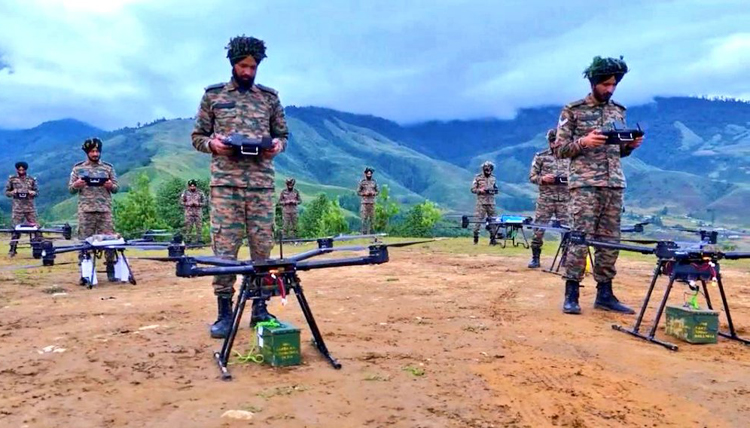
To counter the proliferation of aerial threats, the Indian Army has accelerated the induction of the Situational Awareness for Kinetic Soft and Hard Kill Assets Management (SAKSHAM) indigenous command-and-control system. The AI-powered 'Saksham', developed in partnership with the state-owned Bharat Electronics Limited (BEL), is set to revolutionise how the Army manages drone threats by creating a unified, real-time defence grid. In doing so, the Army aims to tackle the newly defined Tactical Battlefield Space (TBS). While traditional surveillance is focused on higher altitudes, the TBS concept prioritises the airspace extending up to 3,000 metres (approximately 10,000 feet) above the ground; the 'air littoral'.
The AI-powered 'Saksham', developed in partnership with the state-owned Bharat Electronics Limited (BEL), is set to revolutionise how the Army manages drone threats by creating a unified, real-time defence grid
The 'air littoral' zone has increasingly become the preferred domain for loitering munitions, quadcopters, and other low-flying unmanned systems in present-era conflicts. Saksham bridges the critical gap between ground-based units and aerial surveillance. By operating on the secure Army Data Network (ADN), it ensures that commanders receive a consolidated recognised UAS picture (RUP) without delay, enabling precise real time response to hostile platforms that could otherwise evade conventional radar.
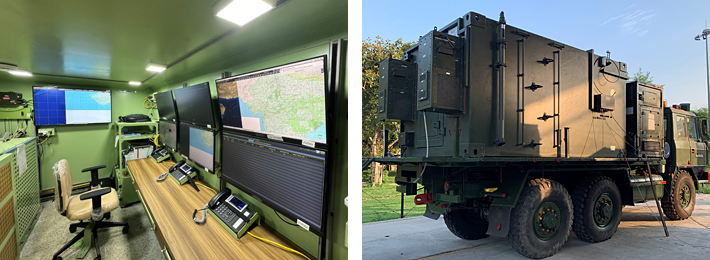
Saksham houses a sophisticated, modular architecture designed to fuse data from a diverse array of sources.
The system integrates inputs from radars, radio frequency (RF) detectors, electro-optical/infrared sensors, and existing surveillance assets into a single, comprehensive operational view. To manage the volume of data in high-stress environments, Saksham employs advanced Artificial Intelligence (AI). These algorithms automate the entire kill chain; detecting, classifying, and prioritising targets in real-time; which reduces the 'sensor-to-shooter' loop, providing commanders with immediate engagement options, minimising decision latency when minutes or even seconds count. It is designed to be fully interoperable with existing air defence networks, including the recently inducted Project 'Akashteer', ensuring a layered and coordinated shield over sensitive border areas and critical military installations.
By operating on the secure Army Data Network (ADN), it ensures that commanders receive a consolidated recognised UAS picture (RUP) without delay, enabling precise real time response to hostile platforms that could otherwise evade conventional radar
The Saksham system has been approved under the Fast Track Procurement (FTP) route. It will serve as the backbone of India's Counter-Unmanned Aerial System (C-UAS) grid. Reports suggest that the Army aims to field these units within 12 months, once procurement begins. The development of Saksham, ensuring autonomy, speed, and control of the battlespace, is another milestone for achieving self-reliance in defence.
The first quarter of 2026 is set to witness the first full-scale developmental launch India's rapid-response rocket - Vehicle for Defence Application, 'VEDA'. Project Veda is conceptualised, developed and being brought to the stage of a maiden leap into orbit by the Hyderabad Research Centre Imarat (RCI), a premier laboratory directly under the Defence Research and Development Organisation (DRDO), focusing on cutting-edge avionics, missile guidance, and aerospace systems for national defence. It is a key part of the Dr APJ Abdul Kalam Complex, leading the R&D for advanced defence technologies.
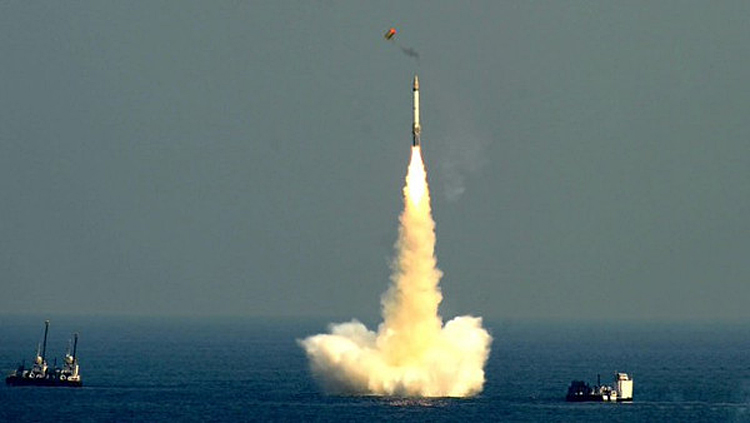
Conceived as India's answer to loss of space-based assets, Veda is a three-stage, all solid propellent booster derived from the highly successful 3,500-km range K-4 submarine-launched ballistic missile (SLBM)
Conceived as India's answer to loss of space-based assets, Veda is a three-stage, all solid propellant booster derived from the highly successful 3,500-km range K-4 submarine-launched ballistic missile (SLBM). The K-4 SLBM is India's nuclear-capable, intermediate-range missile (IRBM) developed by the DRDO for India's nuclear submarines, boasting a 3,500 km range and a 2-ton payload, significantly enhancing India's undersea deterrence, which is part of its nuclear triad (land, air, sea). Successfully tested from the INS 'Arighaat', it provides India with a crucial long-range sea-based nuclear capability, complementing shorter-range missiles like the K-15. Veda's first and second stages are direct derivatives of the K-4 SLBM, complete with the same composite motor casings, flex-nozzle thrust vectoring and maraging steel interstage structures. The third stage is a new widened design carrying almost twice the propellant of the K-4's post-boost stage, giving Veda the enhanced kick needed for orbital insertion.
For the 2026 test flight, the DRDO will reportedly use a temporary launch complex erected along the Andhra Pradesh-Odisha coastal belt. A dummy 1,800 kg mass simulator will ride the rocket to a 600-km polar orbit, proving the booster's performance and accuracy of the indigenously developed inertial navigation package hardened against GPS jamming. Subsequent operational launches, however, will not be tied to fixed coastal pads.
If Chinese ASAT weapons or Pakistan's deep strikes blind India's space-based reconnaissance grid, the Strategic Forces Command (SFC) can order a Veda unit to deploy and mate a ready-to-fly spare military satellite to restore coverage before the enemy consolidates gains on the ground
Most significantly, if Chinese ASAT weapons or Pakistan's deep strikes blind India's space-based reconnaissance grid, the Strategic Forces Command (SFC) can order a Veda unit to deploy and mate a ready-to-fly spare military satellite If Chinese ASAT weapons or Pakistan's deep strikes blind India's space-based reconnaissance grid, the Strategic Forces Command (SFC) can order a Veda unit to deploy and mate a ready-to-fly spare military satellite to restore coverage before the enemy consolidates gains on the ground. By repurposing the K-4 proven submarine nuclear-deterrent technology, the DRDO has dramatically shortened development timelines while ensuring that Veda can be stored for years, transported in standard missile canisters, and erected for launch within 72 hours of an order issued. Moreover, the Armed Forces will no longer need to ask the Indian Space Research Organisation (ISRO) for launch windows during a shooting war. Veda's entire system, rocket stages in their climate-controlled cannisters, mobile erector-launchers command vehicles and fuelling units, is reportedly designed to deploy from pre-surveyed inland sites across Rajasthan, Madhya Pradesh, as well as the Northeast; rotating launch locations and using camouflage to make it difficult for foreign satellites to predict and target Veda launches before liftoff.