




INDIAN ARMED FORCES CHIEFS ON OUR RELENTLESS AND FOCUSED PUBLISHING EFFORTS

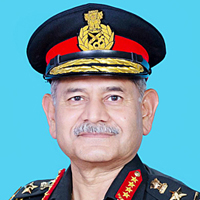
The insightful articles, inspiring narrations and analytical perspectives presented by the Editorial Team, establish an alluring connect with the reader. My compliments and best wishes to SP Guide Publications.

— General Upendra Dwivedi, Indian Army Chief

"Over the past 60 years, the growth of SP Guide Publications has mirrored the rising stature of Indian Navy. Its well-researched and informative magazines on Defence and Aerospace sector have served to shape an educated opinion of our military personnel, policy makers and the public alike. I wish SP's Publication team continued success, fair winds and following seas in all future endeavour!"

— Admiral Dinesh Kumar Tripathi, Indian Navy Chief

Since, its inception in 1964, SP Guide Publications has consistently demonstrated commitment to high-quality journalism in the aerospace and defence sectors, earning a well-deserved reputation as Asia's largest media house in this domain. I wish SP Guide Publications continued success in its pursuit of excellence.

— Air Chief Marshal A.P. Singh, Indian Air Force Chief


Quantum Mission Policy and AI

India is accelerating military modernisation through quantum technologies and artificial intelligence, centred on the new Military Quantum Mission Policy Framework
February 26, 2026 By Lt. General P.C. Katoch (Retd) Photo(s): By PIB, X / HQ_IDS_India, X / adgpi
The Author is Former Director General of Information Systems and A Special Forces Veteran, Indian Army


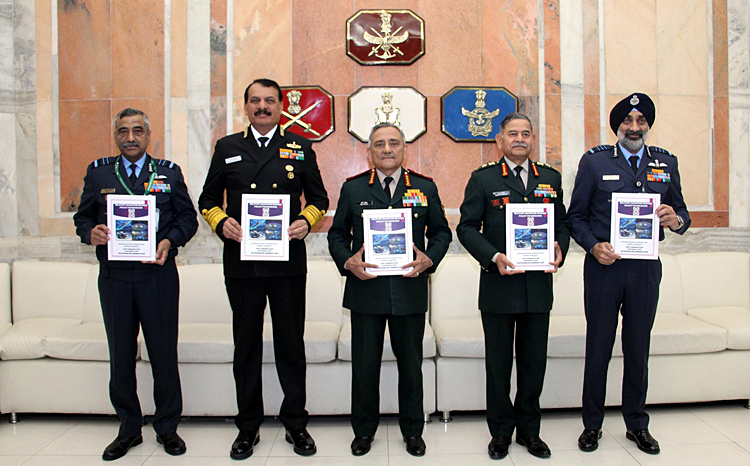
CHIEF OF DEFENCE STAFF GENERAL ANIL CHAUHAN (IN THE CENTRE) RELEASES MILITARY QUANTUM MISSION POLICY FRAMEWORK, ON JANUARY 22, 2026. ALSO PRESENT ON THE OCCASION WERE (FROM LEFT TO RIGHT) THE CHIEF OF THE INTEGRATED DEFENCE STAFF AIR MARSHAL ASHUTOSH DIXIT, THE CHIEF OF THE NAVAL STAFF ADMIRAL DINESH K. TRIPATHI, CHIEF OF THE ARMY STAFF GENERAL UPENDRA DWIVEDI AND CHIEF OF THE AIR STAFF AIR CHIEF MARSHAL A.P. SINGH.
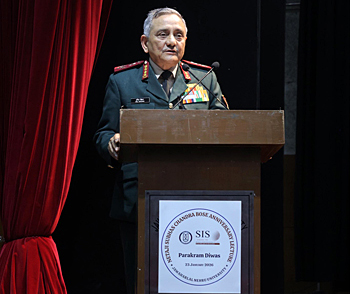
General Anil Chauhan CDS delivered the inaugural lecture commemorating Netaji Subhash Chandra Bose Jayanti at Jawaharlal Nehru University (JNU).

On January 22, 2026, the CDS General Anil Chauhan, released the Military Quantum Mission Policy Framework. Chief of the Naval Staff Admiral Dinesh K. Tripathi, Chief of the Army Staff General Upendra Dwivedi, Chief of the Air Staff Air Chief Marshal A.P. Singh and Chief of the Integrated Defence Staff Air Marshal Ashutosh Dixit were present on the occasion. The Framework aims to integrate the four pillars of Quantum technologies – Quantum Communication, Quantum Computing, Quantum Sensing & Metrology and Quantum Materials and Devices - into the Tri-Services to empower them to prepare for the future battlefield and to achieve technological dominance in the rapidly evolving world.

The Framework aims to integrate the four pillars of Quantum technologies – Quantum Communication, Quantum Computing, Quantum Sensing & Metrology and Quantum Materials and Devices - into the Tri-Services

The document aligns with the National Quantum Mission, defining the way ahead to achieve synergy in the amalgamation of quantum technologies, and formulates an indicative roadmap and policy for implementation of this niche field in the military. It will form the basis of incorporation cutting-edge quantum technology into the Armed Forces through synergised efforts of all three services. The document underscores the increasing need for the assimilation of these technologies from defence perspective and highlights the milestones and goals to be achieved by utilising civil-military fusion. It also highlights the critical need for jointness and integration in assimilating this technology to achieve technological supremacy in future battlefields.
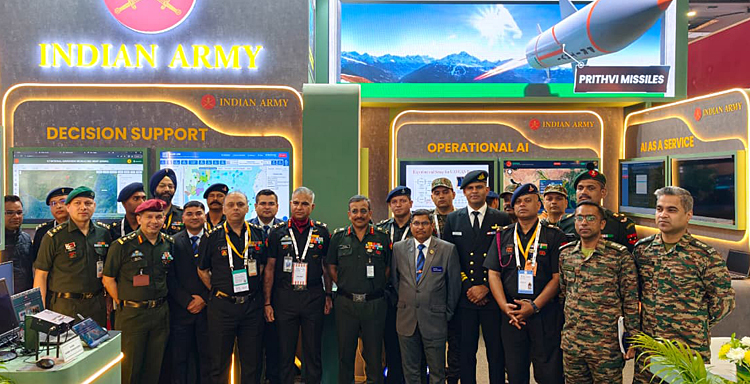
AT THE AI IMPACT SUMMIT, THE INDIAN ARMY'S PANEL ON "DEFENCE PERSPECTIVE IN AI" ATTRACTED A WIDE AUDIENCE, BRINGING TOGETHER MILITARY LEADERSHIP, INDUSTRY AND ACADEMIA FOR A FOCUSED DIALOGUE ON RESPONSIBLE AI IN DEFENCE.

Addressing the Jawahar Lal University later on January 24, 2026, General Chauhan said India today faces a fundamentally different set of security challenges driven by rapid technological disruption that is reshaping the nature of warfare. Linking complex threats to the rise of artificial intelligence (AI), cyber capabilities, big data and private technology companies, he said that technology today is defining strategy and war-winning strategy, and nations were fighting informal, proxy and hybrid wars rather that declared conflicts, adding that the world is witnessing great disruption (geopolitical, geo-economic and technological) with profound implications for the military.

The document aligns with the National Quantum Mission, defining the way ahead to achieve synergy in the amalgamation of quantum technologies, and formulates an indicative roadmap and policy for implementation of this niche field in the military

Referring to Operation 'Sindoor', General Chauhan noted that modern military operations increasingly relied on precision, speed and multi-domain integration rather than geography alone. He also warned of cognitive colonialism, with societies influenced and destabilised through information operations, narrative manipulation and psychological warfare enabled by AI, machine learning and data mining. "Traditional colonialism was led by trading companies. New colonialism (is) by multinational corporations. Cognitive colonialism will be ushered in by large IT and datamining companies," he said, cautioning that such disruptions could engineer social disorder without a single shot being fired. He stressed on self-reliance, military preparedness, anticipation of threats and societal resilience being essential to preserve India's sovereignty in an era where might is right and the rules-based global order is under strain.

The Indian Army has drawn up a detailed roadmap identifying key areas where it plans to deploy AI, machine learning and big data analytics by 2026–27
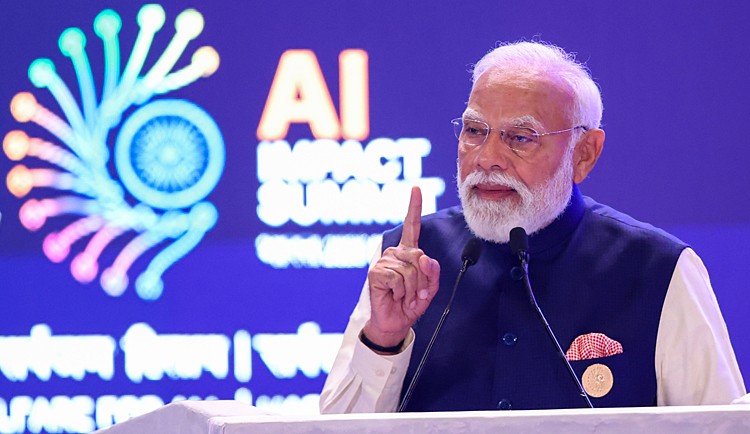
Prime Minister Narendra Modi addressing the gathering at the Opening Ceremony of India AI Impact Summit – 2026 at Bharat Mandapam, in New Delhi on February 19, 2026.

At the AI Impact Summit 2026 India, categories of equipment and technologies demonstrated by the Indian Army were those focusing on Artificial Intelligence, Drone and Related Systems, Mobility and Connectivity projects and force multipliers. The display included the following:

  • Artificial Intelligence for Better Ground Awareness - an AI-based satellite imagery analysis system that helps interpret satellite pictures quickly and accurately. Instead of manually studying images, the system uses artificial intelligence to identify changes, track developments and flag important observations. Developed with Indian startups and academic institutions, the technology supports better planning, monitoring and decision-making. It strengthens the Army's awareness and preparedness, and also supports civilian agencies in areas such as disaster monitoring, land management, agriculture assessment and infrastructure planning. development.
  • Portable AI System for Remote Areas – an "AI-in-a-Box" allows users to analyse information, plan tasks and receive decision support independently. Built to work in tough conditions, the system ensures that technology remains available even in remote locations. Developed with Indian research institutions and industry partners, it highlights how artificial intelligence can be adapted to Indian conditions rather than relying on imported solutions. The same technology can also support disaster relief teams and emergency planners working in isolated regions. It offers dual-use strategic capabilities, including intelligence automation, real-time situational awareness, vision-based inspection, logistics forecasting, process optimisation, and training simulations, making it a force multiplier for the Armed Forces as well as government agencies and critical national infrastructure.
  • Ekam AI –a fully indigenous and secure AI platform designed for sensitive environments. It enables users to analyse information, manage documents, and support decision-making without dependence on foreign software or external cloud systems. Built for ease of use, it allows personnel at different levels to leverage AI-enabled support without requiring specialised technical expertise. By ensuring complete data security and sovereignty, Ekam AI marks a significant step towards building trusted national digital systems.
  • AI-Driven Military Climatology & Disaster Prediction System - India's first hybrid military climatology decision-support system capable of predicting landslides, floods, and avalanches 3-7 days in advance using multi-agency scientific datasets, terrain intelligence, and AI/ML modelling. Developed through collaboration with national scientific agencies and MoES, it provides highly accurate, location-specific hazard forecasts for sensitive operational regions. It provides early warning capability for disaster management authorities, border area communities, infrastructure planners and emergency response agencies, strengthening national disaster resilience.
  • XFace - AI-powered identification and authentication system for rapid image and video-based verification to support installation security, surveillance and identity verification. Useful for law enforcement, airport security and missing-person identification.
  • Nabh Drishti - a distributed mobile-enabled telemetry reporting system capturing positional data, imagery, orientation parameters and time-stamped observations, processed through an AI backend for real-time visualisation. Enables rapid reporting and coordinated response in operational environments. Also supports disaster reporting, environmental monitoring, and emergency search coordination by citizens.
  • Driver Fatigue Detection - portable rugged AI device that detects driver drowsiness in real time and generates alerts, functioning reliably in darkness, rough terrain and long driving conditions.
  • AI-in-a-Box (Portable Edge AI Platform) – a compact deployable high compute platform capable of running AI models locally in secure or disconnected environments. Enables AI deployment in remote or classified operational zones. Useful for remote hospitals, rural administration centres, industrial automation sites and disaster-affected regions.
  • Vehicle Tracking System - an AI-enabled fleet monitoring system combining GPS telemetry, analytics, and real-time dashboards. Supports convoy monitoring, logistics visibility and route optimisation.
  • Deepfake Video Detection System - an AI system that detects synthetic or manipulated media using advanced facial and signal-pattern analysis to counter information warfare and false narratives.
  • Proactive Mobile Security System – an AI-driven mobile protection solution identifying abnormal behaviour, malware threats and suspicious data transmission patterns. Strengthens endpoint security for operational communications. Supports enterprise device security, banking protection, and institutional cybersecurity frameworks.
  • Machine Learning Based Web Application Firewall - adaptive AI firewall detecting SQL injection cross-site scripting, bot attacks, API abuse and emerging cyber threats in real time to protect critical digital infrastructure from cyber warfare attacks. Secured banking, healthcare, e-commerce, and citizen service platforms can be secured with this application.

AI will be used to analyse feeds from drones, satellites, aircraft and ground sensors, and fuse data in real time to support faster, more informed decision-making

The Indian Army has drawn up a detailed roadmap identifying key areas where it plans to deploy AI, machine learning and big data analytics by 2026–27. These include text summarisers built on Large Language Models (LLMs) to scan and condense long reports, AI-powered chatbots, voice-to-text systems, facial recognition, and tools that can detect unusual patterns or threats. AI will be used to analyse feeds from drones, satellites, aircraft and ground sensors, and fuse data in real time to support faster, more informed decision-making.