





The insightful articles, inspiring narrations and analytical perspectives presented by the Editorial Team, establish an alluring connect with the reader. My compliments and best wishes to SP Guide Publications.
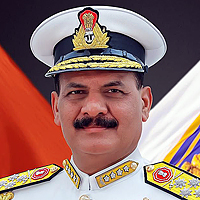
"Over the past 60 years, the growth of SP Guide Publications has mirrored the rising stature of Indian Navy. Its well-researched and informative magazines on Defence and Aerospace sector have served to shape an educated opinion of our military personnel, policy makers and the public alike. I wish SP's Publication team continued success, fair winds and following seas in all future endeavour!"

Since, its inception in 1964, SP Guide Publications has consistently demonstrated commitment to high-quality journalism in the aerospace and defence sectors, earning a well-deserved reputation as Asia's largest media house in this domain. I wish SP Guide Publications continued success in its pursuit of excellence.
The Indian Navy is accelerating its indigenous modernisation drive with new warships, submarines, carrier aviation and unmanned platforms. The planned induction of INS Arisudan, together with an expanding fleet of indigenous combat vessels, reflects India's growing emphasis on maritime self-reliance and strategic deterrence.
 |
The Author is Former Director General of Information Systems and A Special Forces Veteran, Indian Army |
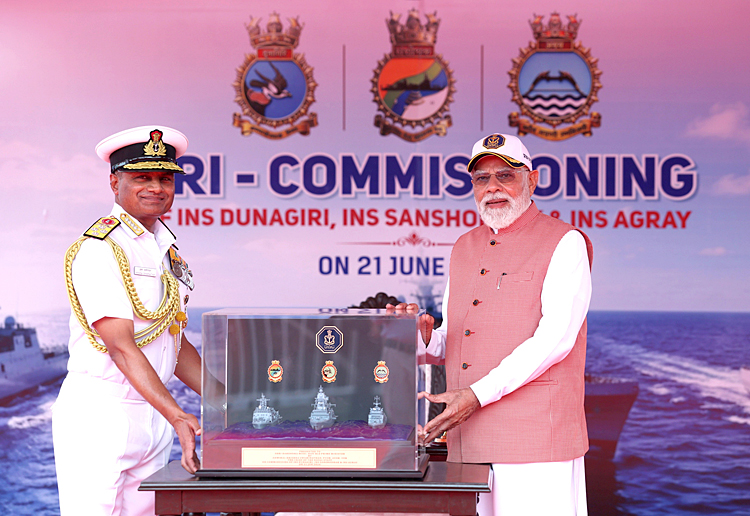
During the period May–June 2026, the Indian Navy inducted or initiated commissioning processes for multiple indigenous platforms, focused mainly on enhancing anti-submarine warfare (ASW) and hydrographic capabilities. These vessels, built in domestic shipyards such as Garden Reach Shipbuilders & Engineers (GRSE), Mazagon Dock Shipbuilders Limited (MDL) and Cochin Shipyard Limited (CSL), included the following:
The Navy plans to incorporate up to 20 long-endurance unmanned undersea platforms for ASW by 2040
The Indian Navy is adding a new indigenous vessel approximately every 40 days to bolster operational reach in the Indian Ocean Region (IOR), highlighting India's ongoing Atmanirbhar Bharat (self-reliance) initiative in defence.
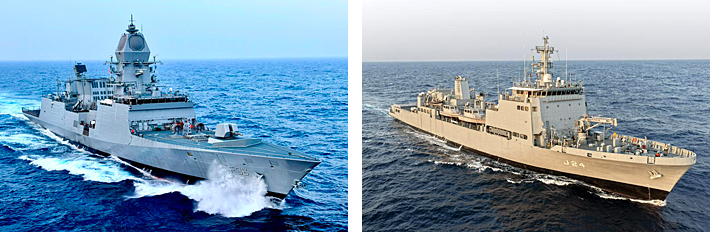
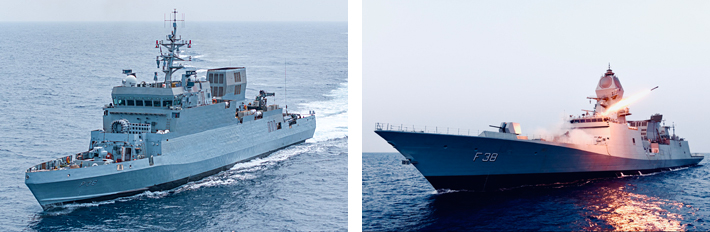
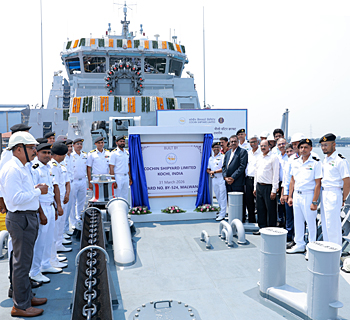
Future expansion plans of the Indian Navy aim to build a 200-vessel force indigenously by 2035. The Navy's modernisation efforts are focused on expanding its submarine fleet, commissioning another aircraft carrier, inducting 26 Rafale M fighter aircraft by 2030, and deploying advanced long-range unmanned aerial vehicles for surveillance. The Navy currently operates around 150 warships, with more than 45 vessels under construction. The ultimate target is to build a fleet of 150–160 warships by 2030, expanding to more than 200 vessels by 2035. The Navy is planning to acquire additional large indigenous aircraft carriers to shift to Catapult-Assisted Take-Off But Arrested Recovery (CATOBAR) systems.
Arisudan is the fourth and final Arihant-class nuclear-powered ballistic missile submarine planned
Under Project 18 for next-generation destroyers, the Navy is planning a major leap in naval firepower, with 10,000-tonne next-generation stealth destroyers expected by the mid-2030s. In April 2025, the Navy signed a deal for 26 Dassault Rafale M fighter aircraft for its aircraft carriers, with deliveries expected to conclude by 2030. The Indian Naval Aviation Technology Roadmap 2047, released recently, reveals plans to build a 400-aircraft fleet. This will feature fifth-generation twin-engine deck-based fighters, airborne early warning and control aircraft, and a heavy focus on uncrewed/remotely piloted systems.
Under Project-75(I), the conventional submarine fleet is being bolstered with indigenous Air-Independent Propulsion (AIP) to strengthen sea-denial roles. Additional nuclear-powered ballistic missile submarines (SSBNs) are in the pipeline to reinforce the underwater nuclear triad, and the Navy plans to incorporate up to 20 long-endurance unmanned undersea platforms for anti-submarine warfare (ASW) by 2040.
The submarine features a high indigenous content, reportedly between 80 and 90 per cent
Notably, India has launched its fourth Arihant-class nuclear-powered ballistic missile submarine, designated S4*, which is expected to be commissioned into the Indian Navy around 2027 as INS 'Arisudan', according to reports dated May 21, 2026. Arisudan means "Slayer of Enemies"—the same naming convention as its predecessors INS 'Arihant', INS 'Arighat' and INS 'Aridhaman'. Built under the Advanced Technology Vessel (ATV) project at the Ship Building Centre (SBC) in Visakhapatnam, Andhra Pradesh, Arisudan was launched in October 2024 and is presently undergoing rigorous sea trials.
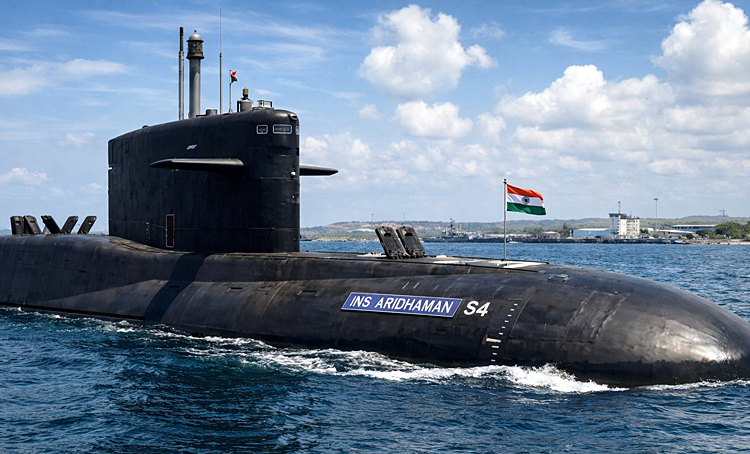
Arisudan is the fourth and final Arihant-class nuclear-powered ballistic missile submarine planned. It is a stretched version of the Arihant-class design, with enhanced capabilities, including the capacity to carry more K-4 submarine-launched ballistic missiles (SLBMs), offering greater strike range and endurance for extended patrols. The submarine features a high indigenous content, reportedly between 80 and 90 per cent, showcasing India's growing self-reliance in critical defence technologies.
Arisudan will serve as a stealthy, survivable second-strike platform to significantly strengthen India's strategic nuclear triad
Key capabilities and features of Arisudan, which will serve as a stealthy, survivable second-strike platform to significantly strengthen India's strategic nuclear triad, include:
Arisudan will serve as a bridge to the more advanced S5-class SSBNs currently under development
The targeted induction of Arisudan into the Indian Navy will enable the service to field four Arihant-class submarines in various stages of readiness, strengthening underwater strategic capabilities amid evolving regional security challenges. Moreover, Arisudan will serve as a bridge to the more advanced S5-class SSBNs currently under development. With more than 80 per cent indigenous content, the programme not only enhances national security but also positions India as a significant player in advanced naval technologies.
In a recent report, the Stockholm International Peace Research Institute (SIPRI) stated that India has deployed at least 12 nuclear warheads and may have started deploying a small number of nuclear warheads aboard a single SSBN conducting occasional patrols. But what else is India supposed to do with its 'No First Use' policy, facing mounting regional threats (with China and Pakistan compressing the sensor-decision-shooter chain after Operation 'Sindoor'), global geopolitical convulsions, the US-Israel war on Iran, and various ongoing conflicts that are destabilising regions?