





The insightful articles, inspiring narrations and analytical perspectives presented by the Editorial Team, establish an alluring connect with the reader. My compliments and best wishes to SP Guide Publications.
"Over the past 60 years, the growth of SP Guide Publications has mirrored the rising stature of Indian Navy. Its well-researched and informative magazines on Defence and Aerospace sector have served to shape an educated opinion of our military personnel, policy makers and the public alike. I wish SP's Publication team continued success, fair winds and following seas in all future endeavour!"

Since, its inception in 1964, SP Guide Publications has consistently demonstrated commitment to high-quality journalism in the aerospace and defence sectors, earning a well-deserved reputation as Asia's largest media house in this domain. I wish SP Guide Publications continued success in its pursuit of excellence.
The proposed $8 billion Project-75(I) submarine deal between India and Germany remains unsigned despite advanced negotiations
 |
The Author is Former Director General of Information Systems and A Special Forces Veteran, Indian Army |
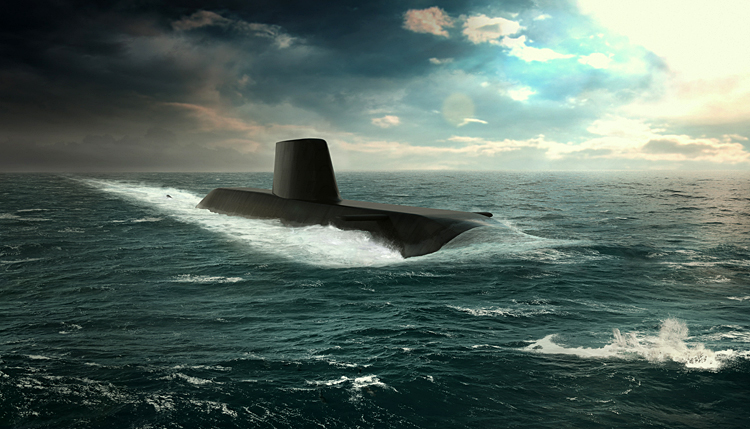
Before the maiden visit of German Chancellor Friedrich Merz's to India on January 12-13, 2026, a report of January 8, stated that Germany and India are likely set to sign a major defence deal worth over $8 billion, and that this agreement will see German technology transferred for submarine production in India, marking a boost India's naval capabilities. The report, quoting sources who asked not to be named discussing confidential information, said that the agreement, negotiated ahead of Merz's visit, would for the first time include technology transfer for submarine production, and if the deal comes through, India would scrap plans to buy three more French submarines. The report further said that Germany's ThyssenKrupp Marine Systems (TKMS) and India's state-owned Mazagon Dock Shipbuilders Ltd (MDL) will work together to manufacture the vessels, said the sources, and that the new submarines will be equipped with air-independent propulsion (AIP) systems, which increase the boats' endurance and allows them to remain submerged longer than with diesel-electric propulsion.
Another report said that India and Germany are finalising a significant $8 billion deal (Project-75(I)) for Germany's ThyssenKrupp Marine Systems (TKMS) to build six advanced, Air-Independent Propulsion (AIP) equipped Type-214NG submarines in India, marking a major boost to India's naval strength, domestic defence manufacturing, and strategic partnership with Germany, with the deal expected to be formalised during Chancellor Friedrich Merz's visit in January 2026.
India and Germany have not yet signed the final contract for the six advanced submarines under the Project-75(I) programme, but negotiations have reached an advanced stage
It may be noted that these submarines are part of Project-75(I) and procurement of six submarines under Project-75(I) was approved by the Defence Acquisition Council, headed by the then Defence Minister Arun Jaitley in October 2014.
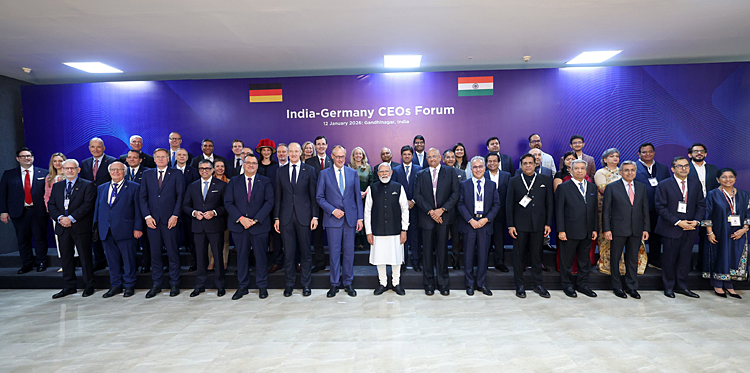
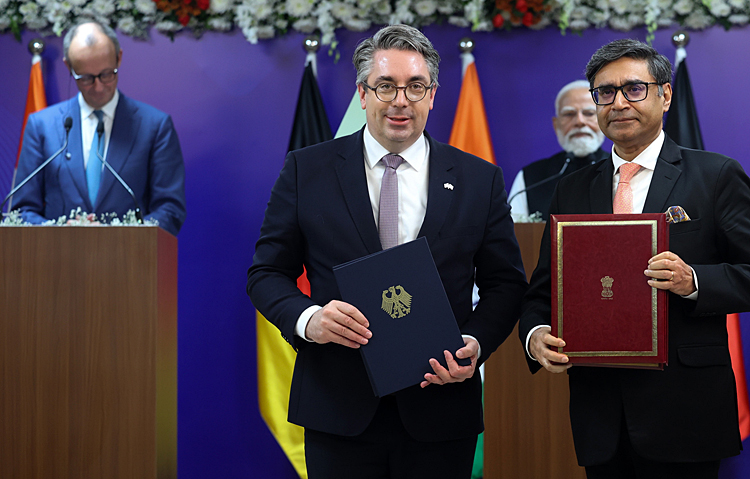
During Merz's visit, India and Germany signed 19 memorandums of understanding (MoUs) and a Joint Statement was also issued, on defence co-production, critical tech (semiconductors, minerals), green energy (hydrogen), economic cooperation (CEO forum), healthcare (traditional medicine), and skill development, alongside agreements for hockey, education, and urban heritage projects to boost strategic ties and secure supply chains.
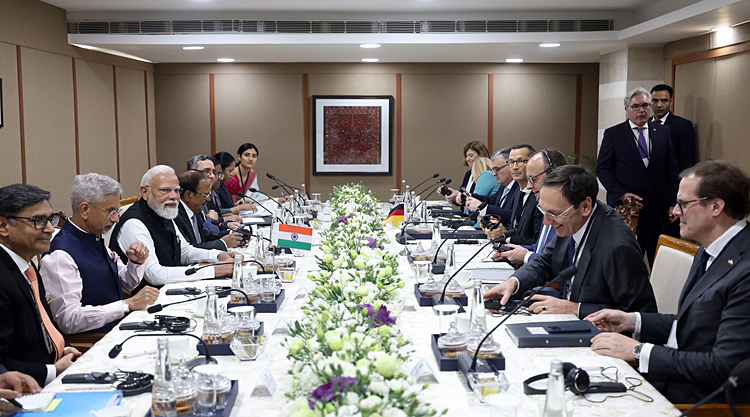
It is not known whether a MoU was signed on Indo-German collaboration for submarine production under 'Make in India', but there is no such mention in the Joint Statement during Merz's visit. Prime Minister Narendra Modi also did not mention co-production of submarines in his speech. Subsequent news reports, after the visit of Merz have said that India and Germany have not yet signed the final contract for the six advanced submarines under the Project-75(I) programme, but negotiations have reached an advanced stage. The deal is expected to be finalised by March 2026. It states that the submarines will be based on the German Type-214 Next Generation (214NG) design and feature Air-Independent Propulsion (AIP) technology, which allows them to stay submerged for up to three weeks. Under 'Make in India', indigenous content is expected to start at 45 per cent and rise to 60 per cent for the final units.
The submarines will be based on the German Type-214 Next Generation (214NG) design and feature Air-Independent Propulsion (AIP) technology, which allows them to stay submerged for up to three weeks
According to an article in Eurasia Times, TKMS, which had initially declined to bid for Project-75(I), entered the competition after the German government backed the project. It is intriguing that India, having built four SSBNs and currently building two SSNs (with a total of six SSNs planned), still needs to acquire Submersible Ship Hunter-Killer (SSKs) from Germany, especially after already inducting seven Scorpene-class SSKs with technology transfer from France. It points out possibilities that SSBNs and SSNs are being built in India with foreign assistance, assemblies, equipment, and materials without real technology transfer, and despite trumpeting the Atmanirbhar Bharat (self-reliance) mantra, the Government of India continues to use defence procurement as a geopolitical ingratiation tool.
Though the Indian Navy had initially stipulated that only operational submarine designs would be considered under Project-75(I), TKMS has proposed a submarine based on its Type 214 design, incorporating specific modifications for the Indian Navy, such as enhanced stealth and AIP. Since, TKMS is not offering a fully operational, off-the-shelf design, possibility of delays runs counter to the objective of fast-paced procurement, although TKMS successfully demonstrated the AIP capability on its Type 212 submarine during evaluation.
Under 'Make in India', indigenous content is expected to start at 45 per cent and rise to 60 per cent for the final units.
The blame for delaying Project-75(I) was primarily on the Indian Navy drafted qualitative requirements (QRs) which were very ambitious. Had the Indian Navy set realistic qualitative requirements at the outset, Larsen and Toubro (L&T), armed with SSN-building experience, could have built what the Navy is now buying from TKMS, filling gaps through partners of its own choosing. To a certain extent this may be true but the draft QRs of the Navy should be seen in context of the polity crying hoarse about achieving 100 per cent Atmanirbhar Bharat and the Ministry of Defence (MoD) with a Chief of Defence Staff (CDS) heading the Directorate of Military Affairs (DMA) not expected to scrutinize such issues (especially ones related to national security like this one).
At the same time, can we discount other factors that may not be very apparent? In mid-1997, the then Chief of Naval Staff, Admiral Vishnu Bhagwat had voiced that he is likely to be sacked; which he unceremoniously was in December 1998, not even allowing him to meet the President, the Supreme Commander of Armed Forces. The reason given by Admiral Bhagwat was that he wanted to promote submarine collaboration with South Korea, which was advanced in this technology. But the bureaucracy was wanting collaboration with Germany – for obvious reasons? For that matter, a view is that Hindustan Aeronautics Limited (HAL) deliberately "goofed up" (read delayed) the Tejas Mk-2 project in order to facilitate import of more fighter jets. This may or may not be true but the existence of "wheels within wheels" in the government machinery is a known fact.