





The insightful articles, inspiring narrations and analytical perspectives presented by the Editorial Team, establish an alluring connect with the reader. My compliments and best wishes to SP Guide Publications.
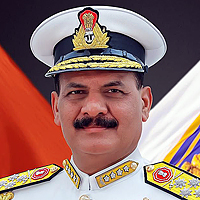
"Over the past 60 years, the growth of SP Guide Publications has mirrored the rising stature of Indian Navy. Its well-researched and informative magazines on Defence and Aerospace sector have served to shape an educated opinion of our military personnel, policy makers and the public alike. I wish SP's Publication team continued success, fair winds and following seas in all future endeavour!"

Since, its inception in 1964, SP Guide Publications has consistently demonstrated commitment to high-quality journalism in the aerospace and defence sectors, earning a well-deserved reputation as Asia's largest media house in this domain. I wish SP Guide Publications continued success in its pursuit of excellence.
India's successful K-4 IRBM test from an SSBN in the Bay of Bengal marks a decisive shift in its nuclear deterrence, reinforcing credible second-strike capability amid rising Chinese and great-power naval activity in the eastern maritime theatre
 |
The Author is Former Director General of Information Systems and A Special Forces Veteran, Indian Army |
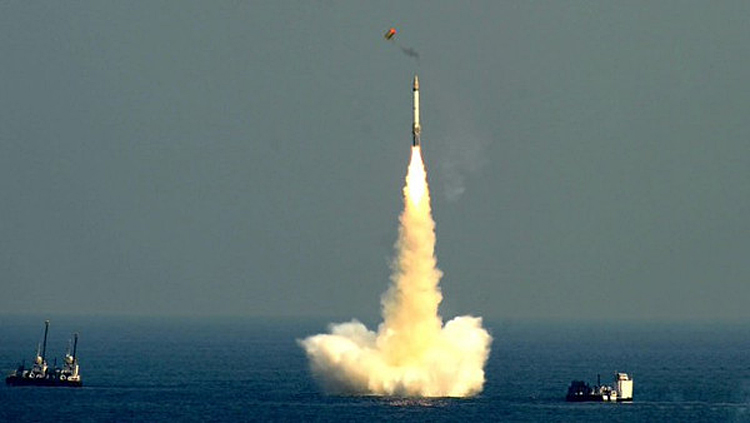
On December 23, 2025, India successfully tested the K-4 intermediate-range ballistic missile (IRBM) from INS 'Arighaat' in the Bay of Bengal. This marked a qualitative shift in India's nuclear deterrent posture. It validated the full integration of the missile, submarine and command-and-control architecture, moving India's sea-based deterrent from a developmental phase to one that is operationally credible. With an approximate range of 3,500-km, the K-4 substantially extends India's second-strike reach, allowing targeting flexibility deep into the Indo-Pacific while keeping launch platforms in relatively secure bastions. With India's stated policy of 'No First Use', successful testing of the K-4 IRBM was officially described as a routine exercise focused on readiness and reliability, not as a response to any specific contingency, but as a measure to reinforce assured retaliation and the credibility of India's nuclear doctrine.
Periodic reports of the sighting of a Chinese research vessel, operating with its Automatic Identification System switched off near Indian waters, have heightened Indian concerns over covert mapping of the seabed, surveillance and possible preparation of undersea operating areas. The People's Liberation Army Navy has also expanded its operational footprint through flotillas transiting the Andaman Sea and skirting the Bay of Bengal. Chinese naval survey ships, intelligence-gathering vessels and submarines have appeared with mounting frequency, often under the guise of research or goodwill missions.
The successful test of the K-4 intermediate-range ballistic missile (IRBM) validated the full integration of the missile, submarine and command-and-control architecture, moving India's sea-based deterrent from a developmental phase to one that is operationally credible
With the regime change in Bangladesh, its extreme radicalization and anti-India posture, movement of Peoples' liberation Army Navy LA Navy (PLAN) and Pakistani ships to Bangladesh are also transiting the Bay of Bengal. These deployments, typically covered in terms like search-and-rescue drills or escort training exercises under banners such as 'Peace and Friendship 2025', indicate normalisation of Chinese naval presence in proximity to India's eastern maritime approaches. In addition are the Coco Islands, located close to India's Andaman and Nicobar archipelago that India gifted to Myanmar, and is suspected of having Chinese presence, although Beijing denies the same. However, upgraded airstrips, jetties and communications infrastructure areas are seen in these islands, amid China's deepening involvement in Myanmar. China is also developing a deep-water facility as part of its Kyaukphyu Port project in Myanmar (similar to the deep-water port at Gwadar in Pakistan), which may also see PLA deployment in Myanmar in times to come.
In addition to the above, America's Donald Trump administration is seeking to establish a naval base in Bangladesh (St. Martin's Island), ostensibly under the cover for use by QUAD and America's allies. America's interest in Myanmar has also deepened with Trump's focus on rare earth minerals in that country. And, Trump's anti-India stance is more than visible. All these activities contribute to an evolving pattern in which the Bay of Bengal is no longer a peripheral body of water, but an active arena for strategic signalling and presence operations; increasingly become a theatre of great-power competition and undersea activity.
The Bay of Bengal is no longer a peripheral body of water, but an active arena for strategic signalling and presence operations; increasingly become a theatre of great-power competition and undersea activity
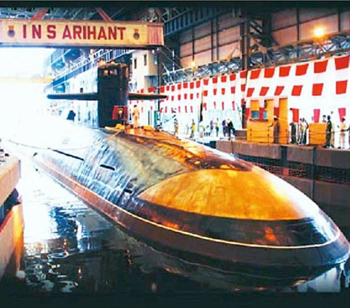
In the above backdrop, India's successful K-4 IRBM test indicates the geographic rebalancing of India's deterrence posture from the western land front to the eastern maritime theatre; while Historically, Indian strategic planning concentrated on continental threats, with the Bay of Bengal perceived primarily as a commercial and connectivity space. The deployment of K-4-armed SSBNs from the Bay of Bengal fundamentally recalibrates India's deterrence geometry. By enabling secure second-strike capabilities from relatively protected eastern bastions, India reduces its dependence on land-based and western-facing assets and introduces a distributed, less vulnerable deterrent posture. Basing the ballistic missile submarine fleet on the eastern seaboard, using the Bay of Bengal as a principal operating area, denotes a well-though and deliberate strategic decision.
In 2018, Admiral Aun Prakash, former Chief of the Naval Staff and Chairman of Chiefs of Staff Committee (COSC), wrote that the missile range of the Arihant-class submarines is not sufficient to target potential adversaries of India, and that a missile with a range of around 6,000-8,000 km would be required for this task to be performed by a submarine patrolling in a "safe haven". When the missile payload limitations of the Arihant-class were realised, India began developing the S5-class of submarines and the K-6 ballistic missiles.
The deployment of K-4-armed SSBNs from the Bay of Bengal fundamentally recalibrates India's deterrence geometry
The development of the K-6 missile, with a range of 6,000 km, was initially reported in early 2017; the development work started in February 2017 at the Advanced Systems Laboratory of the Defence Research and Development Organisation (DRDO), with a completion target of less than ten years. K-6 is an intercontinental ballistic missile (ICBM) with a planned range of more than 8,000-km.
It is a three-stage, solid fuel missile, a length of over 12 metres and a diameter of over 2 metres. With a range of 8,000-12,000 km and a three tonne payload, it is planned to be armed with four multiple independently targetable re-entry vehicles (MIRVs). The K-6 will be able to carry both conventional and nuclear warheads. India is expected to conduct the first underwater launch trials for the K-5 SLBM in 2026, following successful static tests of its crucial Stage-2 rocket motor in late 2025. The K-5's development is reportedly progressing towards full-scale flight tests from platforms like the Arihant-class submarine. Successful testing of the K-5 SLBM will help expedite development of the K-6 ICBM.