





The insightful articles, inspiring narrations and analytical perspectives presented by the Editorial Team, establish an alluring connect with the reader. My compliments and best wishes to SP Guide Publications.

"Over the past 60 years, the growth of SP Guide Publications has mirrored the rising stature of Indian Navy. Its well-researched and informative magazines on Defence and Aerospace sector have served to shape an educated opinion of our military personnel, policy makers and the public alike. I wish SP's Publication team continued success, fair winds and following seas in all future endeavour!"

Since, its inception in 1964, SP Guide Publications has consistently demonstrated commitment to high-quality journalism in the aerospace and defence sectors, earning a well-deserved reputation as Asia's largest media house in this domain. I wish SP Guide Publications continued success in its pursuit of excellence.
The long-awaited Project-75(I) submarine agreement between India and Germany could be finalised in the next couple of months within 2026
 |
The Author is Former Director General of Information Systems and A Special Forces Veteran, Indian Army |
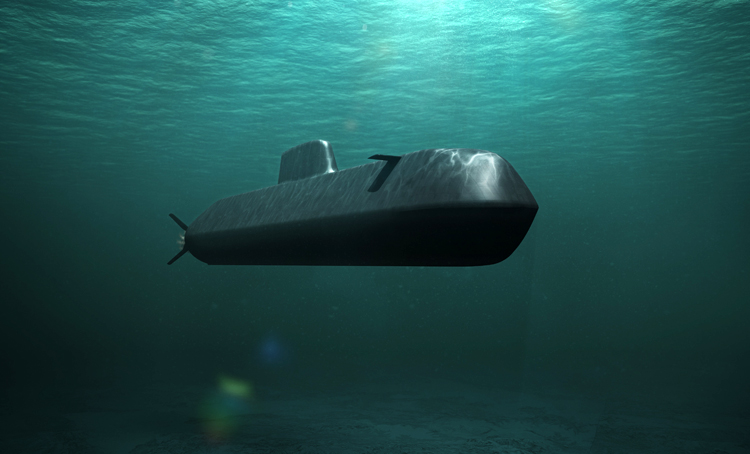
The Indo-German over ₹90,000 crore (€8 billion) contract to build six advanced, stealth-enhanced conventional submarines under Project-75(I) has reached its final stages, according to recent news reports. These submarines are to be built with collaboration between Germany's ThyssenKrupp Marine Systems (TKMS) and India's Mazagon Dock Shipbuilders (MDL). The six submarines will be constructed domestically in Mumbai with major technology transfers.
The over ₹90,000 crore (€8 billion) contract to build six advanced, stealth-enhanced conventional submarines in India—jointly by Germany's TKMS and Mazagon Dock Shipbuilders (MDL)—is in its final stages
The German Type 214 submarine design will form the basis of this project. This collaboration aims to strengthen the Indian Navy's underwater capabilities significantly. The deal is expected to be finalized in the coming weeks. Key technology of the submarines will feature fuel-cell-based Air-Independent Propulsion (AIP) for extended submerged endurance. Speaking on the sidelines of an industry event organised by the Indo-German Chamber of Commerce (IGCC), German Ambassador to India Philipp Ackermann has expressed confidence that the long-awaited Project-75(I) submarine agreement could be finalised as early as next month- September 2026.
Developed by Germany's Howaldtswerke-Deutsche Werft (HDW), the TKMS Type 214 submarine design combines the hull characteristics of the Type 209 family with the fuel cell propulsion technology used in the Type 212A. The Type 214 measures 65 metres in length with a beam of 6.3 metres and a draught of 6 metres. It has a displacement of 1,690 tonnes on the surface and 1,860 tonnes when submerged. Its pressure hull is constructed using high-yield HY-100 ferromagnetic steel to reduce its magnetic signature. The submarine is powered by two MTU 16V-396 diesel engines generating 3.96 MW, a Siemens Permasyn low-speed permanently excited electric motor producing 2.85 MW, and two HDW Polymer Electrolyte Membrane hydrogen fuel cell modules rated at 120 kW each. The propulsion system is optimally integrated with modern diesel generator sets and can operate flexibly with either lead-acid batteries (LAB) or lithium-ion batteries (LIB).
The submarines feature fuel-cell Air-Independent Propulsion (AIP) allowing continuous underwater endurance for up to three weeks, an operational range of 12,000 nautical miles, diving depths down to 400 meters, and an X-rudder configuration for enhanced maneuverability.
The submarine can achieve a surfaced speed of 10 to 12 knots and a maximum submerged sprint speed of 20 knots. While operating on AIP, it cruises at speeds between 2 and 6 knots. It is officially rated to operate at depths exceeding 250 metres, with estimates suggesting a maximum diving depth of around 400 metres. The Type 214 has an operational endurance of up to 84 days and can remain continuously submerged for as long as three weeks using its AIP system. Its range extends to 12,000 nautical miles on the surface and approximately 1,248 nautical miles underwater using fuel cells.
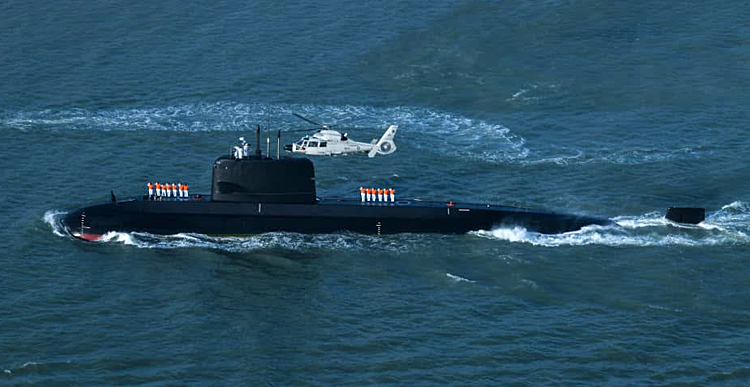
The Type 214 submarine is equipped with eight 533mm bow torpedo tubes capable of launching heavyweight wire-guided torpedoes, including the DM2A4 and Black Shark variants, as well as submarine-launched anti-ship missiles such as the Sub-Harpoon through dedicated launch tubes. Its combat suite includes the advanced ORCCA combat management system and the ISUS 90 sonar and weapon control system, supported by the SPHINX-D Low Probability of Intercept navigation radar. The submarine also integrates a torpedo countermeasures (TCM) system and features a large payload concept that supports different combinations of weapon payloads and future mission modules. Operators can choose from different optical sensor configurations based on mission requirements.
The platform incorporates eight 533mm bow torpedo tubes for heavyweight torpedoes and anti-ship missiles, managed by the ORCCA combat management system and ISUS 90 sonar suite, alongside acoustic/magnetic signature reduction for high survivability.
The submarine is also designed to support a wide range of special operations forces (SOF) missions and offers universal deployment capabilities across multiple operational environments. The Type 214 features an X-rudder configuration that improves underwater manoeuvrability and handling. Its propulsion system uses a permanently excited motor with continuously variable control to enhance efficiency and reduce noise. The submarine has also been optimised to minimise its acoustic and magnetic signatures while meeting high shock-resistance standards, improving survivability in combat. The vessel has a crew complement of 27 personnel, comprising five officers and 22 sailors.
India is accelerating its naval expansion with the ambitious goal of operating nearly 200 warships by 2035, a move driven by China's growing Indo-Pacific presence and Pakistan's modernising fleet. China's naval dominance, with more than 370 warships including carriers and advanced submarines, has intensified India's urgency. Pakistan's acquisition of eight Hangor-class submarines from China, equipped with AIP for extended underwater endurance, further complicates India's maritime security environment. These developments have compelled India to accelerate shipbuilding and commissioning cycles. The Indian Navy is commissioning a new warship or submarine every six weeks, with 15 vessels planned for induction in 2026 alone. This pace is unprecedented in Indian naval history.
Driven by China's fleet of over 370 vessels and Pakistan's acquisition of eight Chinese AIP-equipped Hangor-class submarines, India is executing an unprecedented shipbuilding pace—aiming for nearly 200 warships by 2035 and commissioning a new vessel every six weeks
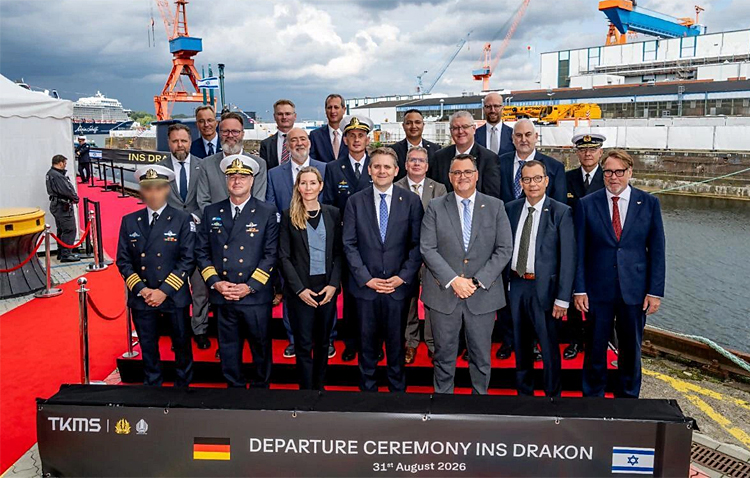
Interestingly, Germany recently handed over the INS 'Drakon', Israel's most advanced and expensive submarine to date, with estimated cost €550 million ($634 million). Built by Germany's TKMS in Kiel, the submarine transferred to the Israeli Navy is the largest submarine built in Germany since World War II. Its built-in Vertical Launch System (VLS) makes it capable of launching long-range ballistic missiles or nuclear-capable cruise missiles, expanding the country's strategic strike range directly from the Mediterranean. Security analysts note the vessel provides a highly survivable second-strike option, critical for maintaining deterrence amid heightened regional tensions with Iran.