




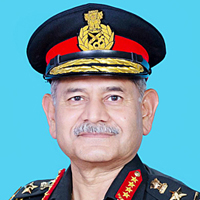
The insightful articles, inspiring narrations and analytical perspectives presented by the Editorial Team, establish an alluring connect with the reader. My compliments and best wishes to SP Guide Publications.
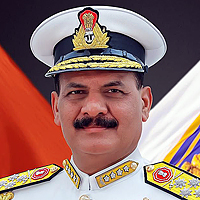
"Over the past 60 years, the growth of SP Guide Publications has mirrored the rising stature of Indian Navy. Its well-researched and informative magazines on Defence and Aerospace sector have served to shape an educated opinion of our military personnel, policy makers and the public alike. I wish SP's Publication team continued success, fair winds and following seas in all future endeavour!"

Since, its inception in 1964, SP Guide Publications has consistently demonstrated commitment to high-quality journalism in the aerospace and defence sectors, earning a well-deserved reputation as Asia's largest media house in this domain. I wish SP Guide Publications continued success in its pursuit of excellence.
Chief of Defence Staff (CDS) General Anil Chauhan stressed that delays and inflated claims undermine national security and operational readiness
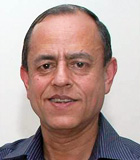 |
The Author is Former Director General of Information Systems and A Special Forces Veteran, Indian Army |
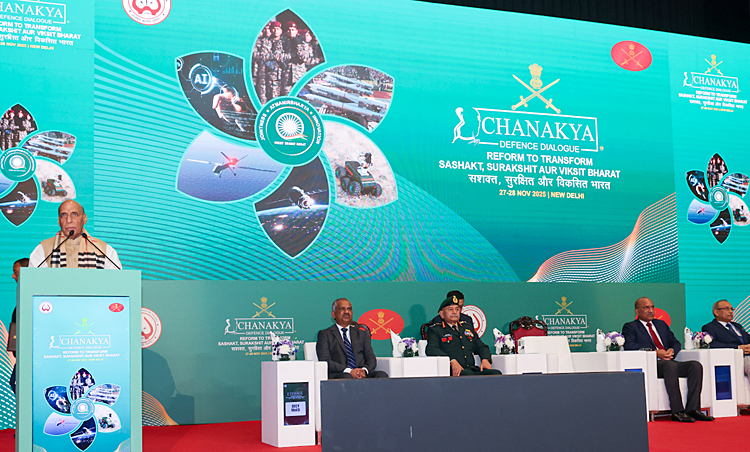
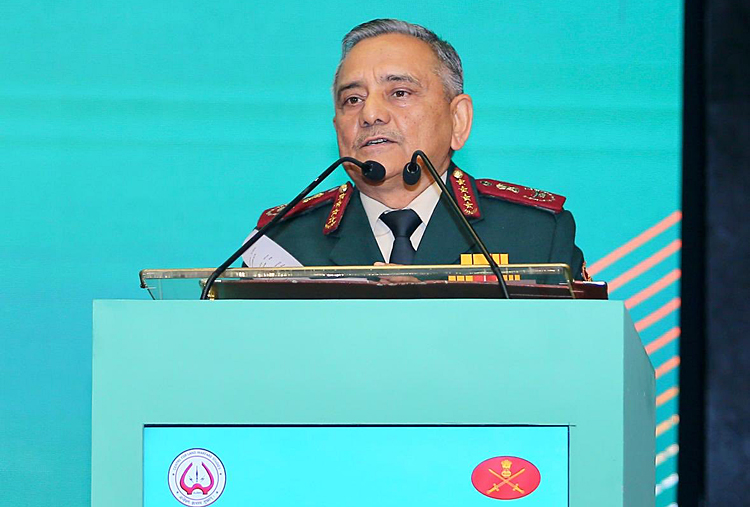
At the 2025 Chanakya Defence Dialogue, conducted the by Indian Army in collaboration with the Centre for Land Warfare Studies (CLAWS) at the Manekshaw Centre, New Delhi, Chief of Defence Staff (CDS) General Anil Chauhan urged the Indian defence industry to do more by showing patriotism, being truthful about indigenous capabilities, delivering products on time, and at globally competitive costs. He stressed that delays and inflated claims undermine national security and operational readiness.
Chief of Defence Staff (CDS) General Anil Chauhan urged the Indian defence industry to do more by delivering products on time, and at globally competitive costs
General Chauhan pointed out that failing to deliver equipment on time results in a capability being lost, which is unacceptable for national security preparedness. He warned against exaggerated claims of indigenous content in products, saying this impinges on security and that honesty should be paramount. He also emphasised that products must be cost-competitive not only for domestic procurement but also for international export market, and called for a focus on R&D, innovation, and reliability, saying you can't win today's wars with yesterday's weapons. He also said that while profit is a valid motive, the industry should have a sense of nationalism and patriotism especially given the critical nature of their work for the Armed Forces.
Notably, General Chauhan said, "We have problems like our procurement procedures are so slow, that it is difficult to imbibe technology at the rate the Armed Forces would want to." He pointed to lessons from recent operations, such as Operation 'Sindoor', which demonstrated the critical need for indigenously developed systems, like counter-drone technologies, to avoid the vulnerabilities of relying on foreign imports. "Procuring military hardware can take years under India's weapon-buying rules", General Chauhan said, adding that India needed to induct more technologies at a faster rate in order to narrow the technological gap with its adversaries.
Gen Chauhan pointed out that failing to deliver equipment on time results in a capability being lost, which is unacceptable for national security preparedness
The above needs to be viewed in the backdrop of 2025 having been designated as the "Year of Reforms', on January 1, 2025, aimed at transforming the Armed Forces into a technologically advanced combat-ready force capable of multi-domain integrated operations. But the ironic part is that General Chauhan appeared to be sermonising as an outsider, whereas, he is very much part of the Ministry of Defence (MoD) as the Secretary, Department of Military Affairs (DMA) and a member of the Defence Acquisition Council (DAC). Every time the MoD announces a new Defence Procurement/Acquisition Procedure, it is accompanied by rhetoric that it is the best ever. What has General Chauhan done to reform these procedures, knowing the flaws, including the DRDO-bureaucratic nexus focused primarily on making money?
It is no secret that the Defence Secretary, by virtue of being responsible for capital acquisitions and having been charged with the defence policy in both war and peace, subordinates the CDS with the latter's recommendations going up to the Defence Secretary. This was a victory of the deep state while authorising appointment of the CDS, including making him an advisor to the Defence Minister, not the Prime Minister, which should have been the case.
MoD announced that the DAC, headed by Defence Minister Rajnath Singh, has approved 'guidelines for reducing the timelines at various stages of the capital acquisition process, to make it faster, more effective and efficient'
The CDS is Permanent Chairman of the Chiefs of Staff Committee (COSC). Moreover, besides being Secretary DMA and adviser to the tri-service Nuclear Command Authority, serving on multiple advisory MoD and associated bodies, committees and councils, the CDS is also responsible for prioritising and affecting material procurements and defining military and security policies. So why has General Chauhan spoken up now? Is it because he has been given an extension up to the date coinciding with the retirement date of the current Army Chief? Why has he not raised voices against the slow defence procurement process, which he was entitled to as the Secretary DMA?
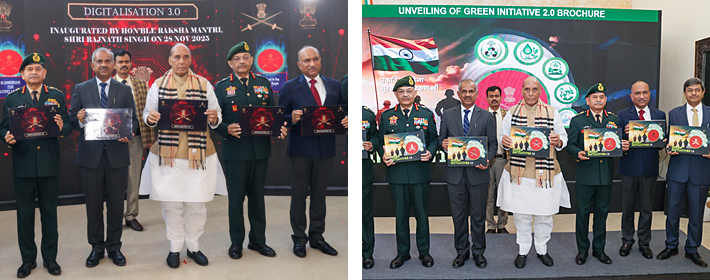
Interestingly, 24 hours after General Chauhan raised the above issues at the Chanakya Defence Dialogue, the MoD announced that the DAC, headed by Defence Minister Rajnath Singh, has approved "guidelines for reducing the timelines at various stages of the capital acquisition process, to make it faster, more effective and efficient. But the lack of any elaboration has raised questions if this is more of a cover up. Also, is 'capital acquisitions' the only issue?
DRDO Chairman, Samir V. Kamat called for enhanced investment in defence R&D to prepare for future warfare; amid rapid technological transformations across land, air, sea, space, cyber, and information domains
There are periodic headlines of the DAC according its Acceptance of Necessity (AoN) for defence procurements and defence-related projects. But this only implies 'in principle' approval by the government, nothing more. Beyond this are complex stages, with each stage having the potential to delay or derail the entire project; often taking twice or three times the laid down period. As for the intractable corruption at every step, less said the better. What has General Chauhan and his predecessor's done to cleanse the system and justify the CDS tab on their shoulders?
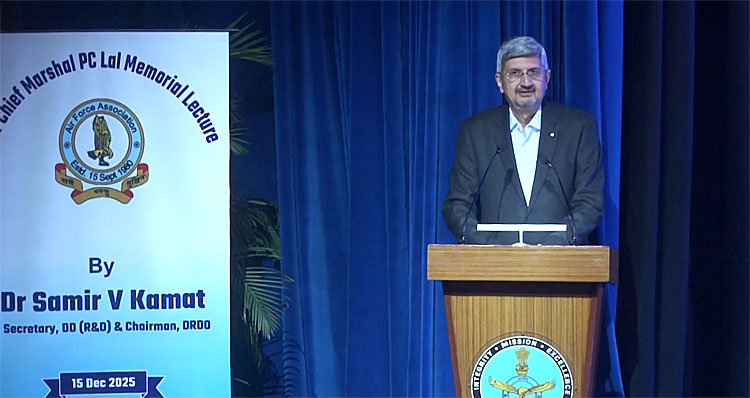
Speaking at the 40th Air Chief Marshal P.C. Lal (Retd) Memorial Lecture organised by the Air Force Association on December 15, 2025, DRDO Chairman, Samir V. Kamat called for enhanced investment in defence R&D to prepare for future warfare; amid rapid technological transformations across land, air, sea, space, cyber, and information domains. He highlighted the disparity in R&D spending, noting that India allocates 0.65 per cent of its overall R&D budget compared to over 2 per cent committed by competitors. He said this shortfall hinders India's ambitions to emerge as a technology leader. He advocated greater industry participation in design and development, alongside contributions from start-ups and MSMEs, stressing the vital role of academia in basic and applied research on emerging technologies, coupled with the establishment of advanced test facilities and infrastructure, and that capacity building remains a critical priority.
India needs to seriously address the above anomalies, in addition to the following:
Finally, whether there is any scope of improvement or the current lackadaisical approach will continue, only time will show.