





The insightful articles, inspiring narrations and analytical perspectives presented by the Editorial Team, establish an alluring connect with the reader. My compliments and best wishes to SP Guide Publications.
"Over the past 60 years, the growth of SP Guide Publications has mirrored the rising stature of Indian Navy. Its well-researched and informative magazines on Defence and Aerospace sector have served to shape an educated opinion of our military personnel, policy makers and the public alike. I wish SP's Publication team continued success, fair winds and following seas in all future endeavour!"

Since, its inception in 1964, SP Guide Publications has consistently demonstrated commitment to high-quality journalism in the aerospace and defence sectors, earning a well-deserved reputation as Asia's largest media house in this domain. I wish SP Guide Publications continued success in its pursuit of excellence.
India's recent satellite launches highlight the country's accelerating space ambitions, growing private-sector ecosystem, long-term goals of a human lunar landing and a $44-billion space economy by 2033
 |
The Author is Former Director General of Information Systems and A Special Forces Veteran, Indian Army |
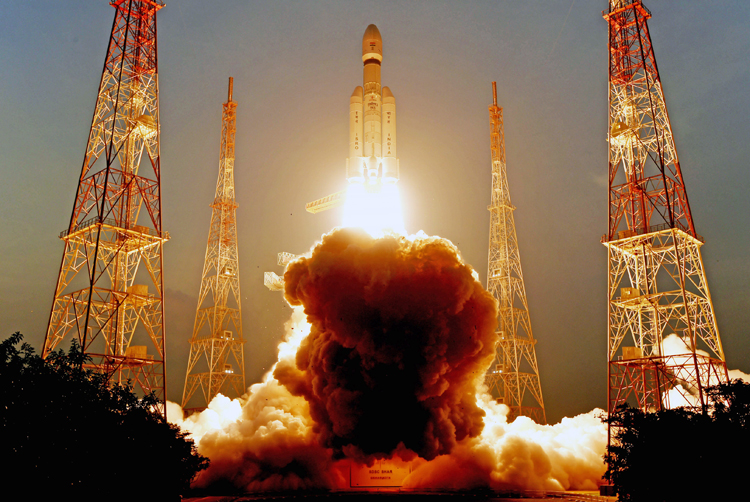
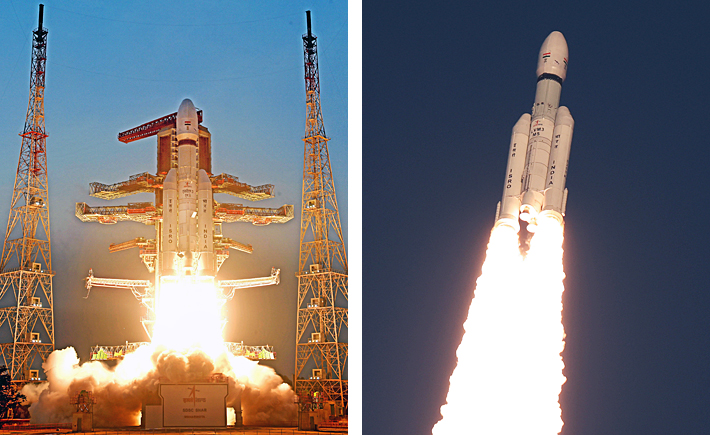
On November 2, 2025, ISRO's LVM3 rocket launched the 4,410 kg CMS-03 satellite into space. The 43.5 metre tall LVM3 rocket with a lift-off of 640 tonne, embodies India's heavy-lift ambitions. Its three-stage architecture combining solid S200 strap-ons, liquid L110 core, and cryogenic C25 upper stage can deliver approximately 4,000 kg to Geosynchronous Transfer Orbit and 8,000 kg to Low Earth Orbit (LEO). CMS-03, codenamed GSAT-7R, replaces the Rukmini satellite, expands the Indian Navy's networked warfare capabilities.
CMS-03, codenamed GSAT-7R, replaces the Rukmini satellite, expands the Indian Navy's networked warfare capabilities
Operating across multi-band frequencies—UHF, S, C, and Ku bands—CMS-03 enables secure real-time voice, video, and data transmission between warships, submarines, aircraft, and shore-based command centres across vast oceanic expanses; for example, can span from the Strait of Hormuz to the Malacca Strait. This satellite-enabled integration is the backbone of network-centric operations, compressing decision-making cycles and enabling coordinated strikes across multiple domains - the capability required for modern high-intensity warfare.
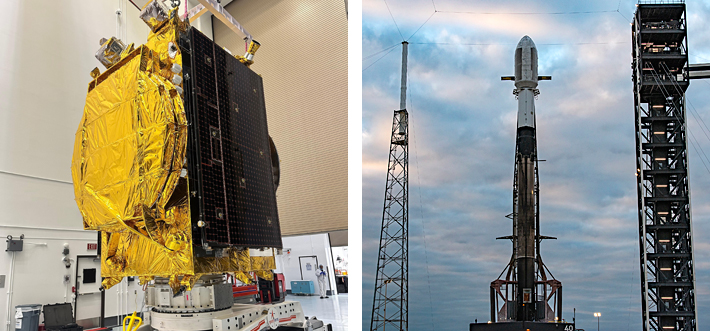
Earlier on November 19, 2024, India's GSAT-N2 (GSAT-20) communication satellite was successfully launched by SpaceX's Falcon-9 rocket from Cape Canaveral, Florida. The satellite was initially expected to be launched in 2024 on an LVM3 rocket. But this was shifted to Falcon 9 rocket due to the satellite being 700 kg overweight for a successful launch on indigenous platforms. Indian communication satellites are heavy because they are designed for long service life of 10-15 years with inbuilt redundancy (duplicate systems) to ensure reliability, which further increases weight.
This satellite-enabled integration is the backbone of network-centric operations, the capability required for modern high-intensity warfare.
After the launch, the Master Control Facility (MCF) in Hassan, Karnataka, guided the GSAT-20 to its final geostationary orbit 36,000 km above the Earth. GSAT-20, owned and operated by New Space India Limited, enhances data transmission capacity to the communication infrastructure. It features a Ka-band high-throughput communications payload with 70 Gbit/s throughput utilizing 40 beams offering HTS capacity of nearly 48 Gbit/s. Each beam has 2 polarisations, effectively making them 80 beams and plays a vital role in enhancing broadband services across India, including remote areas, and enabling in-flight internet connectivity.
ISRO Chairman V. Narayanan told Press Trust of India on October 15, 2025, that the space agency has set a target of landing Indians on the Moon by 2040, while its maiden human spaceflight mission 'Gaganyaan' is on track for launch in 2027. He said a slew of ambitious space projects and sector reforms were currently underway, including a national space station by 2035, and three uncrewed 'Gaganyaan' missions by 2026, with the first one that includes a half-humanoid robot 'Vyommitra', targeted for December 2025.
ISRO has set a target of landing Indians on the Moon by 2040, while its maiden human spaceflight mission ‘Gaganyaan' is on track for launch in 2027.

He further said, "Prime Minister Narendra Modi has given a guideline for an indigenous crewed lunar mission by 2040, under which we have to land our own citizens on the moon and bring them back safely. A Venus Orbiter Mission (VOM) has also been approved to study the planet." He said the Bharatiya Antriksh Station (BAS) is expected to come up by 2035, and initial modules in space are expected as early as 2027.
Concurrently, speaking at the 35th convocation ceremony of Ranchi-based Birla Institute of Technology (BIT) Mesra, Narayanan said "There are a lot of developments in 'Gaganyaan'. We are planning some more experiments. Before the crewed mission, we are planning three uncrewed missions. 'Vyommitra' is going to fly on that in December this year. Two more uncrewed missions will take place next year. Crewed 'Gaganyaan' mission would be possible by 2027 first quarter." He said India's upcoming projects include Chandrayaan-4 and Chandrayaan-5, a new Mars mission, and AXOM, a high-priority astronomical observatory mission, adding, "The Aditya-L1 mission has already yielded over 15 terabits of solar data, with valuable insights into coronal mass ejections and space weather." He said, "We are open to international collaborations but how and where we collaborate will be debated and decided based on scientific and strategic priorities."
The space sector has been transformed through the Indian National Space Promotion and Authorisation Centre (IN-SPACe), which integrates startups and private players into the national ecosystem.
Highlighting the role of reforms, Narayanan said the space sector has been transformed through the Indian National Space Promotion and Authorisation Centre (IN-SPACe), which integrates startups and private players into the national ecosystem. He said, "Just a few years ago, there were barely one or two startups in the space sector. Today, there are over 300 working on satellite manufacturing, launch services, and space-based data analytics. This shift is seen as crucial to meeting India's rising demand for satellite-based applications in agriculture, disaster management, telecommunication, real-time train and vehicle monitoring, and fisheries."
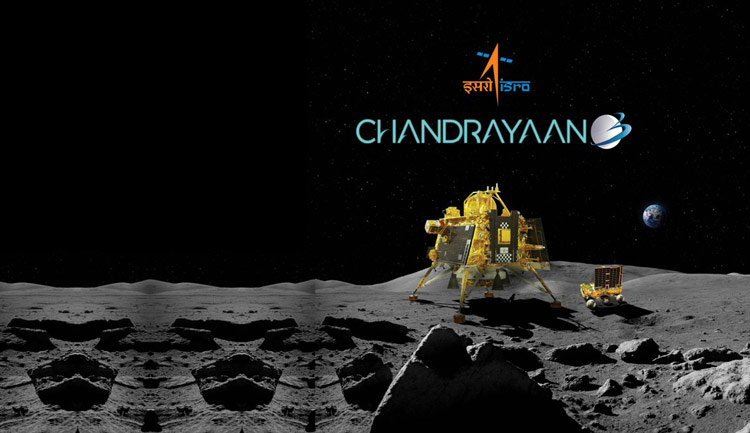
Talking about Artificial Intelligence (AI), Robotics, and Big Data, Narayanan said these are becoming integral to space missions. He said today India stands as the world's fourth-largest economy, with a burgeoning space sector that is not only matching, but often surpassing global benchmarks."From discovering water on the Moon with Chandrayaan-1, to the first soft landing near the lunar south pole with Chandrayaan-3, India has set multiple world records in space. Today, we are No. 1 in nine areas globally," he asserted. On atomic energy, he said, currently India has 23 nuclear reactors across eight major nuclear plants, including Tarapur and Bhabha Atomic Research Centre. While ISRO is on track to launch the maiden human spaceflight mission 'Gaganyaan' in 2027, Narayanan has said, "By 2040, India will be in par with any other developed space faring nation in terms of launcher capability, in terms of satellite capability, in terms of scientific missions, in terms of ground equipment."
India's space economy, currently around $8 billion, is projected to reach $44 billion by 2033, capturing eight per cent of the global market
India's space economy, currently around $8 billion, is projected to reach $44 billion by 2033, capturing eight per cent of the global market; leveraging satellite manufacturing and cost-efficient launch systems delivering missions at 10-15 per cent of Western costs. However, significant gaps remain vis-à-vis China. India lacks comprehensive around-the-clock in-orbit monitoring capability and lags in cutting-edge counter-space systems like space-based lasers, jamming-resistant satellites, and AI-powered Space Situational Awareness, plus vulnerability to space debris and potential hostile actions. The Department of Space (DoS) received ₹13,416 crore in Budget 2025-26 - a modest 2.86 per cent increase over the previous year. Early establishment of a full-fledged Space Command would be good to secure India's space orbital interests.