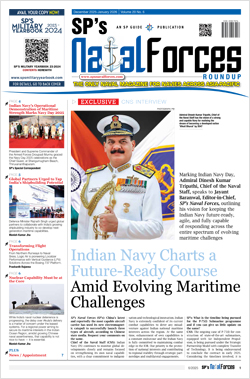





The insightful articles, inspiring narrations and analytical perspectives presented by the Editorial Team, establish an alluring connect with the reader. My compliments and best wishes to SP Guide Publications.

"Over the past 60 years, the growth of SP Guide Publications has mirrored the rising stature of Indian Navy. Its well-researched and informative magazines on Defence and Aerospace sector have served to shape an educated opinion of our military personnel, policy makers and the public alike. I wish SP's Publication team continued success, fair winds and following seas in all future endeavour!"

Since, its inception in 1964, SP Guide Publications has consistently demonstrated commitment to high-quality journalism in the aerospace and defence sectors, earning a well-deserved reputation as Asia's largest media house in this domain. I wish SP Guide Publications continued success in its pursuit of excellence.

General Atomics Aeronautical Systems, Inc. (GA-ASI) and the US Navy continue to expand the Anti-Submarine Warfare (ASW) capability of the MQ-9B SeaGuardian® Unmanned Aircraft System (UAS). Flight test was performed on December 17 and featured Sonobuoy Dispensing System (SDS) pods, more than previously tested, doubling the number of sonobuoys available.
"Expanding sonobuoy capacity, including Multi-static Active Coherent (MAC) technology for SeaGuardian, has been an integral part of our advanced ASW strategy to broaden and enhance search areas," said GA-ASI President David R. Alexander. "The wider maritime coverage our MQ-9B's ASW capability provides is extremely valuable to our customers."
Sonobuoys are naval sensors that drop from an aircraft into the ocean and help detect submarines. The SeaGuardian deployed AN/SSQ-36 Bathythermal, AN/SSQ-53G Directional Frequency Analysis and Recording (DIFAR) (passive), and AN/SSQ-62F Directional Command Activated Sonobuoy System (DICASS) (active) buoys. This was the first time Multi-static Active Coherent (MAC) buoys have been dispensed from an uncrewed aircraft. The MAC buoys are better at detecting submarines over large areas and require fewer buoys compared to using DIFAR and DICASS.
Sponsored by the US Navy, the flight tests were specifically aimed at certifying the SDS. This flight testing supports the Commander, US Pacific Fleet's Operational Evaluation deployment to SEVENTH Fleet and enjoyed additional support and governmental supervision from the Naval Air Warfare Center Aircraft Division (NAWCAD) AIRWorks.
Upon completion of the testing and data review, the US Navy is expected to give GA-ASI deployment flight clearance for ASW operations using MQ-9B SeaGuardian in January 2026.
SeaGuardian has also been used by the US Navy in various recent exercises, including Northern Edge, Integrated Battle Problem, RIMPAC, and Group Sail.